
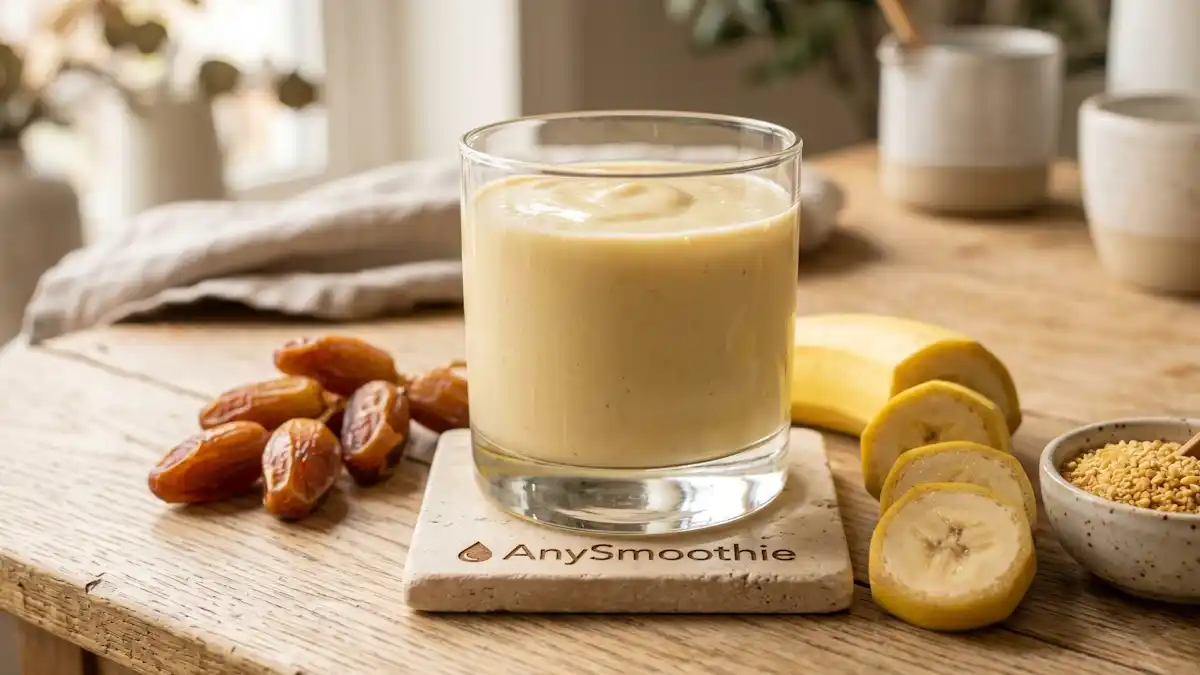
A banana smoothie can do more than taste good. Built well, it can act like a soft support formula for the mucosal lining in the throat, stomach, and gut. That lining is the body’s front surface barrier, and it helps reduce friction and irritation. Bananas help because they blend into a thick base, bring pectin and potassium, and create a texture that coats better than a thin drink. This kind of banana smoothie formulation for mucosal protection works best when it stays mild, cohesive, and easy to tolerate.
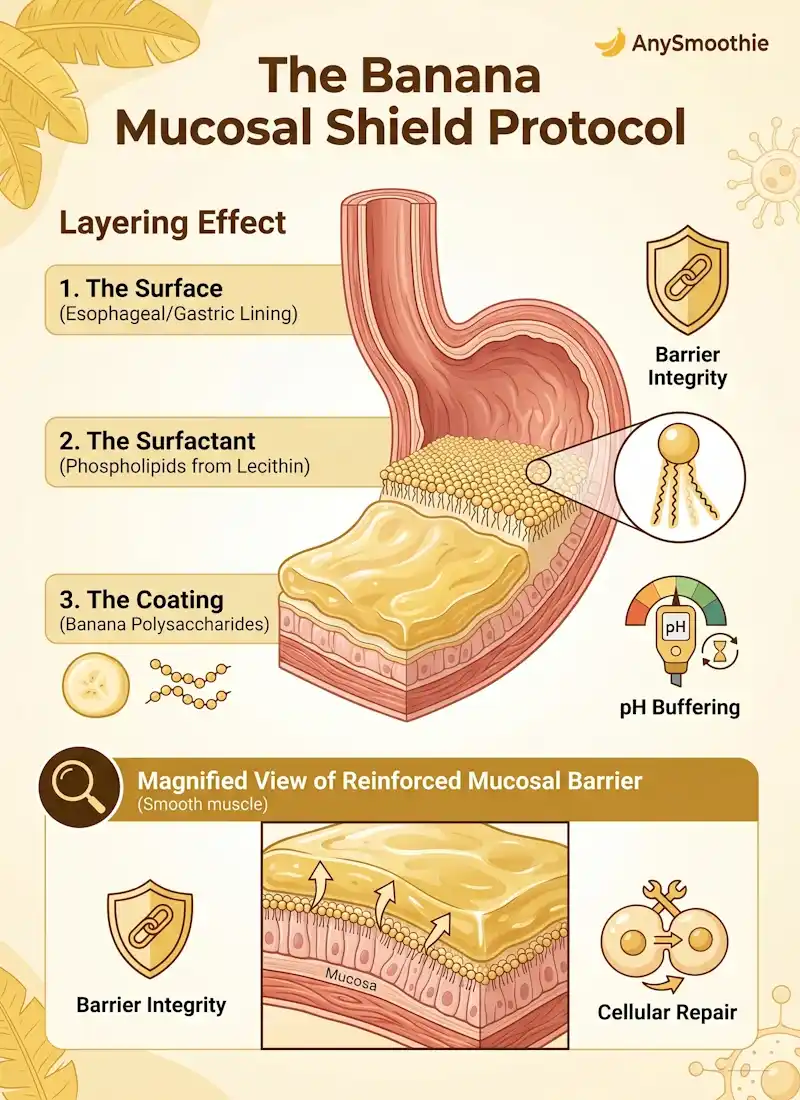
The Bio-Adhesive Shield: How Banana Polysaccharides Coat the Epithelium
Bananas bring a natural polysaccharide matrix, and that matters. Their pectin and soft fiber build body in the blender, so the drink clings a little longer to oral and upper GI surfaces. That slower contact is useful because a thin, watery smoothie moves fast and feels less protective.
The idea is simple. A thick banana base acts like a scaffold, then other ingredients can plug into that structure. If the base is sloppy or too thin, the rest of the formula has less to work with. For a basic overview of banana fiber and pectin, see here.
| Mucosal Modulator | Physiological Mechanism | Target Zone | Best Smoothie Pairing | Impact on Surface Tension |
|---|---|---|---|---|
| Banana polysaccharide matrix | Physical coating and thickening through pectin and soft fiber | Mouth, throat, upper GI | Lecithin, oats, dates | Lowers the feel of sharpness by adding body |
| Sunflower lecithin | Phospholipids that support the hydrophobic barrier | Mouth, esophagus, stomach surface | Banana, yogurt, nut butter | Moderately lowers surface tension and improves dispersion |
| DGL | Botanical support for the mucosal surface | Stomach and upper small intestine | Banana, mild yogurt, soft oats | Minimal direct effect, better as a co-factor than a texture aid |
Banana is the scaffold. Lecithin and DGL make more sense when the base is already smooth.
Why ripe bananas are usually the best starting point
Ripe bananas blend cleaner, taste better, and digest more easily for most people. As they ripen, starch shifts toward sugars, and the texture softens. That gives the smoothie a more uniform feel.
Very ripe bananas can push sweetness too far, though. If the mix starts to taste flat or sugary, balance it with oats, yogurt, or lecithin. The goal is a smooth base, not dessert in a glass.
How phospholipids help reinforce the protective layer
Sunflower lecithin adds phospholipids that mix water and fat more evenly. In a banana base, that can improve mouthfeel and help the drink leave a softer film.
It also helps keep ingredients from separating. That matters because a more unified smoothie usually feels gentler on contact and less abrupt going down. In practical terms, lecithin helps banana do its job better.
Alkaline Flux: Potassium and Bicarbonate Co-factors
A mucosal-support smoothie works best when the formula feels calm. Bananas bring potassium, which supports normal fluid balance and cellular function. Hydrated tissue usually handles friction better than dry tissue, so that mineral base matters.
Some blends also use small bicarbonate-friendly additions, such as mineral water, if they keep the drink mild. The point is to lower the sharp edge of the formula, not to force a chemistry trick. Keep the drink steady, not aggressive.
Glycoprotein Synthesis: Supporting the Mucin Layer Architecture
The mucin layer depends on water, amino acids, and mineral balance. Glycoproteins help build that slippery surface, so texture and hydration both matter.
That is why a banana smoothie with yogurt, kefir, or another mild protein source can feel more complete. It brings fluid, carbs, and protein together in one coherent mix. That supports normal turnover and gives the body easy fuel for routine repair work.
3 ‘Shield-Base’ Banana Formulation Recipes
These three blends keep the same principle: banana first, then a supportive co-factor, then enough liquid for easy sipping.
Reducing the Peptic Load
A banana smoothie supports comfort best when it stays low on irritation. Large amounts of citrus juice, hot spices, strong coffee, and excess added sugar can make the drink feel harsher. Very cold blends can do the same.
Keep the flavor mild, the temperature moderate, and the sip pace slow. Timing matters too. A smoother formula usually feels better when it isn’t slammed down on an empty, stressed stomach.
Ingredients that can make a banana smoothie feel harsher
Big citrus pours, cayenne, ginger shots, and lots of added sweetener can push the drink in the wrong direction. The goal is a smoother, lower-irritation profile. If an add-in makes the blend sharp, thin, or syrupy, it probably does not fit this use case.
Why steady energy matters for normal tissue renewal
Barrier tissues renew all the time, and that costs energy. A blend with banana, moderate protein, and a little fat gives steadier fuel than sugar alone.
That supports mitochondrial priming in a practical sense. The body gets usable energy for normal turnover, and nutrient partitioning stays more even across the day. The result is less strain on the system and a more stable recovery pattern.
Conclusion
Banana works best as the structural base of the smoothie. Its thick texture, pectin, and easy blending give the formula a real scaffold, while lecithin, minerals, and mild add-ins shape the rest.
The strongest version is thick enough to coat, mild enough to tolerate, and balanced enough to use often. That’s the sweet spot for mucosal protection without making the drink hard to digest.
🛡️ Safety Notes & Contraindications: Mucosal Protection Smoothies
Delayed Gastric Emptying: The high viscosity of these coating blends can slow down stomach emptying; if you have gastroparesis or severe chronic bloating, these thick textures may worsen the feeling of “fullness” or stasis.
Lecithin and Choline Sensitivity: Sunflower lecithin is a potent source of phosphatidylcholine; individuals with specific metabolic disorders (e.g., TMAO concerns) should monitor their total choline intake from all sources.
Interaction with Medications: The “bio-adhesive” nature of banana pectin and lecithin can coat the stomach lining and potentially slow the absorption of oral medications; avoid drinking these smoothies within 2 hours of taking critical prescriptions (e.g., thyroid medication or antibiotics).
Aspiration Risk (Dysphagia): For individuals with swallowing difficulties, the thickness of a banana-lecithin blend must be carefully adjusted to the consistency recommended by a speech-language pathologist to prevent aspiration.
Fructose and SIBO: Ripe bananas are high in fast-fermenting sugars; if you have Small Intestinal Bacterial Overgrowth (SIBO), the high polysaccharide load can trigger rapid fermentation gas and abdominal pain.
FAQ
How do “Banana Polysaccharides” create a bio-adhesive shield on the epithelium?
Bananas are rich in pectin and soluble fiber, which possess high viscosity and mucoadhesive properties. Biochemically, these polysaccharides form a physical gel-like matrix that adheres to the oral and upper gastrointestinal mucosa. Supporting this physiological system through a thick banana base optimizes the natural pathways of “surface coating,” ensuring the biochemical mechanics of the drink provide a protective buffer against luminal irritants.
Why is “Sunflower Lecithin” used to reinforce the hydrophobic barrier?
Sunflower lecithin is a primary source of phospholipids, particularly phosphatidylcholine. Biochemically, these molecules are essential components of the non-wettable, hydrophobic layer that protects the gastric and esophageal lining from acid and friction. Supporting this physiological system by integrating lecithin into a banana scaffold facilitates the biochemical mechanics of “barrier lipid replenishment,” helping to maintain the integrity of the surface shield.
How does “Glycoprotein Synthesis” support mucin layer architecture?
The mucosal lining is primarily composed of mucins—large, heavily glycosylated proteins. Biochemically, the body requires a steady supply of amino acids, water, and mineral co-factors to maintain the rapid turnover of these glycoproteins. Supporting this physiological system through balanced smoothies (pairing banana with mild proteins like yogurt) optimizes the natural pathways of “mucin secretion,” ensuring the biochemical mechanics of the protective slippery surface are well-maintained.
What is the role of “Potassium and Bicarbonate” as mucosal co-factors?
The stomach lining maintains a “bicarbonate-alkaline” microenvironment at the epithelial surface to neutralize acid. Biochemically, potassium (found abundantly in bananas) supports cellular ion pumps and fluid balance, which are necessary for healthy mucosal hydration. Supporting this physiological system through mineral-dense formulations optimizes the natural pathways of “alkaline flux,” ensuring the biochemical mechanics of the tissue can better withstand mechanical and chemical stress.
Why is “Shear-Stress Reduction” important for sensitive GI tissues?
High-velocity, thin liquids or abrasive, high-fiber textures can cause mechanical irritation (shear stress) on sensitive mucosal surfaces. Biochemically, a cohesive, low-shear formulation—achieved through ripe bananas and blended oats—provides a “mechanical glide” during transit. Supporting this physiological system through texture engineering facilitates the biochemical mechanics of “low-impact digestion,” allowing the gut lining to remain calm during the nutrient delivery process.

Medical Disclaimer: AnySmoothie content is for educational purposes only and is not a substitute for professional medical advice. Consult a healthcare provider for personalized guidance. See our full Disclaimer & Terms of Use. AI Transparency: AnySmoothie may use AI to support content development. All content undergoes human editorial review for accuracy, clarity, and editorial quality. See our full AI Transparency.