
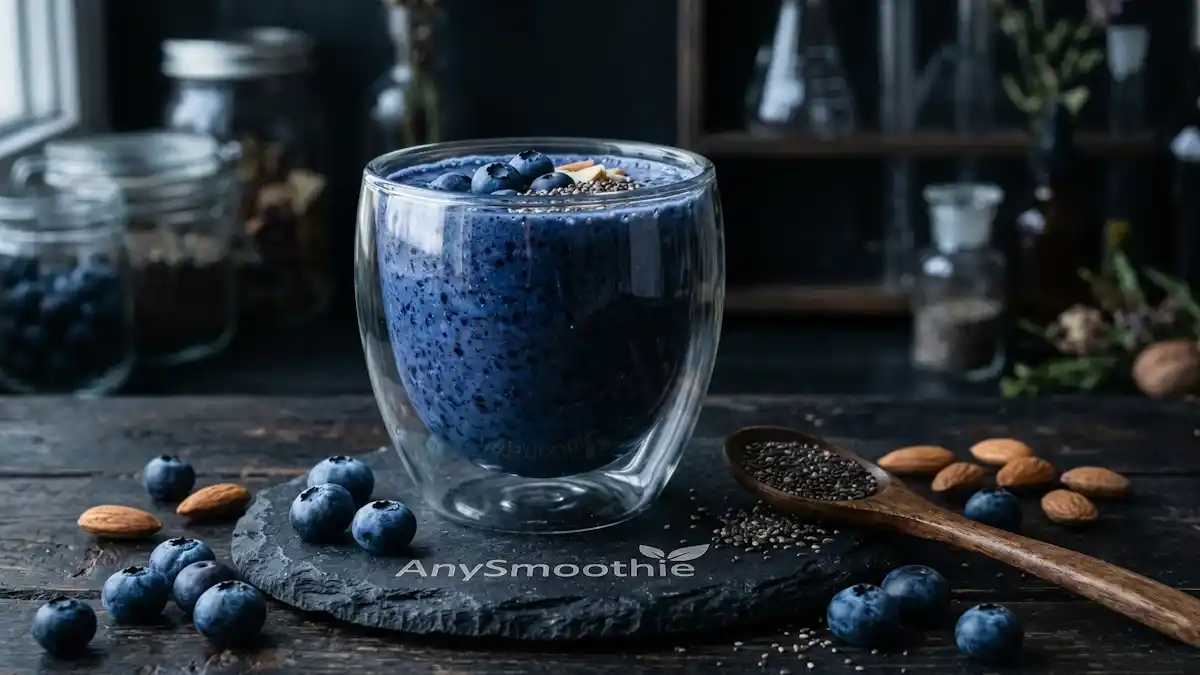
Your cells deal with stress long before you feel tired. Poor sleep, hard training, and long workdays all add up.
A pterostilbene smoothie for cellular stress response is a simple, food-first way to support the body’s own defense systems. The goal here is not a medical claim. It’s smart pairing, better uptake, and easy daily use.
When you blend pterostilbene with fats, fiber, and berries, you get more than flavor. You build a drink that fits real life and supports mitochondrial priming, too.
What makes pterostilbene stand out in a smoothie?
Pterostilbene is a stilbenoid found in blueberries. It belongs to the same family as resveratrol, but its structure is different. Two methyl groups make it more lipophilic, which means it mixes better with fat and tends to move through the body with less friction.
That matters in a smoothie. Food compounds don’t help much if they never get absorbed well. In one rat pharmacokinetic study, pterostilbene showed about four times the oral bioavailability of resveratrol, and the plasma exposure was much higher overall. You can see that data in this pterostilbene and resveratrol pharmacokinetics paper.
Methylated resveratrol: why structure changes how the body handles it
Methyl groups sound small, but they change behavior. They can help a compound stay stable longer, cross cell membranes more easily, and avoid fast breakdown.
That is why pterostilbene often gets more attention than resveratrol in smoothie-friendly recipes. A berry blend gives you a fat-friendly matrix, and that helps a lipophilic compound fit the meal instead of fighting it.
Pterostilbene, resveratrol, and polydatin compared side by side
Here’s a quick comparison that keeps the chemistry practical.
| Criterion | Pterostilbene | Resveratrol | Polydatin |
|---|---|---|---|
| Bioavailability, plasma half-life | About 4x more bioavailable than resveratrol in comparative data, with longer blood presence | Lower oral bioavailability, cleared faster | Better water solubility, but still needs conversion after absorption |
| Primary target | Nrf2, PPAR-alpha, SIRT1-adjacent signaling | SIRT1, AMPK, Nrf2 | Antioxidant and resveratrol-precursor support |
| Absorption rate | Fast uptake, strong membrane permeability | Rapid absorption, rapid metabolism | Slower entry, partly because it is a glycoside |
| Best smoothie pairing | Wild blueberries, almond butter, chia | Grapes, cacao, walnuts | Purple berries, kefir, flax |
The practical takeaway is simple. Pterostilbene fits a smoothie better when the drink includes fat and fiber. A recent study on lipophilicity and cellular uptake also supports that pattern.
How this smoothie supports healthy stress-response pathways
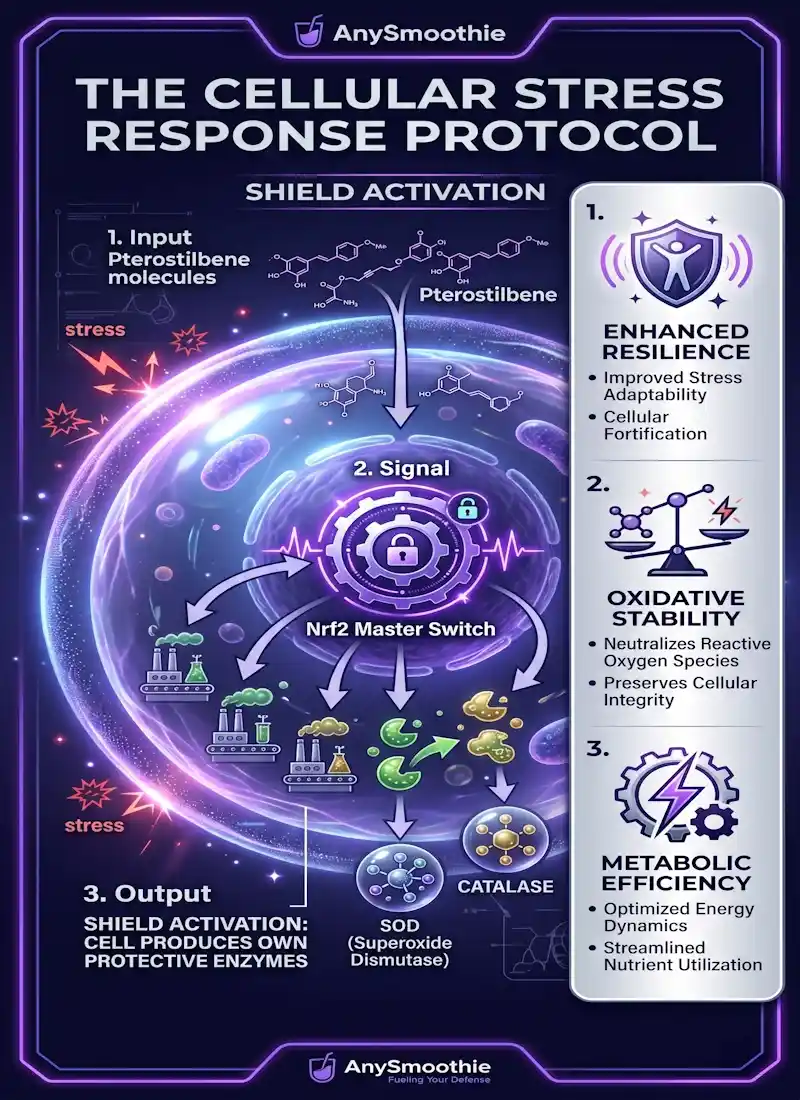
Pterostilbene is interesting because of the pathways it may support. Two of the most discussed are Nrf2 and PPAR-alpha. Nrf2 helps regulate the body’s antioxidant defense network. PPAR-alpha is tied to fat use and energy balance.
A mechanistic paper on pterostilbene-mediated Nrf2 activation showed that it can influence the Keap1-Nrf2 interaction. That matters because it helps explain why this compound gets grouped with redox support and cellular defense, not just berry flavor.
A smoothie can help here because it gives pterostilbene a better delivery context. Fat helps move lipophilic compounds through digestion. Fiber slows the pace, which can support smoother nutrient partitioning. Meanwhile, berries, greens, and spices bring their own antioxidants. The result is a drink that feels light but still works as part of a metabolic efficiency routine.
Hormetic signaling and why small stress cues can be useful
Hormesis is a mild stress signal that nudges cells to adapt. Exercise does this. So do some plant compounds.
Small stress cues can support a stronger response later, as long as the dose stays food-level.
That is the value of pterostilbene in a daily smoothie. It may help support the body’s own repair and defense pathways without turning breakfast into a lab project. The signal should stay gentle.
Why fat, fiber, and antioxidants help pterostilbene work better
A smoothie gives you a lipid matrix that helps pterostilbene travel with the meal. Almond butter, avocado, chia, flax, or Greek yogurt can all help. They slow digestion, add texture, and make the blend more satisfying.
Antioxidant-rich fruits also help balance the mix. Berries, cacao, spinach, and citrus all fit. When the base is steady, the body has an easier time handling the whole drink.
3 stress-shield smoothie recipes you can actually make
These are simple, repeatable blends, not strict formulas.
How to get the most from the ingredients you blend
Timing matters less than consistency. Drink it in the morning, after a workout, or before focused work if that fits your day. The best time is the one you can repeat.
The same goes for texture. Keep the base thick enough to slow the drink down a little, because that helps with steadier energy. If you need swaps, keep the fat-fiber-berry structure intact.
- Dairy-free: use almond milk or coconut yogurt.
- Higher protein: add Greek yogurt or unsweetened soy yogurt.
- Lower carb: skip banana and use avocado or ice.
- Nut-free: use sunflower seed butter or pumpkin seed butter.
Conclusion
A pterostilbene smoothie works because the logic is simple. Blueberries bring the compound, fat helps uptake, and fiber slows the ride. That makes it a clean fit for healthy stress-response support.
Start with the Blue-Hormesis blend if you want the easiest daily version. Then adjust the texture, sweetness, and creaminess until it feels like something you’ll actually drink again tomorrow.
🛡️ Safety Notes & Dietary Interactions
- Phase II conjugation, Pterostilbene moves through the liver’s glucuronidation and sulfation pathways. If you take daily medication, keep this smoothie a few hours away from your usual schedule.
- Keap1-Nrf2 signaling, wild blueberries contain compounds that activate a mild food-level antioxidant response. Skip high-dose synthetic antioxidant isolates in the same smoothie, so the whole-food mix can do its job.
- GI transit and fiber load, dense berry fiber, raw seeds, and fats like almond butter slow gastric emptying. If your gut is sensitive to a sudden fiber increase, start with half servings and increase the amount step by step.
- Metabolic coordination, the flavonoids and lipids in this formula support glucose handling and fuel use. If you track blood sugar or other metabolic markers, keep an eye on your usual numbers and adjust the recipe around them.
FAQ
What is pterostilbene, and why is it considered better absorbed than resveratrol?
Pterostilbene is a natural stilbenoid found in high amounts in wild blueberries. It belongs to the same chemical family as resveratrol, but it has two extra methyl groups. That small change makes the molecule more lipophilic, so it crosses cell membranes with less resistance. In comparative pharmacokinetic studies, pterostilbene has about four times the oral bioavailability of resveratrol. It stays in circulation longer and supports cellular defense systems.
How does a pterostilbene smoothie help the body handle everyday oxidative stress?
A smoothie does not block stress on its own. It supports the body’s own defense pathways. Pterostilbene interacts with Nrf2, a transcription factor that helps control antioxidant gene expression. When Nrf2 activity rises, cells increase production of their own antioxidant enzymes. That helps maintain redox balance during hard training, busy days, and other common stress loads.
Why do healthy fats like almond butter or avocado matter in a pterostilbene blend?
Pterostilbene is lipophilic, so it dissolves in fat better than in water. If you blend blueberries with only water or skim milk, absorption is less efficient. Adding almond butter, chia seeds, or avocado helps the digestive system form mixed micelles. These tiny lipid structures move through the intestinal lining more easily and carry pterostilbene into systemic circulation.
What is hormesis, and how can a berry smoothie activate it?
Hormesis is a response where a small, harmless stressor triggers adaptive changes in the body. Exercise uses this mechanism. A hard workout stresses muscle tissue, then the body adjusts. Plant compounds like pterostilbene provide a mild hormetic signal at food-level doses. That signal can support mitochondrial quality control, antioxidant defense, and other cellular repair pathways.
When is the best time to drink a pterostilbene smoothie for steady energy?
Consistency matters most, but timing can still help. Morning intake or a smoothie about 45 minutes after intense training can work well. During those windows, the body is primed to handle nutrients efficiently. Berry fiber slows digestion, healthy fats slow gastric emptying, and flavonoids support metabolic steadiness. Together, they can help limit sharp blood-sugar swings that often lead to an afternoon drop in energy.

Medical Disclaimer: AnySmoothie content is for educational purposes only and is not a substitute for professional medical advice. Consult a healthcare provider for personalized guidance. See our full Disclaimer & Terms of Use. AI Transparency: AnySmoothie may use AI to support content development. All content undergoes human editorial review for accuracy, clarity, and editorial quality. See our full AI Transparency.