
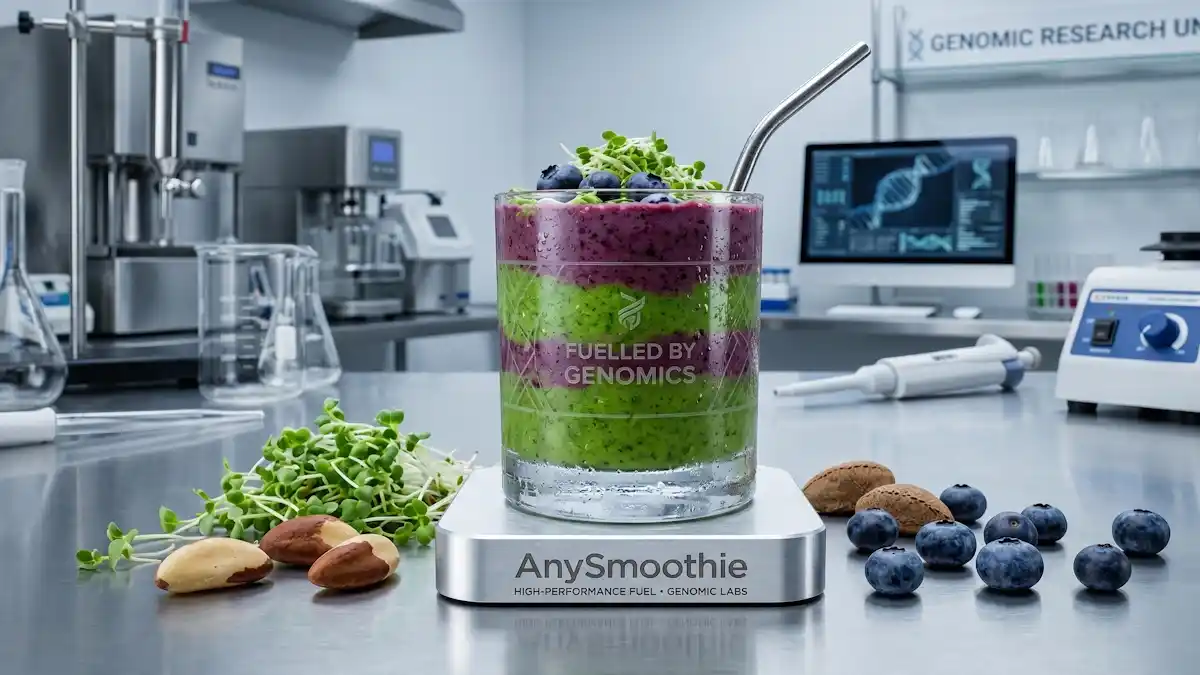
A good smoothie can do more than fill you up. With the right ingredients, it can bring antioxidants, minerals, folate, and plant compounds that help support the body’s natural DNA maintenance systems.
That matters because smoothies for genomic stability support are about daily input, not drama. The goal is to support oxidative balance, healthy cell function, and repair-friendly nutrition through smart food choices.
When you build a smoothie well, you also help nutrient partitioning. Fat, fiber, and protein change how the body handles sugar and plant compounds, so the blend works harder for you.
The Genomic Guardian: Understanding DNA Surveillance Mechanisms
Every cell watches for damage. It checks for breaks, repairs errors, and clears away unstable strands before they spread trouble.
That job costs energy. It also depends on a steady supply of nutrients that support repair enzymes and antioxidant systems. Smooth ingredients help here because they bring polyphenols, sulfur compounds, folate, and minerals into one easy dose. Sulforaphane is a strong example, and this review on sulforaphane and genomic stability explains how it supports the cellular defense response.
DNA repair runs all day long, so nutrient supply matters more than most people think.
PARP enzymes and NAD+, the energy cost of molecular repair
PARP enzymes are part of the DNA damage response. They detect breaks and use NAD+ to add repair signals.
That matters because NAD+ is also tied to cellular energy. When oxidative stress rises, PARP demand can climb, and NAD+ pools can feel the strain. Food won’t replace repair work, but it can support the energy balance behind it. A smoothie with berries, greens, and some fat helps keep the system fed without a hard sugar spike.
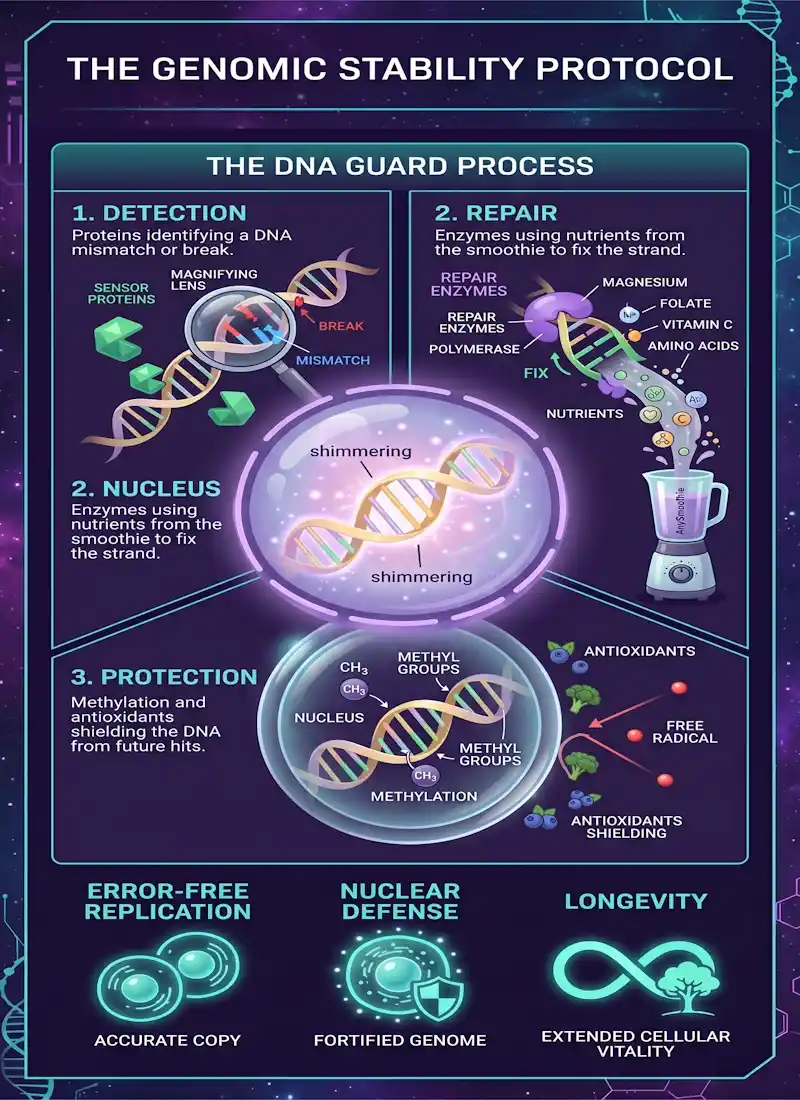
Nutritional Shielding: How smoothie ingredients help protect the double helix
The best smoothie ingredients do different jobs. Some buffer oxidation. Some support methylation. Others bring mineral cofactors that keep enzymes active.
Broccoli sprouts, berries, cacao, greens, seeds, and nuts all fit this pattern. Sulforaphane and selenium are especially useful together, and this review on isothiocyanates and selenium covers their complementary roles in antioxidant and epigenetic balance.
Here’s a quick comparison of three useful genomic protectors:
| Genomic protector | Physiological role | Target stability mechanism | Best smoothie pairing | Synergistic nutrient |
|---|---|---|---|---|
| Sulforaphane from broccoli sprouts | Phase II enzyme induction | DNA strand protection during oxidative stress | Berries and lemon | Vitamin C |
| Selenium from Brazil nuts | Critical component of selenoproteins that support nuclear defense and redox balance | Oxidative buffering | Cacao and berry base | Zinc |
| Folate from active 5-MTHF | Nucleotide synthesis and methylation support | Stable gene expression | Spinach and avocado | Choline or B12 |
The takeaway is simple. A strong smoothie does not rely on one ingredient. It stacks defenses.
Methylation flux and why folate matters for clean gene expression
Methylation is a small chemical tagging process. The body uses it to build DNA material and manage gene activity.
Folate, especially in an active form like 5-MTHF, helps keep that cycle moving. Food still comes first, but a folate-aware smoothie can support a cleaner nutrient flow. Pair greens with choline-rich foods when you can, and keep sugar low enough that the drink stays metabolically calm.
Build a genome-safe smoothie with the right ingredient stack
A smart smoothie has three layers. The first is the base, which gives volume and fiber. The second is the functional layer, which brings plant compounds and minerals. The third is the delivery layer, which adds fat or protein.
That last part matters more than many people think. Fat helps the body package fat-soluble compounds for transport, while protein slows the glucose rise. In practice, that means better nutrient partitioning and better metabolic efficiency. A smoothie that stays steady is easier on mitochondria, too, which supports a cleaner start to the day.
Broccoli sprouts, berries, and Brazil nuts for a strong core blend
Broccoli sprouts bring sulforaphane support. Berries add polyphenols and color-rich antioxidants. Brazil nuts supply selenium, but the portion should stay small because selenium is potent.
One nut is often enough. More is not better here. This core blend gives you the most direct path toward antioxidant buffering and nuclear support.
Zinc, magnesium, and healthy fats for better nutrient delivery
Zinc helps structural proteins bind DNA properly, and magnesium supports enzyme function and ATP use. Those are basic mechanics, not hype.
Add avocado, chia, flax, or almond butter to improve absorption and smooth out the texture. These fats help with transport of plant compounds after digestion. They also make the smoothie feel more like a meal than a snack.
3 genome-safe smoothie recipes that are easy to rotate
A good rotation keeps the body exposed to different plant compounds without turning breakfast into a science project.
Small habits that make these smoothies work better
Fresh or frozen ingredients both work. The bigger issue is balance.
Pair the smoothie with protein when you can, keep sweeteners modest, and rotate greens so you don’t depend on one plant every day. Consistency matters more than perfection. A good smoothie is a repeatable habit, and repeatable habits are what change the daily nutrient picture.
Conclusion
Smoothies can support the body’s DNA maintenance systems when they’re built with purpose. Antioxidants, minerals, folate, and sulfur compounds all help keep damage in check and repair running well.
Start with one recipe that fits your routine, then adjust the ingredients as you go. That’s the simplest path to genomic stability support with real food and better nutrient delivery.
🛡️ Safety Notes & Dietary Interactions
Phase II Enzyme Induction Dynamics: The high-density intake of sulforaphane from broccoli sprouts aggressively activates the intracellular Nrf2 pathway, which upregulates your body’s natural Phase II detoxification enzymes. To allow your liver and systemic clearance networks to adapt to this metabolic induction smoothly, introduce these potent cruciferous components gradually into your weekly rotation.
Selenium Pool Saturation: Incorporating raw Brazil nuts introduces exceptionally concentrated, highly bioavailable organic selenium, a critical structural component for nuclear selenoproteins. Because selenium operates within a tight physiological window, restrict your portion to just one single nut per formulation to maintain optimal baseline parameters without over-saturating your system.
Folate-Driven Methylation Flux: Utilizing active 5-MTHF precursors from raw spinach shifts the operational velocity of the one-carbon cycle to support nucleotide synthesis. To ensure this methylation flux remains perfectly balanced and un-congested, couple your green matrices with adequate hydration and companion whole-food co-factors like choline.
Enterocyte Osmo-Adsorption Speed: Stacking dense plant fats like avocado monounsaturated lipids alongside raw seed fibers slows down gastric emptying and modifies local intestinal transit kinetics. If your digestive tract operates on a highly sensitive baseline, ensure a thorough high-powered blend to pre-digest the structural plant walls, facilitating comfortable enterocyte absorption.
FAQ
What exactly is genomic stability, and how can a functional smoothie support it?
Genomic stability refers to your cells’ built-in capacity to preserve the precise structural architecture of your DNA against constant daily wear and tear. Every single day, your cells are exposed to internal and environmental stressors that can cause microscopic nicks or replication errors in your genetic blueprint. A well-built functional smoothie provides a highly concentrated, bioavailable matrix of raw micronutrients, sulfur compounds, and specific mineral co-factors. This food-first input ensures that your internal DNA surveillance systems have an uninterrupted supply of raw materials to maintain baseline oxidative balance and support healthy replication.
How do PARP enzymes interact with your cellular NAD+ pools during molecular repair?
Think of PARP enzymes as your cells’ automated internal emergency responders. The moment a strand break or structural error is detected in your DNA, PARP enzymes immediately latch onto the damaged area and begin signaling for repair crews to assemble. However, driving this molecular repair mechanism requires a high amount of cellular energy, and PARP enzymes must consume active NAD+ to fuel their signaling work. When localized oxidative stress rises, intense PARP activity can place a heavy drain on your intracellular NAD+ pool, which is why providing clean, slow-burning nutrients helps support your overall mitochondrial energy balance.
Why is the combination of sulforaphane and selenium considered the ultimate double-layer shield?
This specific pairing works so well because it targets two entirely different but highly complementary cellular defense pathways. Sulforaphane from broccoli sprouts is an exceptional inducer of the Keap1-Nrf2 pathway, signaling your cells to ramp up their production of homegrown protective enzymes. Selenium, on the other hand, is a mandatory structural building block for selenoproteins like glutathione peroxidase, which actively buffer the cell nucleus against oxidative stress. Stacking them together ensures that you are simultaneously opening the genetic instructions for cellular defense while supplying the exact raw minerals needed to build the protective enzymes.
Why does a folate-aware smoothie matter for clean, stable gene expression?
Folate sits at the very heart of a vital biochemical process known as one-carbon metabolism or methylation flux. Your cells utilize this pathway to attach tiny chemical tags called methyl groups directly to your DNA, acting like switches that tell your body which genetic instructions should stay open and active, and which ones should stay quiet and silenced. If your dietary intake of active folate runs low, this chemical tagging process can become erratic, leading to cellular spelling errors or compromised nucleotide synthesis. Supplying natural 5-MTHF from greens helps keep this assembly line moving predictably.
Why are healthy fats from avocado or chia seeds required to unlock a green smoothie’s potential?
The active plant compounds and structural antioxidants found in your functional ingredients require a reliable transport vehicle to pass through your digestive barrier effectively. Many vital nutrients are strictly fat-friendly, meaning they cannot cross the unstirred water layer of your small intestine on their own. Including a high-quality lipid matrix like avocado or chia seeds triggers the release of bile acids during digestion, encapsulating the active plant molecules into microscopic droplets called mixed micelles. These lipid droplets slide through your enterocyte membranes smoothly, radically improving systemic transport.

Medical Disclaimer: AnySmoothie content is for educational purposes only and is not a substitute for professional medical advice. Consult a healthcare provider for personalized guidance. See our full Disclaimer & Terms of Use. AI Transparency: AnySmoothie may use AI to support content development. All content undergoes human editorial review for accuracy, clarity, and editorial quality. See our full AI Transparency.