
A smoothie can support liver chemistry, but it doesn’t replace a full diet or act like a cure. With smoothie protocols for hepatic Phase I functional support, the goal is simpler, feed the pathways that keep normal enzyme work moving.
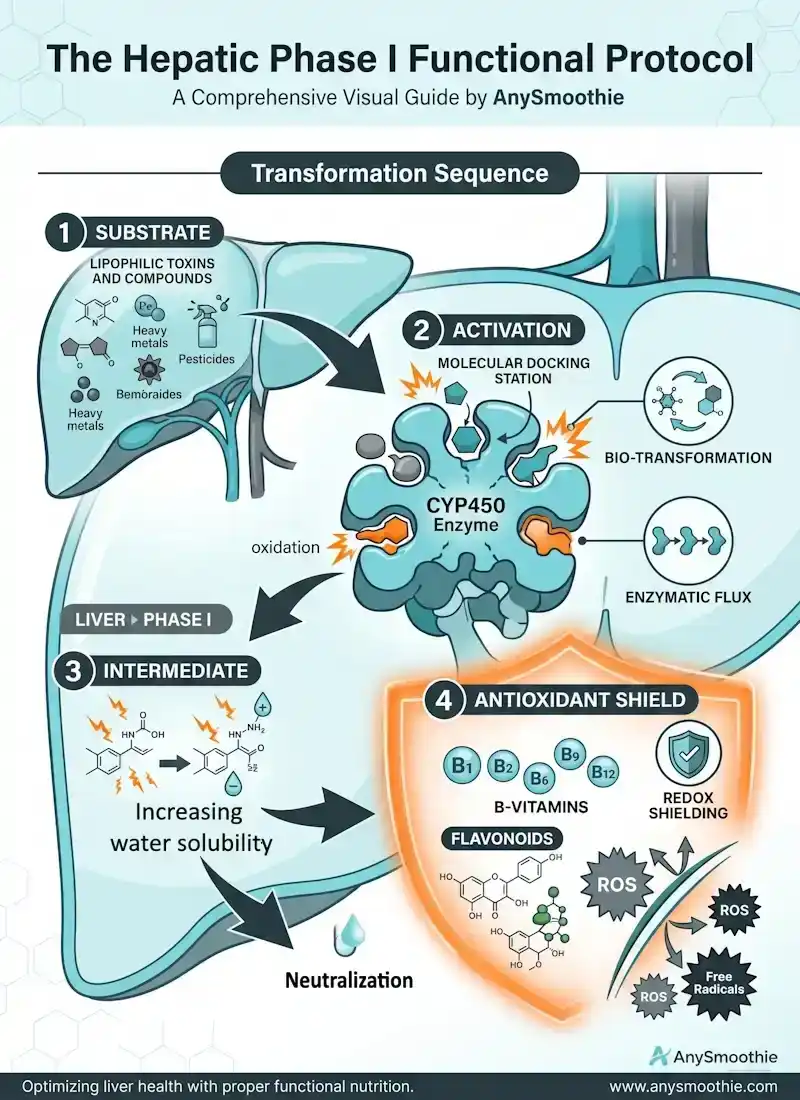
Phase I is the liver’s first processing step. Enzymes like cytochrome P450 transform compounds so the body can handle them efficiently. That process depends on steady nutrients, clean redox balance, and enough cell energy to keep electrons moving.
The best blends are calm, not chaotic. You’ll see which nutrients matter most, how to build a practical smoothie, and how to avoid the common mistakes that make a good idea backfire.
The Cytochrome P450 Engine: Mechanics of Bioactivation
Cytochrome P450 enzymes work like small electron machines. They take in a compound, move electrons through a reductive chain, and change its shape for later pathways. That work depends on FAD, FMN, iron, and a steady supply of NADPH. When those pieces are present, Phase I runs with better metabolic efficiency.
This process also creates a little reactive oxygen species. That’s normal. The issue starts when nutrient supply, recovery, or antioxidant support falls behind. A smoothie built for Phase I should keep the system fed without pushing sugar too high or stripping away fiber.
Smoothie support works best when it feeds the system at a steady pace, not in spikes.
Redox Balance: Managing Reactive Oxygen Species (ROS)
Berries, citrus, and leafy greens help buffer the short oxidative burst that comes with normal enzyme activity. Their polyphenols and vitamin C support redox homeostasis, which helps cells stay stable while Phase I does its job. In plain terms, the smoothie should help the cell stay calm while chemistry stays active.
Why the cytochrome P450 system depends on cofactors
Enzymes do not run well without helper nutrients. Riboflavin supports the flavin groups that move electrons. Niacin supports the NADPH pool that feeds the cytochrome P450 reductase step. Iron also matters because many P450 enzymes rely on it inside the catalytic core. The point is to optimize natural pathways, not force them.
Enzymatic Co-factors: B-Vitamins and Iron Integration
The three compounds below fit different jobs in a Phase I-supportive smoothie.
| Compound | Physiological Mechanism | Role in Phase I | Best Smoothie Pairing | Synergistic Nutrient |
|---|---|---|---|---|
| Riboflavin (B2) | FAD and FMN prosthetic groups for redox reactions | Supports electron transfer in oxidative enzymes | Spinach, kefir, and berries | Iron |
| Quercetin (Flavonoid) | Modulates enzyme kinetics and supports redox balance | Fine-tunes CYP450 activity | Apples, blueberries, and citrus zest | Vitamin C |
| Niacin (B3) | Precursor for NADPH, which powers the cytochrome P450 reductase step | Essential for Phase I electron flow | Citrus greens smoothie with protein | Riboflavin |
Riboflavin, niacin, folate, B6, and iron all matter in different ways. Together, they help the liver keep normal energy transfer moving. The key is balance. Too little iron can slow metabolism, while too much is not the goal either. Food first works well here.
Flavonoid Modulation: Fine-Tuning CYP450 Activity
Colorful plants bring flavonoids that can support enzyme balance and redox homeostasis. Berries, citrus peel, kale, and even small amounts of apple or onion fit that pattern. Grapefruit is the one to watch. It can interact with CYP enzymes in ways many readers may want to avoid, so a grapefruit-free plan is cleaner. For a closer look at flavonoids, see here.
Best Smoothie Structure for Metabolic Efficiency
A good build starts with a low-to-moderate sugar fruit base, one leafy green, one cofactor-supportive ingredient, and a fat or protein source. Add enough liquid for easy digestion. That mix gives smoother energy delivery and better mitochondrial priming than a fruit-heavy drink. Keep it simple enough to repeat.
3 ‘Phase I-Prime’ Metabolic Support Smoothie Recipes
These are practical templates, not gourmet projects. Each one keeps the load balanced.
Metabolic Intermediate: Preparing for Phase II
Phase I support works best when the next step has room to follow. That means the smoothie should stay modest, digestible, and repeatable. One serving a day is enough for most people. Breakfast or an afternoon snack works well. More is not better here, because Phase I support works best with steady nutrients and normal recovery time.
Who may want to start slowly
People who react to fiber, high fruit loads, or strong polyphenol foods should begin with half portions. Use fewer ingredients at first, then build up. That keeps the gut calm while you test what feels good.
Simple signs your smoothie is too much or too little
A smoothie that feels heavy, causes bloating, or pushes the blood sugar curve too fast is too much for now. If you get hungry again fast or feel flat, it may be too light. Use those signals to adjust fruit, fat, or protein one step at a time. Watch ingredient choices if you have food sensitivities or a history of reacting to grapefruit.
Conclusion
The strongest smoothie protocols for hepatic Phase I functional support stay simple. They supply cofactors, protect redox balance, and keep energy flow steady while cytochrome P450 does its normal work.
Colorful plants, B vitamins, and balanced protein or fat go further than a crowded ingredient list. Keep grapefruit out unless you have a clear reason to use it, and build recipes you can repeat without effort. Consistency does more for metabolic efficiency than any extreme blend ever will.
🛡️ Safety Notes & Contraindications
Drug Interactions (CYP450): The liver’s Phase I pathways are responsible for metabolizing over 50% of prescription drugs. Ingredients that significantly modulate these enzymes (like concentrated polyphenols or specific herbs) can alter the efficacy and toxicity of medications. If you are on prescription therapy, consult your physician before starting a daily Phase I support protocol.
Grapefruit Warning: This protocol deliberately avoids grapefruit due to its potent inhibition of CYP3A4. If you choose to add it, be aware that it can lead to dangerously high blood levels of certain medications (e.g., statins, calcium channel blockers, immunosuppressants).
Iron Overload (Hemochromatosis): Phase I enzymes are heme-dependent and require iron. However, individuals with hereditary hemochromatosis or iron overload disorders should avoid iron-rich smoothie add-ins (like molasses or excessive spinach) as it can exacerbate oxidative damage in the liver.
Niacin Flush: High doses of Niacin (B3) can cause a “flush” (redness and tingling of the skin). While nutritional yeast and standard food amounts are generally safe, avoid excessive supplementation within the smoothie if you are sensitive to B3.
Oxidative Burst: Phase I support must always be balanced with Phase II support (sulfur compounds, amino acids). Stimulating Phase I without adequate Phase II capacity can lead to an accumulation of toxic reactive intermediates.
FAQ
How does the “Cytochrome P450 Engine” utilize electrons for Phase I processing?
CYP450 enzymes operate as a reductive chain that changes the molecular shape of compounds. Biochemically, this electron flow is powered by NADPH and facilitated by flavin-containing prosthetic groups (FAD and FMN). Supporting this physiological system through riboflavin- and niacin-rich smoothie bases (like spinach and kefir) optimizes the natural pathways of “electron transfer,” ensuring the biochemical mechanics of Phase I remain well-fueled.
Why is “Redox Balance” essential during Phase I enzyme activity?
The process of Phase I bioactivation naturally generates reactive oxygen species (ROS) as a byproduct. Biochemically, if the cell’s antioxidant capacity is overwhelmed, this oxidative burst can lead to cellular stress. Supporting this physiological system with polyphenol-rich berries and Vitamin C-dense greens facilitates the biochemical mechanics of “redox buffering,” helping to neutralize ROS while the liver performs its routine chemistry.
What is the role of “Riboflavin (B2)” as a rate-limiting cofactor?
Riboflavin is the precursor to FAD and FMN, which are the essential cofactors for the cytochrome P450 reductase step. Biochemically, without these flavins, the electron machine cannot effectively process compounds. Supporting this physiological system through ingredients like nutritional yeast or kefir facilitates the biochemical mechanics of “oxidative enzymes,” providing a steady supply of the prosthetic groups required for enzyme kinetics.
How do “Flavonoids” like Quercetin fine-tune CYP450 activity?
Flavonoids found in apples, blueberries, and citrus zest can modulate the kinetics of Phase I enzymes. Biochemically, these compounds support a healthier redox balance and may help stabilize enzyme activity. Supporting this physiological system through color-dense smoothies optimizes the natural pathways of “enzymatic modulation,” ensuring the biochemical mechanics of bioactivation are balanced rather than chaotic.
Why is “Mitochondrial Priming” necessary for hepatic hydroxylation?
Hepatic processing is an energy-intensive task that requires a constant flux of ATP and cellular reducing power (NADPH). Biochemically, mitochondria must provide the energetic foundation for these enzymes to function without depletion. Supporting this physiological system with balanced protein and healthy fats (like avocado or almond butter) facilitates the biochemical mechanics of “metabolic priming,” ensuring the liver has the steady fuel necessary for Phase I work.

Medical Disclaimer: AnySmoothie content is for educational purposes only and is not a substitute for professional medical advice. Consult a healthcare provider for personalized guidance. See our full Disclaimer & Terms of Use. AI Transparency: AnySmoothie may use AI to support content development. All content undergoes human editorial review for accuracy, clarity, and editorial quality. See our full AI Transparency.