
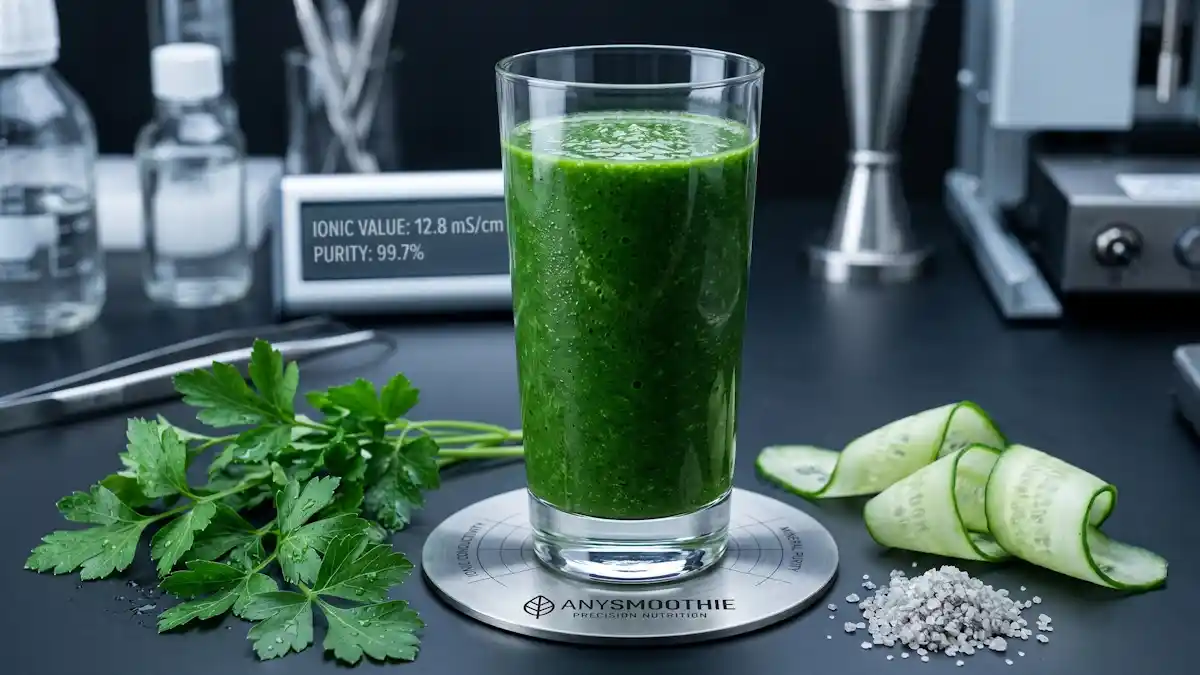
A green smoothie can look healthy and still miss the mark. If you want better mineral intake, the goal is bigger than drinking greens. You need a repeatable green smoothie protocol for cellular mineral saturation, one that supports mineral intake, mineral absorption, and cell function.
In plain terms, cellular mineral saturation means your cells have enough usable minerals inside them to help run enzymes, stabilize charge, and manage fluid balance. That comes down to smart greens, fewer blockers, better pairing, and good timing. The rest is just flavor.
The bioavailability matrix: how to get more minerals from your greens
Not all green smoothies work the same way. Mineral content matters, but bioavailability matters more. If a mineral is trapped by oxalates, phytates, or excess fiber, your body gets less of it.
The smartest protocol starts with better ingredient selection, not more ingredients. A plain-language review of phytates and oxalates in plant foods shows why this matters.
| Mineral | Physiological Role | Primary Mechanism of Uptake | Best Smoothie Pairing | Impact of Antinutrients |
|---|---|---|---|---|
| Magnesium | ATP stabilization, over 300 enzymatic reactions | Whole-food intake plus cofactor support | Low-oxalate greens, cucumber, avocado | Oxalates can reduce usable magnesium |
| Potassium | Resting membrane potential, fluid balance | Dietary intake from produce | Leafy greens, cucumber, coconut water | Less affected, but matrix still matters |
| Zinc | Enzyme catalyst, protein support | Seed foods and amino-acid support | Pumpkin seeds, hemp, lime | Phytates can bind zinc strongly |
Magnesium is the master key here. It supports more than 300 enzymatic reactions, so it deserves top priority.
How oxalates and phytates can block mineral uptake
Oxalates and phytates bind minerals in the gut. That lowers the amount your body can use. The effect is practical, not dramatic, but it adds up fast.
A smoothie can be nutrient-dense and still underperform if oxalates and phytates tie up the minerals first.
That is why spinach-heavy smoothies every day can be a weak trade. Spinach brings useful nutrients, but it also brings a lot of oxalates. If you repeat it daily, you may not get the mineral benefit you expect.
Low-oxalate greens that give you more usable cations
Better greens usually mean better mineral yield. Parsley, romaine, cilantro, bok choy, and young cucumber greens are all stronger choices for this approach. They tend to be easier to rotate and gentler on the mineral balance.
Rotation matters too. When you vary greens, you spread out your antinutrient load. You also widen the mineral profile. That helps the protocol stay useful over time.
The voltage gate: magnesium and potassium for membrane potential
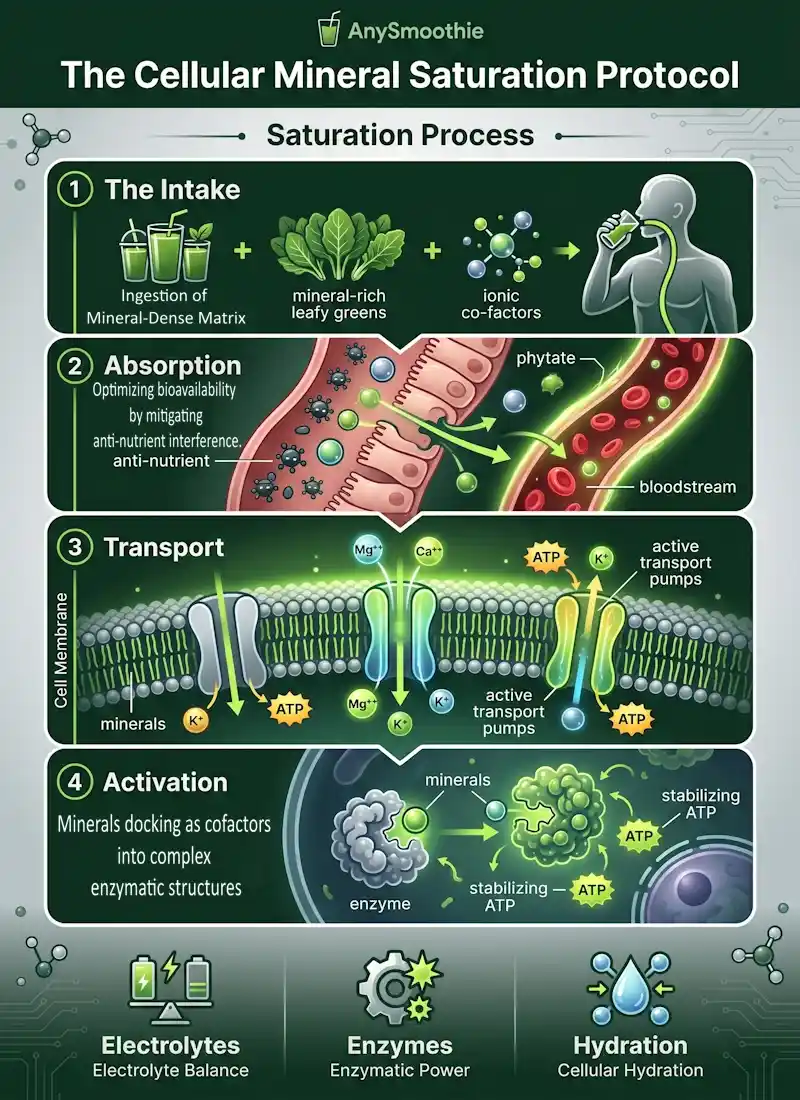
This is the electrical side of the protocol. Cells depend on membrane potential to move ions, make energy, and keep signals clean. Magnesium and potassium are central to that work.
When these minerals are available, ionic flux runs more smoothly. That supports nerve signaling, muscle function, and metabolic efficiency. A green smoothie can help support the body’s natural electrical environment, especially when magnesium gets the lead role.
For a practical look at how green smoothies contribute nutrients, see this green smoothie nutrient review.
Why chlorophyll-bound magnesium deserves the lead role
Chlorophyll brings magnesium into the picture naturally. It is not a magic form, but it does come inside a whole-food matrix. That means fiber, water, and plant cofactors stay with it.
This can make the mineral feel smoother in a smoothie format. It also fits the goal of steady intake, which matters more than chasing exotic ingredients.
Using potassium-rich ingredients to support fluid balance and cell charge
Potassium works with magnesium to help maintain resting membrane potential. That matters for cell charge and fluid balance.
Cucumber, avocado, leafy greens, and a small amount of coconut water can all help here. Keep coconut water modest, though. Too much fruit sugar can pull the smoothie away from its mineral focus.
3 mineral-dense smoothie formulas you can rotate through the week
Rotation keeps the plan from getting stale. It also lets you shift mineral emphasis without losing consistency. Each blend below supports cellular mineral saturation in a different way.
Intracellular pH and enzymatic activity
Mineral balance also affects how well enzymes work inside the cell. Magnesium matters here because it helps bind ATP, the energy currency your body uses all day.
Mitochondrial priming: magnesium as the essential ATP co-factor
When magnesium is available, ATP is easier for enzymes to use. That supports mitochondrial priming and basic energy handling. It also helps keep intracellular pH steadier through better mineral balance and fluid control.
A green smoothie won’t replace sleep, food, or movement. It can still support the terrain your cells work in. That is the point of this protocol.
How to time your smoothie for better mineral use
Morning is a strong choice for many people. You start with fluids, minerals, and a cleaner intake window. Still, the bigger win is regular use.
Drink it between meals or before a meal if you want lighter digestion. Use it post-workout if you want fluids and minerals after sweat loss. Keep the blend simple, and avoid huge sugar loads that distract from the mineral goal. Consistency beats complexity here.
Pre-meal, between meals, or post-workout: what makes the most sense
Pre-meal timing works well when you want appetite support and easy absorption. Between meals is often best for a cleaner mineral hit. Post-workout makes sense when hydration and electrolyte support matter most.
Pick the slot you can repeat. A good protocol only works if you actually use it.
Conclusion
A good green smoothie protocol is about smart ingredients, mineral balance, and repeatable habits. Low-oxalate greens, magnesium-first thinking, potassium support, and rotation give you a better shot at cellular mineral saturation.
Start with one mineral-dense formula and use it for a week. Then adjust the greens, seeds, and timing until it fits your routine. That is how a smoothie stops being a habit and starts working like a real protocol.
🛡️ Safety Notes & Contraindications: Mineral Saturation Smoothies
Renal Function: High-potassium smoothies are beneficial for most, but individuals with chronic kidney disease (CKD) or those taking potassium-sparing diuretics must avoid these protocols, as they can lead to dangerous hyperkalemia.
Oxalate Sensitivity: Even “low-oxalate” protocols should be rotated. Individuals with a history of calcium-oxalate kidney stones should ensure adequate calcium intake (e.g., from a yogurt base) to bind any residual oxalates in the gut.
Thyroid Interference: Raw cruciferous greens (like bok choy) contain goitrogens. If you have diagnosed hypothyroidism, lightly steam these greens before blending to deactivate the enzymes that interfere with iodine uptake.
Zinc/Copper Balance: Frequent use of zinc-rich seeds (pumpkin/hemp) can interfere with copper absorption over time. Ensure your overall diet remains varied to maintain this delicate mineral ratio.
Hydration Alert: Increasing mineral intake requires sufficient water to help the kidneys process and balance electrolytes. Do not use these smoothies as a replacement for pure water intake.
FAQ
How does “Oxalate Management” determine the bioavailability of minerals in a green smoothie?
Oxalates are naturally occurring compounds in plants like spinach that can bind to minerals, particularly magnesium and calcium, in the digestive tract. Biochemically, this forms insoluble crystals that the body cannot absorb. Supporting this physiological system by utilizing low-oxalate greens (such as parsley, romaine, or bok choy) optimizes the natural pathways of “mineral dissociation,” ensuring that a higher percentage of the cations are available for uptake across the intestinal wall.
Why is “Magnesium-ATP Binding” the primary goal of cellular mineral saturation?
Adenosine triphosphate (ATP), the body’s primary energy currency, is biologically inactive unless it is bound to a magnesium ion ($Mg^{2+}$). Biochemically, magnesium stabilizes the phosphate groups on the ATP molecule, allowing enzymes to access the energy. Supporting this physiological system through magnesium-dense, low-antivutrient smoothies facilitates the biochemical mechanics of “mitochondrial priming,” providing the essential cofactor required for every energy-dependent process in the cell.
What is the role of “Potassium and Magnesium” in maintaining resting membrane potential?
Cells operate like tiny batteries, maintaining an electrical charge (voltage) across their membranes. Biochemically, potassium is the primary intracellular cation, while magnesium regulates the “voltage gates” (ion channels) that control the flow of sodium and potassium. Supporting this physiological system through mineral-saturated smoothies optimizes the natural pathways of “ionic flux,” ensuring the biochemical mechanics of nerve signaling and muscle contraction remain precise and responsive.
How does “Chlorophyll-Bound Magnesium” provide a whole-food matrix advantage?
In green plants, magnesium sits at the center of the chlorophyll molecule. Biochemically, this whole-food matrix provides the mineral alongside synergistic cofactors, water, and fiber. Supporting this physiological system through fresh, minimally processed greens facilitates the biochemical mechanics of “substrate delivery,” offering a steady, bio-available stream of minerals that the body is evolved to recognize and utilize efficiently.
Why is “Seed-Based Zinc Support” essential for enzymatic catalysis?
Zinc acts as a structural and catalytic component for over 300 enzymes, including those involved in protein synthesis and immune function. Biochemically, zinc uptake is often inhibited by phytates found in many grains and legumes. Supporting this physiological system by pairing zinc-rich seeds (like pumpkin or hemp) with acids (like lime juice) in a low-phytate green base facilitates the biochemical mechanics of “enzymatic priming,” ensuring the body has the mineral precursors needed for routine cellular repair.

Medical Disclaimer: AnySmoothie content is for educational purposes only and is not a substitute for professional medical advice. Consult a healthcare provider for personalized guidance. See our full Disclaimer & Terms of Use. AI Transparency: AnySmoothie may use AI to support content development. All content undergoes human editorial review for accuracy, clarity, and editorial quality. See our full AI Transparency.