
That 10:30 a.m. crash can hit like a wall. So can the heavy, sleepy feeling after lunch, especially when another cup of coffee sounds good but feels like a bad idea.
That’s where best smoothies for natural energy can help. A smart smoothie gives you quick fuel from fruit, then keeps you steady with fiber, protein, and healthy fat. The trick is balance, because a sugar-loaded blend can leave you more tired than before. Start with the formula below, then pick a smoothie that fits your morning, workout, or afternoon slump.
What gives an energy smoothie staying power
A good smoothie should do two jobs at once. First, it should wake you up. Then, it should keep you going.
That’s why the strongest smoothies for fatigue mix carbs with ingredients that slow digestion. Hydration matters too, because mild dehydration can feel like low energy, foggy thinking, or a dull headache. Even a great smoothie won’t help much if it’s thick, sugary, and missing enough fluid.
Use natural carbs for quick fuel, not a sugar spike
Fruit is the fast-start part of the mix. Bananas, berries, mango, pineapple, and dates all give your body carbs it can use quickly. That’s useful in the morning, before exercise, or when your brain feels flat.
Still, whole fruit works better than a lot of juice. Fruit has fiber, so the energy tends to feel smoother. Juice skips most of that fiber, which can turn your smoothie into a sweet drink that fades fast. Dates are a great example. One or two can add sweetness and quick fuel, but a handful can tip the balance too far.
A strong energy smoothie should feel steady, not spiky.
If you want more recipe inspiration, this roundup of energy-packed smoothie recipes shows how simple ingredients can work together.
Add protein, fiber, and healthy fat to stay full and focused
This is where many smoothies fall short. Fruit alone can taste great, but it often won’t last. Add protein, fiber, and fat, and you turn a snack into a more complete source of fuel.
Greek yogurt and kefir add protein and a creamy texture. Milk and soy milk also help. Chia seeds, flaxseed, and oats bring fiber, which can slow the rush from fruit. Nut butters, like peanut or almond butter, add fat and make the smoothie more filling.
You don’t need all of those in one glass. In fact, too many extras can feel heavy. A better approach is simple: fruit plus a protein source, then one or two add-ins. That gives you a smoothie for alertness that tastes good and doesn’t sit like a brick.
Best smoothies for natural energy, six easy blends to try
The best smoothie depends on the moment. Some blends work better for busy mornings. Others are lighter and fit well before a workout. A few feel more like rescue drinks when the afternoon slump shows up.
Smart ingredient swaps that make your smoothie work better for you
Once you know the basic formula, small swaps make a big difference. That matters if you’re dairy-free, want more protein, or need a smoothie that feels more like a meal.
The goal isn’t to pack in every healthy ingredient you own. It’s to match the smoothie to your body, your schedule, and the kind of energy you need.
Choose the right liquid, sweetener, and add-ins
The liquid changes both taste and staying power. Milk gives protein and a fuller feel. Soy milk does something similar and works well for dairy-free blends. Almond milk is lighter, so it’s better when you want fewer calories or a thinner drink. Kefir adds tang and protein, while coconut water fits best in a lighter pre-workout smoothie.
As for sweetness, go easy. Fruit often does the job on its own. If a blend still needs help, try half a date, a small drizzle of honey, or a little maple syrup. Start small, then taste.
Add-ins should have a reason. Chia seeds and flax help with fiber. Oats make smoothies more filling. Nut butter adds richness. If you pile them all in, the smoothie can turn heavy fast.
This guide to best ingredients for energy smoothies has a few more mix-and-match ideas.
Make it dairy-free, higher protein, or more filling
For dairy-free smoothies, swap Greek yogurt for plant-based yogurt or silken tofu. Soy milk also helps keep protein up. If you want more protein without extra bulk, a scoop of plain or vanilla protein powder can work well.
To make a smoothie more filling, add oats, hemp seeds, avocado, or a second spoon of nut butter. Those changes help when the smoothie is replacing breakfast or lunch. On the other hand, if it’s only a snack, keep it smaller and lighter.
That’s the part people miss. A snack smoothie and a meal smoothie shouldn’t look the same. One should hold you over for an hour or two. The other should keep you satisfied much longer.
Common smoothie mistakes that can leave you more tired
Even healthy ingredients can miss the mark when the balance is off. Most smoothie problems come down to too much sugar, too little protein, or a portion that doesn’t fit the moment.
The fix is usually simple, which is good news if you already like making smoothies.
Too much fruit juice, not enough balance
This is the biggest mistake. A smoothie can look healthy and still act like a milkshake or sweet juice. Large amounts of fruit juice, sherbet, sweetened yogurt, and too much very sweet fruit can make energy rise fast, then fall hard.
A better blend uses whole fruit first. Then add protein or fat, such as yogurt, soy milk, or nut butter. Even a small amount changes how long the smoothie lasts. If you’re trying to avoid sugar-heavy blends, these smoothies for energy that aren’t sugar bombs show the right idea.
Portion size and timing matter more than people think
A giant smoothie can leave you sluggish, especially if it’s thick and high in fat. Meanwhile, a too-small smoothie may disappear in 30 minutes and send you looking for snacks.
For breakfast, go bigger and include protein, fiber, and fat. Before a workout, keep it lighter and lower in fat so it digests well. For an afternoon pick-me-up, aim for something moderate that takes the edge off hunger without replacing dinner.
That simple shift, timing the smoothie to the job, often makes the biggest difference.
Midday crashes often come from quick fixes that fade fast. Best smoothies for natural energy work better because they pair quick fuel with ingredients that last.
Start with one easy blend, then tweak it. Add more protein if you’re hungry soon after. Use less fruit if you crash. Thin it out if it feels too heavy.
Build the habit around real food, and your energy routine gets a lot more reliable. Which smoothie will you try first tomorrow?
🛡️ Safety Notes & Contraindications: Energy smoothies
Insulin Sensitivity: if you have type 2 diabetes or insulin resistance, even “natural energy” smoothies can be problematic; prioritize high-fiber and protein-heavy blends (like the Spinach Banana or Berry Almond) and consult your endocrinologist.
Caffeine Overstacking: do not mix energy smoothies with high doses of coffee or pre-workout supplements; the combined effect on heart rate and blood pressure can lead to jitters, palpitations, or increased anxiety.
Post-Workout Osmolality: for a recovery smoothie (like the Cherry Kefir), ensure it’s not too dense; if it’s too thick, it may sit in the stomach and delay rehydration. Add extra water if you’ve sweated excessively.
Nut Allergy Warning: energy smoothies frequently rely on nut butters (almond, peanut) for staying power; if you have allergies, substitute with sunflower seed butter or tahini to maintain the fat-to-carb ratio.
Night-time Consumption: avoid “energy” smoothies after 6:00 PM; the natural sugars and energy-boosting compounds can interfere with your circadian rhythm and delay sleep onset.
FAQ
How does “Mitochondrial Priming” transform a smoothie into sustained cellular energy?
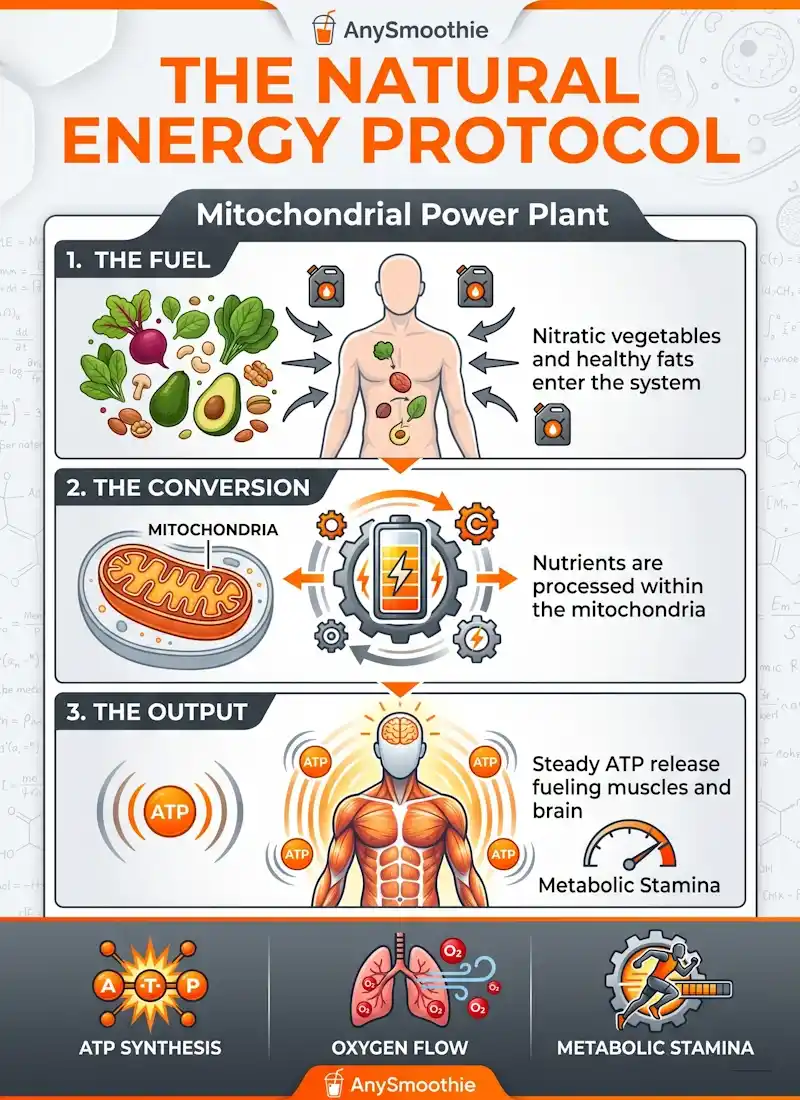
Mitochondria are the cellular power plants responsible for converting nutrients into ATP (adenosine triphosphate). Biochemically, a balanced smoothie provides both glucose for immediate fuel and medium-chain triglycerides (found in coconut or certain nuts) that can be oxidized rapidly. Supporting this physiological system through a combination of targeted carbohydrates and healthy fats optimizes the natural pathways of mitochondrial priming, ensuring the biochemical mechanics of energy production remain consistent and uninterrupted.
Why does the combination of “Fiber and Protein” prevent a post-smoothie energy crash?
Energy spikes followed by “crashes” are typically caused by an excessive insulin response to isolated simple sugars. Biochemically, soluble fibers (from oats or chia) and proteins (from Greek yogurt or soy) slow the rate of gastric emptying and glucose absorption. Supporting this physiological system optimizes the natural pathways of glycemic stability, ensuring the biochemical mechanics of energy release are gradual, thus avoiding the “10:30 a.m. wall.”
What is the role of “Cellular Hydration” in the perception of fatigue?
Physical and mental fatigue are often early biomarkers of mild dehydration, which slows nutrient transport and the removal of metabolic waste. Biochemically, using liquid bases like coconut water provides essential electrolytes—specifically potassium and magnesium—that support the sodium-potassium pump in cell membranes. Supporting this physiological system through hydrating smoothies optimizes the natural pathways of neuro-energetics, ensuring biochemical nerve signaling remains rapid and precise.
How does “Nutrient Partitioning” influence mental focus and alertness?
The brain is an energy-intensive organ, consuming approximately 20% of the body’s total fuel, and it prefers a steady, non-fluctuating supply of glucose. Biochemically, adding unsaturated fats (such as almond butter) helps stabilize neuronal membranes and supports the synthesis of key neurotransmitters. Supporting this physiological system through specific nutrients for mental clarity optimizes the natural pathways of alertness, ensuring the biochemical mechanics of cognitive function do not suffer the dips typical of high-glycemic meals.
Why does “Smoothie Timing” (Pre-workout vs. Morning) change its biochemical profile?
The body’s energetic demand varies drastically between resting states and high-output physical activity. Biochemically, a pre-workout smoothie should prioritize simpler carbohydrates and lower fat content to facilitate rapid digestion and immediate glycogen availability. Supporting these different physiological states optimizes the natural pathways of energy metabolism, ensuring the biochemical mechanics adapt to the needs of “ready-to-use fuel” versus “slow-release energy” for a productive workday.

Medical Disclaimer: AnySmoothie content is for educational purposes only and is not a substitute for professional medical advice. Consult a healthcare provider for personalized guidance. See our full Disclaimer & Terms of Use. AI Transparency: AnySmoothie may use AI to support content development. All content undergoes human editorial review for accuracy, clarity, and editorial quality. See our full AI Transparency.