
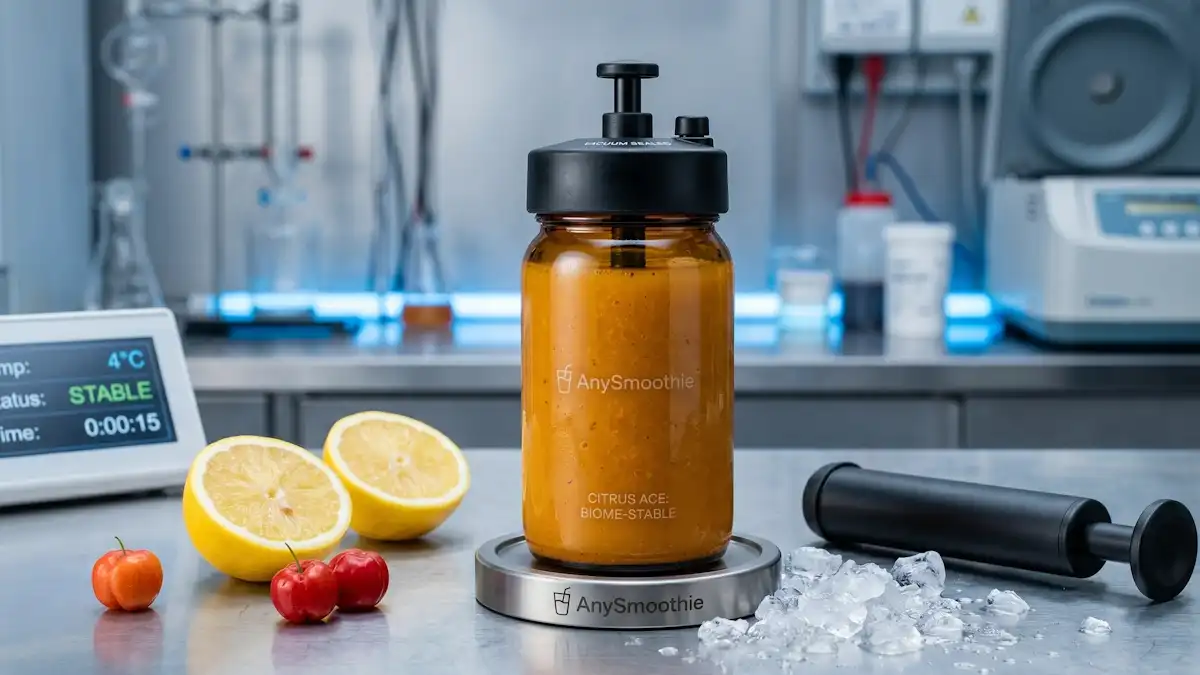
A smoothie is most nutrient-dense right after blending. Once air, light, and warmth get involved, vitamins and pigments start to change, sometimes faster than the flavor does.
If you prep smoothies ahead of time, that matters. Smoothie storage and micronutrient stability come down to simple forces, oxygen, light, and temperature.
The good news is that you do not need a complicated routine. A few small choices can slow nutrient loss without making breakfast harder.
The Oxidation Cascade: Mechanics of Nutrient Degradation
Blending changes the food, not just the texture. It breaks plant cells, spreads enzymes through the liquid, and pulls in extra air. That gives oxygen more contact with fragile compounds, which speeds oxidation and shifts taste, color, and nutrient quality. For a closer look at how ascorbic acid reacts to heat and processing, see ACS Publications’ study on ascorbic acid stability.
Radical Oxygen Species (ROS): How Blending Exposes Molecules to Air
Blenders create more surface area in seconds. That means more molecules sit at the air-liquid edge, where reactive oxygen species can do damage.
Vitamin C is often the first nutrient to react. It works as a sacrificial antioxidant, so it gives up electrons early and slows damage to other compounds for a short time. That helps protect the drink right after blending, but the reserve fades as storage time passes.
Enzymatic Browning: Managing Polyphenol Oxidase (PPO) Activation
Color changes often track chemistry. Browning, separation, and a flatter taste can all point to oxidation that has already started.
Polyphenol oxidase, or PPO, keeps working when oxygen is present. In fruit-heavy smoothies, that can mean a duller color and a less bright flavor by later in the day. The drink may still be fine to consume, but its fresh profile is already slipping.
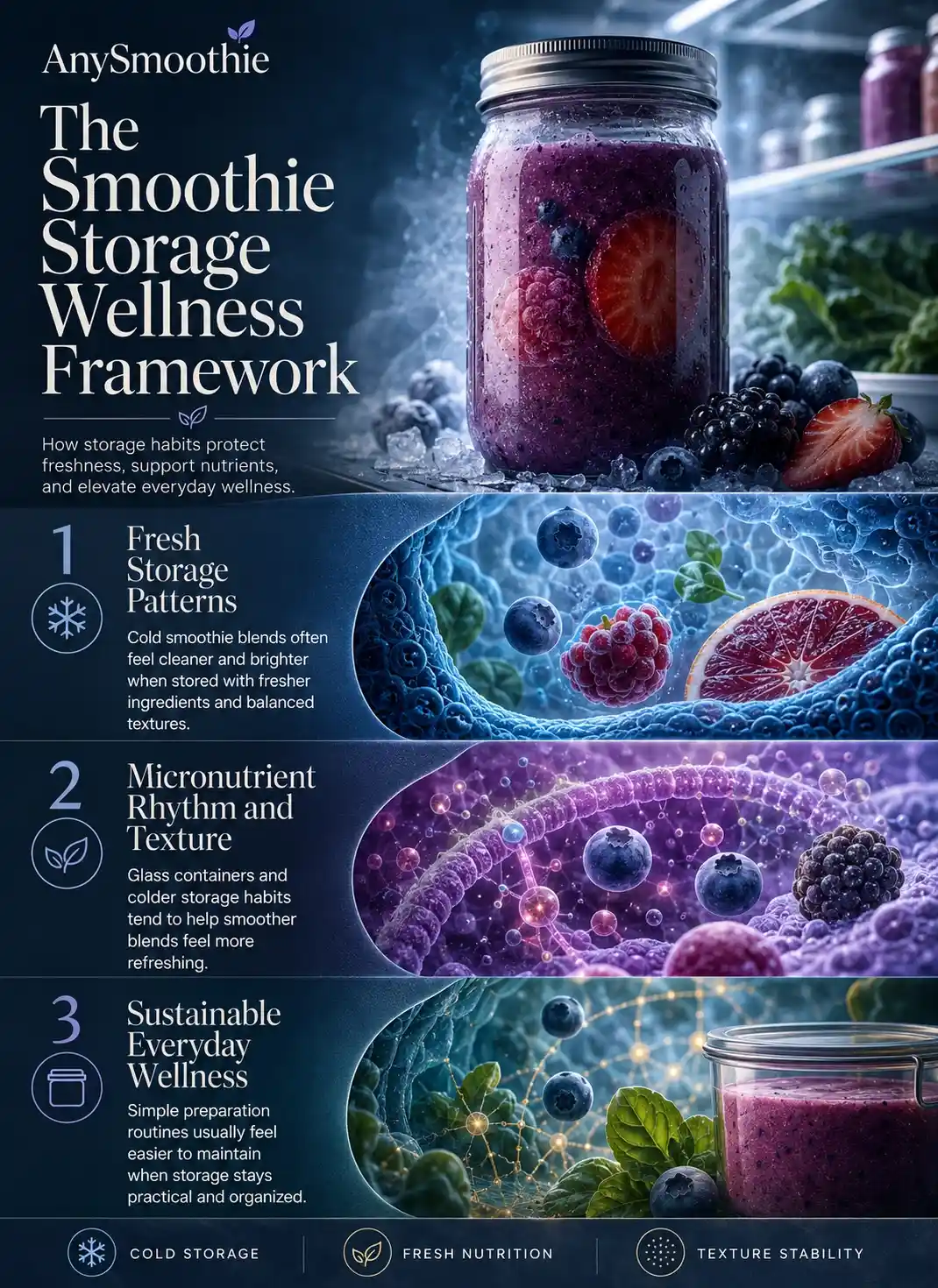
Photodegradation and Thermal Kinetics: Vitamin Vulnerability
Different micronutrients age in different ways. A shelf-storage study in ScienceDirect’s smoothie research found that bioactive compounds tend to decline over time, even when the drink still looks acceptable. That gap between “looks okay” and “nutrient quality is still high” is where storage matters.
Here is a simple comparison of the main players.
| Micronutrient class | Degradation trigger | Half-life in standard storage (4°C) | Best smoothie stabilizer | Retention mechanism |
|---|---|---|---|---|
| Vitamin C (ascorbic acid) | Oxygen, heat, metal contact | Shortest, often the first to drop | Lemon juice, fast chilling, minimal headspace | Sacrificial antioxidant, it oxidizes first and helps protect other compounds |
| Folate (vitamin B9) | Light and time, with more loss in warm storage | Moderate, usually more stable than vitamin C | Opaque container and cold storage | Light-sensitive structure breaks down more slowly in the dark |
| Carotenoids, like lycopene | Oxidation and light, especially in low-fat mixes | Longer than vitamin C, but still vulnerable | A small amount of fat plus opaque storage | Lipids help disperse them and limit exposure to oxygen |
The pattern is simple. Vitamin C usually falls first, folate sits in the middle, and carotenoids last longer when air and light stay low.
Vitamin C, Folate, and Carotenoids Do Not Age the Same Way
Vitamin C is the most fragile of the three. It reacts fast with oxygen and heat, so fridge storage can still change it.
Folate is also sensitive, but light and time are bigger issues than oxygen alone. Carotenoids are steadier, yet they still oxidize if the container has too much air or gets too much light.
That is why a berry smoothie and a carrot-heavy smoothie do not age the same way. The recipe changes the chemistry.
Why Acid, Fat, and Darkness Can Protect Nutrients
Acid slows some oxidation, which is why lemon juice helps. It lowers pH and gives oxygen a harder path.
Fat also matters. Carotenoids dissolve better in a lipid phase, so yogurt, chia, or nut butter can support their stability and use later in the body.
Darkness helps too. Opaque containers reduce light exposure, which matters for folate and carotenoids. If you want one quick rule, lower the pH, reduce the air, and keep the cup dark.
The Best Ways to Store Smoothies Without Losing Too Much Nutrition
The most useful storage plan is simple. Make less air, use less light, and keep the drink cold. A freezer buys more time, but it does not stop chemistry completely.
Work from UNESP’s smoothie storage repository notes that vitamin C loss can rise during storage because oxidative and enzymatic reactions keep moving. That matches what you see at home, where flavor and color often drift before the drink is truly “old.”
Fridge storage, freezer storage, and the time window that matters
If you drink a smoothie within a few hours, nutrient loss is usually smaller. In the fridge, quality starts to drift the same day, especially in blended fruit drinks with lots of headspace.
Freezing slows that drift, so it works better for batches you will use later. Still, freezing only slows the reactions. Once thawed, the clock starts again.
How containers, lids, and light exposure change stability
Airtight containers matter because less oxygen means slower oxidation. Fill the container close to the top so there is less air above the liquid.
Opaque glass or dark plastic helps protect light-sensitive compounds. Cold-safe containers matter too, because warm spots speed up chemical change. Glass is useful when it seals well and stays chilled. Plastic can work as long as it is food-safe and airtight.
A simple prep routine that protects nutrients
- Blend fast, then stop.
- Pour the smoothie into the smallest container that fits it.
- Chill it right away, or freeze it if you are saving it for later.
- Add citrus or a small amount of fat when the recipe allows it.
That routine keeps the drink closer to its fresh state without much extra effort.
Conclusion
The freshest smoothie is still the best bet for micronutrient quality. Even so, smart storage can slow the drop in vitamin C, folate, and carotenoids enough to matter in real life.
The main pattern is simple, reduce oxygen, limit light, keep it cold, and shorten the time between blending and drinking. Good smoothie storage is about managing oxygen, light, heat, and time, not chasing perfection.
🛡️ Safety Notes & Contraindications
Bacterial Proliferation in Headspace: CRITICAL: Storing a smoothie with significant “headspace” (the pocket of air at the top of the container) not only accelerates micronutrient oxidation but provides an aerobic microenvironment ideal for the proliferation of foodborne pathogens (e.g., Listeria monocytogenes, Salmonella spp.), especially if stored above 4°C. Fill containers to the absolute brim.
Anaerobic Fermentation Risks: Conversely, sealing a non-pasteurized smoothie airtight for extended periods (exceeding 48-72 hours in the fridge) can trigger anaerobic fermentation by wild yeasts or lactic bacteria present naturally on raw fruit. This process alters the pH, gas pressure, and ethanol metrics of the blend.
Oxidative Degradation of Added PUFAs: If your storage protocol involves pre-adding oils rich in polyunsaturated fatty acids (like walnut, flaxseed, or hemp oil), know that the blending-induced ROS influx will trigger rapid lipid peroxidation. Peroxidized lipids generate cytotoxic aldehydes. Pro-Tip: Always add delicate omega-3/6 oils after storage, immediately before final consumption.
Plasticizer Leaching in Acidic Blends: Utilizing low-quality or non-BPA-free plastic containers to store highly acidic smoothies (citrus or berry-heavy bases) can accelerate the chemical leaching of endocrine-disrupting plasticizers into the matrix. Restrict storage vessels exclusively to pharmaceutical-grade amber glass or certified food-safe stainless steel.
Histamine Accumulation Over Time: Raw spinach, berries, and fermented bases (kefir/yogurt) accumulate biogenic amines (histamine) during prolonged storage due to ongoing bacterial enzymatic pathways. Individuals with diagnosed Histamine Intolerance (HIT) must completely avoid meal-prepped smoothies and consume them strictly within 10 minutes of blending.
FAQ
How does high-speed blending accelerate the kinetics of the oxidation cascade?
Mechanical blending disrupts plant cellular compartmentalization, instantly liberating intracellular enzymes like Polyphenol Oxidase (PPO) and mixing them with their phenolic substrates in an oxygen-saturated matrix. Biochemically, this creates a high flux of reactive oxygen species that rapidly attack electron-dense molecules. Supporting this physiological system by minimizing blending duration and sealing the fluid immediately slows the thermodynamic velocity of this degradation chain.
Why does Vitamin C function as a sacrificial antioxidant in the smoothie matrix?
Ascorbic acid (Vitamin C) possesses a highly labile ene-diol structure that readily donates electrons to neutralize free radicals. Biochemically, it possesses the shortest half-life in standard storage ($4^\circ\text{C}$) because it oxidizes itself to protect more complex polyphenols and pigments from degradation. Supporting this physiological system by adding exogenous organic acids (like lemon or lime juice) lowers the matrix pH, protonating the ascorbic acid and reinforcing its structural stability against atmospheric oxygen.
What molecular mechanisms cause Folate and Carotenoids to degrade under light exposure?
Folate ($\text{Vitamin B9}$) possesses a p側に structure that undergoes rapid photolytic cleavage when exposed to specific ultraviolet and visible light wavelengths. Carotenoids, conversely, are highly susceptible to singlet oxygen attacks that break down their conjugated double-bond shield. Biochemically, storing the matrix in an opaque, UV-blocking container blocks these photon-driven reactions, optimizing the natural pathways of pigment and coenzyme retention.
How does the introduction of a lipid phase stabilize fat-soluble micronutrients?
Lipophilic bioactive compounds, such as carotenoids (lycopene, beta-carotene) and Vitamin E, are highly unstable when suspended in an unstructured aqueous environment. Biochemically, introducing polar lipids (found in chia seeds, avocado, or sunflower lecithin) drives the spontaneous self-assembly of micelles and liposomal-like emulsions. Supporting this physiological system wraps the fragile lipophilic molecules in a protective lipid bilayer, sheltering them from watery oxidants.
Why does eliminating “Headspace” in a storage container blunt enzymatic browning?
Container headspace represents a fixed reservoir of atmospheric oxygen ($21\%\ \text{O}_2$) trapped directly above the liquid line. Biochemically, as long as oxygen interfaces with the fluid surface, PPO enzymes will continuously catalyze the conversion of monophenols to highly reactive quinones, causing color separation and nutrient loss. Supporting this physiological system by filling an airtight vessel to the absolute brim eliminates the primary gaseous substrate required for this reaction to proceed.

Medical Disclaimer: AnySmoothie content is for educational purposes only and is not a substitute for professional medical advice. Consult a healthcare provider for personalized guidance. See our full Disclaimer & Terms of Use. AI Transparency: AnySmoothie may use AI to support content development. All content undergoes human editorial review for accuracy, clarity, and editorial quality. See our full AI Transparency.