
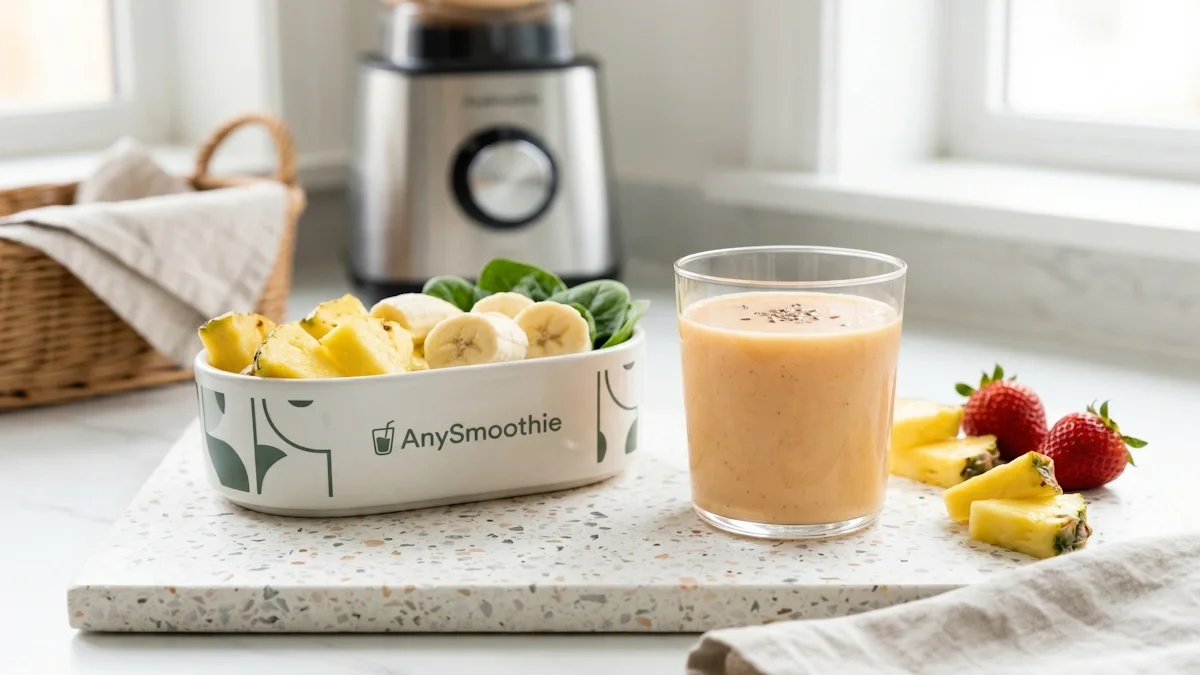
Water moves across your gut based on what is dissolved in the drink. When the mix stays balanced, fluid and nutrients move in a steadier way, and the smoothie feels easier to handle.
That is why one blend feels light, while another feels thick, sweet, or heavy. A smoothie for managing the luminal osmotic gradient is mostly about solute balance, not just more fruit or more ice. The goal is steady absorption, usable energy, and less gut strain.
Osmotic Flux: The Physics of Water Movement in the Gut
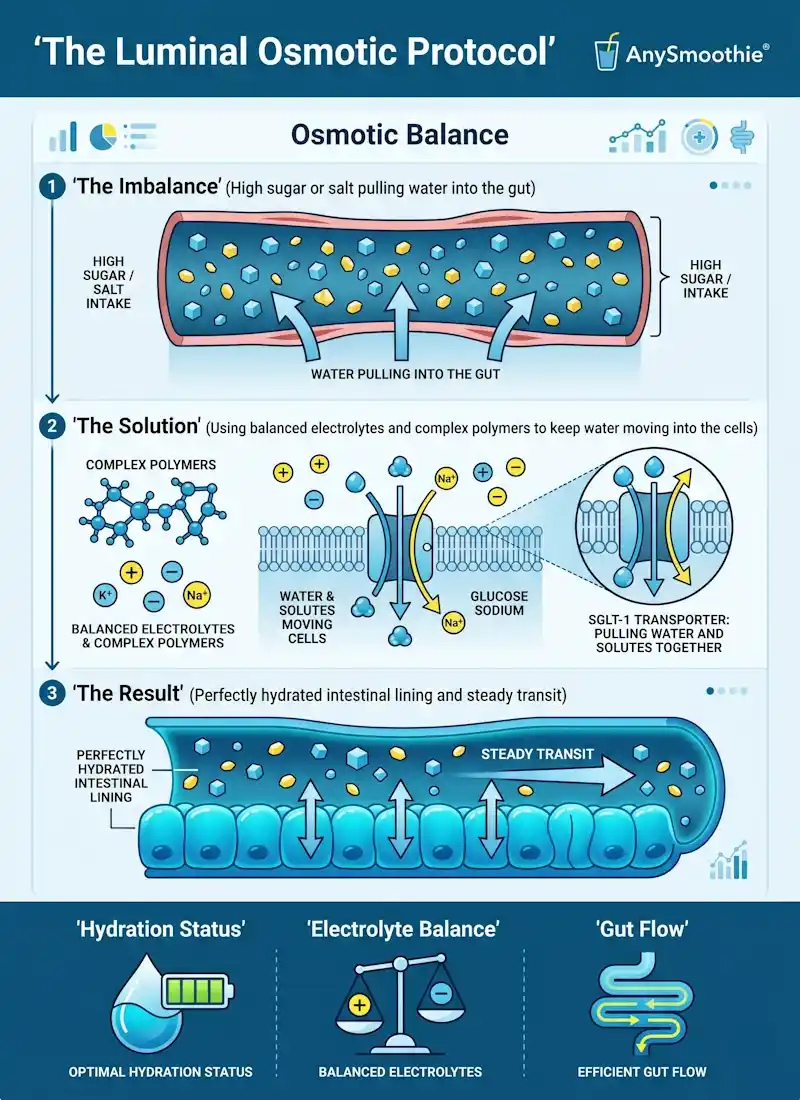
Inside the gut, the lumen is the space where food and drink sit before absorption. Solutes in that space, like sodium, glucose, and amino acids, change where water wants to move. As digestion continues, the mix usually moves toward balance, so water can leave the lumen and nutrients can cross the gut wall.
Solute Balance: How Sodium and Glucose Drive Water Absorption
Sodium and glucose work well together because the SGLT1 transporter moves them across the intestinal wall as a pair. When sodium enters with glucose, water tends to follow that movement. That is why a smoothie with a little salt and a useful carb source can support absorption better than plain water alone.
Why Very Sweet or Very Dense Smoothies Can Feel Different
Very sweet drinks raise the osmotic load. Thick blends can slow emptying, especially when they also carry a lot of fiber, seed, nut butter, or protein powder. None of those ingredients are bad on their own. They just change the fluid math. If you want easier tolerance, keep the drink lighter and less syrupy.
Water follows dissolved particles, so texture alone does not tell you how a smoothie will behave in the gut.
Hypotonic vs. Isotonic Solutions: Engineering Fluid Dynamics
The best build keeps the drink close to hypotonic or isotonic, depending on the goal. Hydration-first blends can stay a little lighter. Training blends can carry more fuel. The table below shows three osmotic modulators and why polymer carbs behave differently from simple sugar.
| Modulator | Physiological Mechanism | Impact on Luminal Water | Best Smoothie Pairing | Target Benefit |
|---|---|---|---|---|
| Sodium Chloride (Electrolytes) | Sodium-coupled transport | Helps water move with absorbed solute | Coconut water, rice base | Steadier hydration |
| Highly Branched Cyclic Dextrin | Low-osmotic pressure energy delivery | Adds calories with less luminal pull than glucose | Training smoothies, light protein | Fuel without the osmotic hit of simple sugar |
| L-Glutamine | Enterocyte fuel and osmotic regulation | Supports intestinal handling of water and ions | Gentle blends, modest sweetness | Gut support and recovery |
The takeaway is simple, calories do not all behave the same in the gut. Polymer carbs, like highly branched cyclic dextrin, give energy with a lower osmotic impact than dextrose or juice. A low-osmolality cyclic dextrin review makes that difference easy to see.
Polymer Maltodextrins: Reducing Osmotic Pressure While Providing Energy
Electrolytes help fluid balance. Polymer carbs supply energy without flooding the lumen with simple sugar. L-glutamine can support enterocyte fuel and osmotic regulation, but it stays in a support role, not a magic one. Put together, these ingredients support nutrient partitioning without turning the smoothie into a sugar load.
Ingredients to Keep Low When the Goal Is Less Osmotic Stress
Fruit juice, honey, table sugar, and heavy fiber add-ins can push the blend toward a higher osmotic load. Use them carefully when faster absorption or gentler digestion matters. The same goes for big doses of nut butters or powders, which can make the drink dense fast.
3 ‘Osmo-Flow’ Gradient Management Smoothie Recipes
These three recipes use the same logic, but each one fits a different use case. The common thread is enough liquid, a measured sodium dose, and one clear carb strategy.
Supporting the SGLT-1 Transporter
The small intestine does more than soak up liquid. SGLT1 pulls glucose and sodium together across the brush border, and water follows that movement. A study on SGLT1 and water transport shows how closely those steps are linked. That is nutrient partitioning in plain language, and it supports metabolic efficiency when the drink is built well. Liposomal transport matters in other formulas, but here sodium and glucose do the main work.
Why the Small Intestine Likes Balanced Fuel
The small intestine spends energy on ion pumps and transport proteins, so it likes fuel it can move without a fight. Balanced carbs and sodium give those cells a cleaner job, which keeps fluid handling more predictable.
Mitochondrial Priming: Powering the Active Transport of Ions
Mitochondrial priming here means supporting the ATP demand that powers active transport. When the smoothie supplies the right mix of water, sodium, and efficient carbs, the gut cells can keep that machinery running without a huge osmotic burden.
Conclusion
The best smoothie for managing the luminal osmotic gradient is the one that respects how water moves with solute. Start with liquid, add a measured pinch of sodium, then pick a carb source that fits the goal, such as rice, cyclic dextrin, or a modest amount of fruit.
That keeps absorption steadier and digestion more comfortable. On your next blend, ask one simple question before you pour: does this recipe support fluid balance, or does it just make the drink sweeter?
🛡️ Safety Notes & Contraindications: Osmotic gradient smoothies
Sodium and Hypertension: while a pinch of sea salt (approx. 200-300mg) is essential for SGLT1 activation, individuals with salt-sensitive hypertension should monitor their total daily sodium intake when using electrolyte-enhanced smoothies.
“Dumping Syndrome” Risk: consuming high-osmolality smoothies (very sweet and thin) too quickly can trigger a rapid shift of fluid into the gut, leading to dizziness, palpitations, and osmotic diarrhea; always sip slowly.
Highly Branched Cyclic Dextrin (HBCD): while excellent for training, excessive use outside of high-energy demand windows can lead to unnecessary caloric surplus; use only when metabolic efficiency during or after exercise is the priority.
Renal Load: very dense smoothies with high protein and mineral content increase the solute load that the kidneys must process; ensure you drink adequate plain water throughout the day to support renal clearance.
L-Glutamine and Osmotic Balance: glutamine is an effective osmolyte, but in high doses (>10g), it can contribute to osmotic pressure itself; keep supplemental amounts within the 2-5g range per smoothie.
FAQ
How does the “SGLT1 Transporter” drive water absorption in the gut?
The Sodium-Glucose Linked Transporter 1 (SGLT1) is the primary mechanism for the active transport of glucose across the intestinal brush border. Biochemically, for every molecule of glucose transported, two sodium ions are pulled along, creating an osmotic pull that forces water to follow. Supporting this physiological system through balanced smoothies—using a specific ratio of sodium and glucose—optimizes the natural pathways of “osmotic flux,” ensuring the biochemical mechanics of hydration are significantly more efficient than drinking plain water.
Why are “Polymer Carbohydrates” like Cyclic Dextrin preferred over simple sugars?
Simple sugars like dextrose raise the osmotic pressure in the lumen rapidly, which can pull water out of the body and into the gut, causing bloating or discomfort. Biochemically, polymer carbohydrates have a high molecular weight and low osmolality, meaning they provide the same energy with less “osmotic hit.” Supporting this physiological system through complex carb bases optimizes the natural pathways of energy delivery, facilitating the biochemical mechanics of fueling without inducing luminal stress.
What is the distinction between “Hypotonic” and “Isotonic” smoothie engineering?
A hypotonic smoothie has a lower concentration of solutes than human blood, favoring rapid water uptake, while an isotonic blend matches the body’s concentration for balanced fuel and fluid delivery. Biochemically, engineering the “solute balance” allows for precise nutrient partitioning based on the goal (e.g., rehydration vs. performance). Supporting these physiological systems optimizes the natural pathways of intestinal handling, ensuring the biochemical mechanics of the drink align with the body’s current tonicity needs.
How does “L-Glutamine” support enterocyte fuel and osmotic regulation?
L-Glutamine is a critical fuel source for enterocytes and plays a role in maintaining the structural integrity of the intestinal villi. Biochemically, it aids in the regulation of ion transport and water balance across the gut wall. Supporting this physiological system through targeted smoothies optimizes the natural pathways of “mucosal resilience,” ensuring the biochemical mechanics of the luminal barrier are powered to manage osmotic gradients effectively during digestion.
Why can high-density “Fiber and Nut Butters” interfere with osmotic flow?
While fiber and fats are nutritious, adding them in excessive amounts can significantly slow gastric emptying and create a dense, high-solute environment in the lumen. Biochemically, this increases the “osmotic burden,” making it harder for the small intestine to process fluids quickly. Supporting the physiological system through lighter, “Osmo-Flow” recipes optimizes the natural pathways of transit, ensuring the biochemical mechanics of absorption are not hindered by an over-concentrated digestive load.

Medical Disclaimer: AnySmoothie content is for educational purposes only and is not a substitute for professional medical advice. Consult a healthcare provider for personalized guidance. See our full Disclaimer & Terms of Use. AI Transparency: AnySmoothie may use AI to support content development. All content undergoes human editorial review for accuracy, clarity, and editorial quality. See our full AI Transparency.