
When bile flow is sluggish, meals can feel heavier than they should. Fat digestion slows down, fat-soluble nutrients may not move as well, and energy after eating can feel flat.
That is why TUDCA smoothies for bile acid metabolism are getting attention. TUDCA is a bile acid isomer that people use to support bile handling and cellular balance, while a smoothie gives you a simple daily format for pairing it with bile-friendly ingredients.
The biliary axis: why bile quality shapes metabolic health
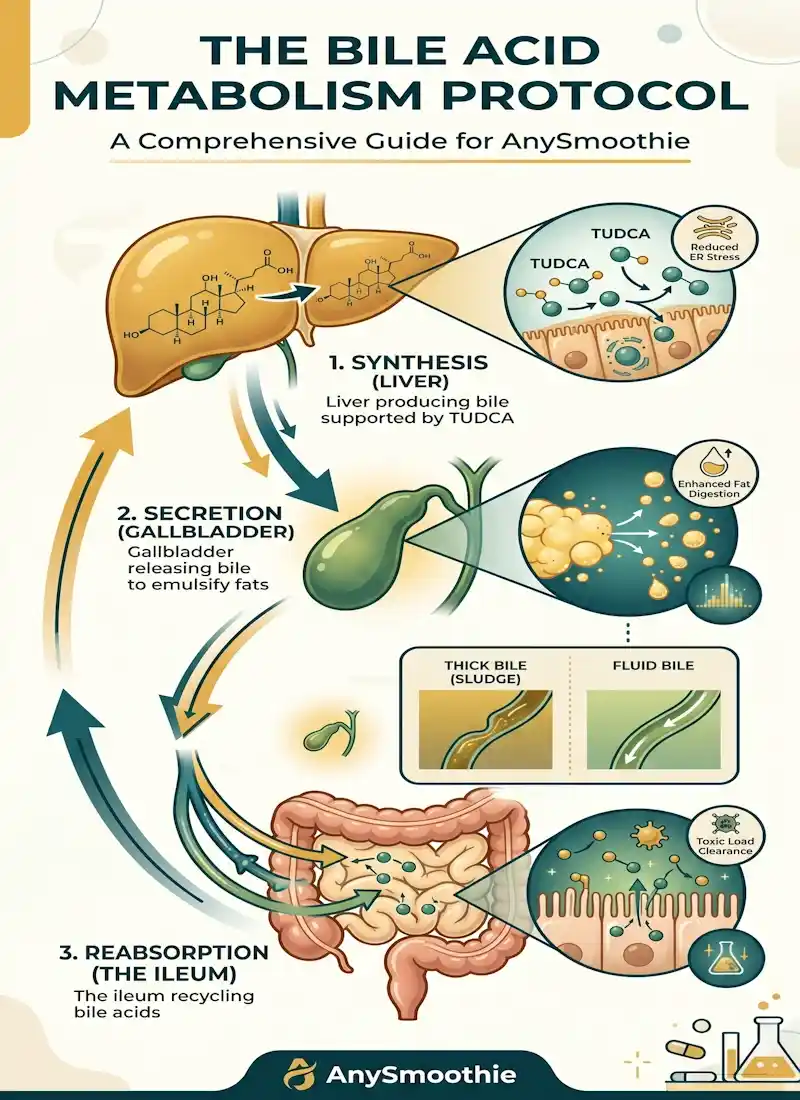
The biliary axis is the back-and-forth system between the liver, gallbladder, and small intestine. It matters because bile does more than break up fat. It also helps the body move lipids and fat-soluble compounds into the right places.
Bile acids act like tiny transport tools. They emulsify fat, form micelles, and help carry nutrients across the gut wall. For a plain-language guide to that process, see bile acids and lipid absorption.
How bile acids help digest fat and move nutrients where they belong
Bile acids are recycled helpers, not one-time digestive fluid. They circle through the gut, bind fats, and keep lipids suspended long enough for enzymes to do their work.
That matters for vitamins A, D, E, and K. It also matters for carotenoids and other lipophilic compounds. Without enough bile support, those nutrients can be harder to absorb well.
Why bile flow can affect how you feel after meals
When bile flow is off, people often notice it after a heavy meal. Food sits longer. Fatty meals may feel harder to handle. Some people also feel low energy or sluggish after eating.
Those signs are not a diagnosis. They are clues that digestive support may be useful. In practice, that means choosing ingredients that help the system move better, not just adding more calories.
Comparing 3 bile-support agents for smoothies
Here is a simple way to separate the main options.
| Agent | Physiological Mechanism | Impact on Liver ER Stress | Best Smoothie Pairing | Primary Metabolic Benefit |
|---|---|---|---|---|
| TUDCA | Bile acid isomer with chaperone-like activity | Most direct, proteoprotective support for liver cells | Pear, citrus, cucumber, artichoke | Bile acid balance and cellular stress support |
| Taurine | Amino acid that supports bile acid conjugation | Indirect support only | Avocado, lemon, ginger | Better bile acid function and fat handling |
| Cynarin from artichoke | Choleretic support, encourages bile flow | Minimal direct effect | Lemon, cucumber, pear | Bile release and digestive flow |
Where TUDCA fits in a smoothie-based bile support strategy
TUDCA is a bile acid that has drawn interest for its chaperone-like activity. Research describes it as supportive of protein folding and cellular balance, especially in liver cells. That proteoprotective angle is one reason it stands out. A review of its cellular effects is available in this PMC article on TUDCA.
ER stress is cellular workload strain. When cells are under pressure, proteins can misfold and pile up. TUDCA appears to help cells keep that internal load more organized.
ER stress management and TUDCA’s cell-protective role
In plain terms, TUDCA helps cells stay calmer under metabolic strain. That does not mean it fixes everything. It does mean the compound is interesting for people who want to support liver cell function and bile acid balance at the same time.
The best formulas support bile flow without turning the smoothie into a heavy meal.
How a smoothie can improve the way TUDCA fits into a daily routine
A smoothie makes TUDCA easier to use consistently. It also gives you a place to add ingredients that support bile flow, texture, and absorption.
That is the practical angle. You are not just hiding a supplement in a drink. You are building a routine around nutrient partitioning and fat handling.
Ingredients that stimulate bile flow and support conjugation
The supporting cast matters. TUDCA works best when the rest of the smoothie matches the goal. Some ingredients help with bile release. Others support conjugation or make the drink easier to digest.
Artichoke is one of the strongest examples. Research on artichoke leaf extract has shown a choleretic effect, which means it can help promote bile flow. You can see that in studies on artichoke and choleresis.
Taurine and artichoke: two ingredients that work well with TUDCA
Taurine supports bile acid conjugation, which helps bile acids stay effective in the gut. Artichoke, especially its cynarin content, is tied to bile flow support.
Put together, they make sense in one formula. TUDCA supports the bile acid pool, taurine supports the conjugation side, and artichoke helps the system move.
Best add-ins for flow, flavor, and fat handling
Citrus adds brightness and a clean taste. Ginger can make the drink feel lighter. Cucumber and pear smooth the texture without overpowering the mix.
Avocado and olive oil are useful when you want a little fat for lipophilic nutrient transport. Keep the amount modest. The goal is support, not a heavy shake.
How to choose the right ingredient for your smoothie goal
Use TUDCA when your focus is cellular support and bile acid balance. Use taurine when conjugation and bile chemistry are the main goal. Use cynarin-rich artichoke when flow is the priority.
Most people do best by combining them with food, not treating them as isolated pieces.
3 biliary-flow TUDCA smoothie recipes to try
These are simple, practical blends. Each one keeps the texture light and the fat load controlled.
The “Liver-Lube” artichoke heart, taurine, and pear blend
Ingredients
- 1/2 cup cooked or canned artichoke hearts, drained and rinsed
- 1 small ripe pear, cored and chopped
- 1/2 cup cucumber, chopped
- 1 tablespoon fresh lemon juice
- Taurine according to the product’s labeled serving
- TUDCA according to your clinician’s or product’s directions
- 1/2 cup cold water
- 1/2 cup ice
The pear softens the flavor, while artichoke and taurine support bile flow and conjugation. It is a good first choice when you want a smooth, digestible base.
Estimated Nutrition per Serving
- Calories: ~145 kcal
- Protein: ~4 g
- Carbohydrates: ~34 g
- Fat: ~1 g
- Fiber: ~9 g
- Sugars: ~18 g
I’d rinse canned artichoke hearts thoroughly before blending. It removes much of the briny liquid and lets the pear and lemon come through more cleanly.
A citrus-ginger TUDCA smoothie for lighter mornings
Ingredients
- 1 medium orange, peeled and segmented
- 1 tablespoon fresh lemon juice
- 1/2-inch piece fresh ginger
- 1/2 cup cucumber, chopped
- 1 cup baby spinach
- 1 tablespoon avocado
- TUDCA according to your clinician’s or product’s directions
- 3/4 cup cold water
- 1/2 cup ice
This version feels bright and light. Ginger and citrus keep the profile sharp, while the small fat addition helps with nutrient transport.
Estimated Nutrition per Serving
- Calories: ~115 kcal
- Protein: ~3 g
- Carbohydrates: ~21 g
- Fat: ~3 g
- Fiber: ~5 g
- Sugars: ~13 g
A creamy avocado smoothie for fat-soluble nutrient support
Ingredients
- 1/4 avocado
- 1 kiwi, peeled
- 1/2 medium pear, cored and chopped
- 1 tablespoon fresh lime juice
- Pinch of sea salt
- TUDCA according to your clinician’s or product’s directions
- 1 cup unsweetened almond milk
- 1/2 cup ice
Keep the avocado portion modest.
The creaminess helps carry lipophilic nutrients without making the drink too dense. It works well on days when you want better satiety and smoother absorption.
Estimated Nutrition per Serving
- Calories: ~200 kcal
- Protein: ~4 g
- Carbohydrates: ~29 g
- Fat: ~10 g
- Fiber: ~8 g
- Sugars: ~15 g
Why enhanced bile flow improves absorption of fat-soluble nutrients
When bile acids do their job well, micelles form more easily. Those micelles package fat and fat-soluble nutrients so the gut can absorb them.
That is why bile support matters for vitamins A, D, E, and K. It also helps with carotenoids in colorful produce.
Micelle formation made simple
A micelle is a tiny transport packet. Bile helps form it, then fat and nutrients ride inside it until absorption happens.
That is the core reason TUDCA smoothies for bile acid metabolism make sense. They combine bile support with the foods that benefit most from it.
How to pair smoothie fats with vitamins and carotenoids
Use small amounts of healthy fat with nutrient-rich fruits and greens. Avocado, a little olive oil, or a spoon of nut butter can help.
Keep the dose moderate. Too much fat can make the smoothie feel heavy, which works against the point.
Conclusion
TUDCA smoothies can be a practical way to support bile acid metabolism, bile flow, and fat-soluble nutrient absorption. The strongest approach is simple, use TUDCA for its proteoprotective role, then pair it with taurine, artichoke, and smart smoothie ingredients that help the whole system work better.
When bile support is matched with the right texture and fat balance, the result is easier digestion and cleaner nutrient handling. Start with one recipe, keep it consistent for a week, and notice how your body responds.
⚠️ SAFETY NOTES: TUDCA & Bile Metabolism
BILIARY OBSTRUCTION: Do not use TUDCA or choleretic agents (like artichoke) if you have confirmed gallstones or a bile duct obstruction. Stimulating bile flow against an obstruction can cause severe biliary colic or gallbladder rupture.
DIARRHEA & BILE ACID MALABSORPTION: High doses of TUDCA can lead to osmotic diarrhea because unabsorbed bile acids draw water into the colon. If your stools become loose or urgent, reduce the dosage immediately.
MEDICATION ABSORPTION: Bile acid sequestrants or certain medications can bind to TUDCA in the gut, rendering both ineffective. Ensure TUDCA smoothies are consumed at least 2 hours away from other prescription medications.
CHRONIC LIVER DISEASE: While TUDCA is used in clinical settings for conditions like PBC (Primary Biliary Cholangitis), individuals with advanced cirrhosis or liver failure must only use TUDCA under strict medical supervision, as liver clearance pathways are compromised.
TASTE & SENSORY ISSUES: Raw TUDCA powder is extremely bitter. Attempting to blend pure powder into a smoothie can ruin the flavor. Most users prefer opening capsules into a highly acidic/citrus base to mask the bitterness, or consuming the capsule alongside the smoothie.
FAQ
How does TUDCA act as a molecular chaperone to support liver cell integrity?
TUDCA (Tauroursodeoxycholic acid) functions as a chemical chaperone that supports the physiological systems of protein folding within the endoplasmic reticulum (ER). Biochemically, it helps mitigate ER stress by preventing the accumulation of misfolded proteins, which is a common bottleneck in hepatocyte function. By optimizing these natural pathways of cellular balance, TUDCA supports the structural integrity of liver cells and ensures they can maintain peak metabolic efficiency during bile acid synthesis.
Why is bile acid conjugation with Taurine essential for lipid emulsification?
Bile acid conjugation is the biochemical process of attaching an amino acid, such as taurine, to a bile salt molecule. This modification supports the physiological systems of fat digestion by increasing the solubility and amphiphilic nature of bile acids. Supporting this conjugation process ensures that bile can effectively form micelles, which are critical transport packets for the absorption of fat-soluble nutrients and the maintenance of a healthy biliary flow.
How does Cynarin from artichoke support the “Choleretic Effect” in the gut?
Cynarin is a phenolic acid derivative found in artichoke hearts that stimulates the physiological systems responsible for bile production and release, a process known as choleresis. Biochemically, it signals the hepatocytes to increase the volume of bile secreted into the biliary tree. This optimization supports the natural pathways of elimination and prevents biliary stasis, ensuring that the “metabolic firewall” remains active and that lipid-soluble metabolites are efficiently moved into the digestive tract.
What is the role of Micelle formation in the absorption of Fat-Soluble vitamins?
Micelles are tiny biochemical transport packets formed when bile acids encapsulate lipophilic molecules like Vitamins A, D, E, and K. Supporting the physiological systems of micelle formation ensures that these nutrients are kept in a stable, water-miscible form as they approach the intestinal brush border. This process optimizes the natural pathways of nutrient partitioning, allowing for the efficient uptake of fat-soluble compounds that are essential for systemic redox balance and cellular repair.
How does TUDCA influence the “Enterohepatic Circulation” of bile acids?
The enterohepatic circulation is the continuous recycling loop of bile acids between the liver and the small intestine. TUDCA supports the physiological systems of this cycle by enriching the bile acid pool with a more hydrophilic and less cytotoxic isomer. This biochemical shift optimizes the natural pathways of bile flow, reducing the potential for localized oxidative stress within the gallbladder and supporting the structural integrity of the intestinal lining during the reabsorption process.

Medical Disclaimer: AnySmoothie content is for educational purposes only and is not a substitute for professional medical advice. Consult a healthcare provider for personalized guidance. See our full Disclaimer & Terms of Use. AI Transparency: AnySmoothie may use AI to support content development. All content undergoes human editorial review for accuracy, clarity, and editorial quality. See our full AI Transparency.