

Shilajit is a mineral-rich resin that shows up in traditional wellness routines for a reason. People blend it into smoothies because the flavor is strong, the texture mixes well, and the drink gives you an easy way to pair shilajit with whole foods.
The draw is not hype. It’s the mix of trace minerals, fulvic acid, and other natural compounds that may support nutrient transport and metabolic efficiency. If you’re shopping for any shilajit product, quality matters first, because purity and testing are part of the story.
For a plain-language overview of what shilajit is and why people use it, Cleveland Clinic’s shilajit guide is a useful starting point.
The Primordial Resin: How Shilajit Recharges Cellular Voltage
Shilajit is a sticky resin that forms over long periods in mountain rock. It contains humic substances, trace minerals, and organic compounds that give it a place in biohacking circles and traditional use alike.
The big idea is simple. Cells depend on mineral balance to keep energy systems moving. Shilajit is interesting because it may help support those systems without acting like a single-ingredient mineral pill.
Fulvic Acid: The Universal Transporter of Micronutrients
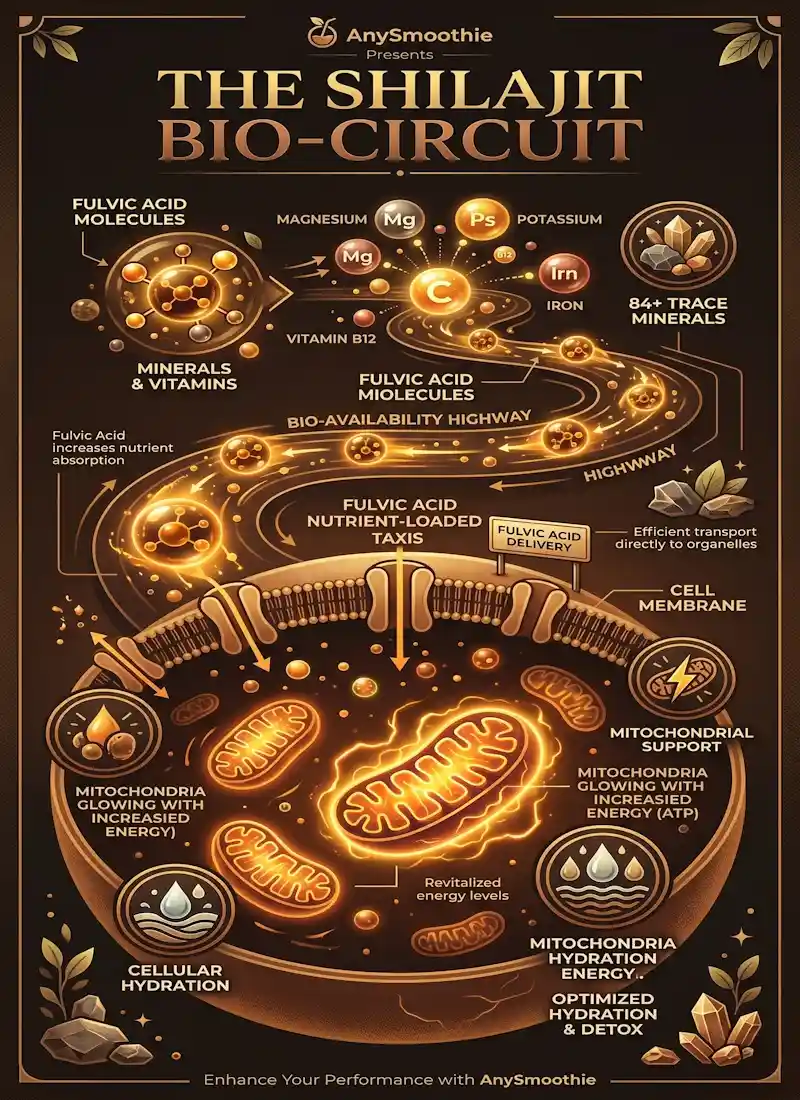
Fulvic acid is the part of shilajit that gets the most attention. In simple terms, it can help bind minerals and carry them in a form the body may use more easily.
That is why people call it a nutrient potentiator. It does not replace a balanced diet, and it does not turn food into magic. It may help support absorption and transport so minerals stay available longer.
If you want a deeper breakdown of fulvic acid as a carrier molecule, this overview on shilajit and fulvic acid explains the idea clearly.
What Makes Shilajit Different from Standard Mineral Supplements
| Mineral Source | Mineral Form | Absorption Mechanism | Trace Mineral Count | Impact on ATP Synthesis |
|---|---|---|---|---|
| Standard multi-mineral salts | Inorganic | Active transport | Limited, formula-based | Indirect support |
| Colloidal minerals | Colloidal | Passive diffusion | Variable | Modest support |
| Shilajit (fulvic complex) | Ionic-organic | Fulvic-mediated entry | Broad trace spectrum | May support ATP-related mineral delivery |
The main takeaway is not that shilajit is a better pill. It’s that the full complex matters. The minerals, fulvic acid, and other compounds work together in a way that plain salts usually do not.
The value is in the whole mineral complex, not a single headline nutrient.
Why Smoothies Are a Smart Way to Take Shilajit
Smoothies make shilajit easier to use because they soften the taste and texture. They also let you build a better nutrient context with fruit, protein, fat, and fiber.
That matters for nutrient partitioning. When you blend shilajit with the right foods, you create a meal that may support how minerals and macronutrients are used together. In other words, the drink becomes part of a routine, not just a supplement shot.
How Blending Can Support Better Mineral Uptake
A smoothie gives shilajit a friendly environment. Fruit adds natural sweetness. Fat can slow digestion a bit. Protein adds balance.
That mix may support how nutrients move through the gut and into circulation. It can also make the drink easier to tolerate day after day, which matters more than perfect timing.
Best Foods to Pair with Shilajit for a Balanced Blend
Bananas help with body and sweetness. Berries add tartness and color. Cacao brings a deep flavor that covers shilajit well.
Yogurt, milk alternatives, nut butter, seeds, and avocado all work too. They improve texture and raise the nutrient density without making the smoothie heavy.
3 Mineral-Rich Shilajit Smoothie Recipes
Biohacking Bioavailability: Why Shilajit Makes Your Other Nutrients Better
Fulvic acid may help keep minerals in a more available form, which is why people talk about bioavailability with shilajit. Some compare that support to liposomal-style transport, but the useful point is easier than the jargon.
The body still needs the basics. That means food, sleep, hydration, and consistent mineral intake. Shilajit fits best when it supports that foundation, not when it tries to replace it.
Mineral Balance, Enzyme Catalysis, and Neural Signaling
Trace minerals help enzymes do their normal work. That matters for energy production, muscle function, and nerve signaling.
Shilajit can fit into that picture by supporting mineral balance and mitochondrial priming, the prep work cells do before making ATP. It is a support tool, not a shortcut.
Heavy Metal Safety: Selecting Purified, Third-Party Tested Resin
This part matters more than flavor. Shilajit must be purified and third-party tested, because raw resin can carry heavy metals or other contaminants.
Look for clear testing on lead, arsenic, cadmium, and mercury. Third-party shilajit safety testing gives you a model for what transparent quality control should look like.
Conclusion
Shilajit smoothies can be a simple way to support mineral intake, fulvic acid delivery, and daily energy routines. They work best when you pair shilajit with whole foods that improve taste, texture, and nutrient balance.
Start small, choose a tested product, and build a smoothie you’ll actually drink often. That consistency matters more than chasing a big claim from a single serving.
⚠️ Safety Notes for Shilajit Smoothies
Heavy Metal Contamination: Raw shilajit can contain high levels of lead, arsenic, and mercury. Never buy “raw” or unrefined resin. Ensure your product is third-party tested and certified for purity to protect your metabolic pathways from toxicity.
Uric Acid and Gout: Shilajit can increase the production of uric acid. If you suffer from gout or kidney stones, consult your physician before use, as it may trigger an inflammatory flare.
Iron Overload (Hemochromatosis): Shilajit is exceptionally rich in iron. If you have hemochromatosis or other iron-storage disorders, avoid shilajit smoothies to prevent oxidative damage to your organs.
Blood Sugar Interaction: Shilajit may lower blood glucose levels. If you are taking insulin or diabetic medications, monitor your blood sugar closely to prevent unexpected hypoglycemia.
Fasting and Potency: Due to its high fulvic acid content, taking shilajit on an empty stomach in a very light smoothie can be too potent for some, causing nausea. Always include a base of protein or fiber to buffer absorption.
FAQ
How does Fulvic Acid act as a “biochemical transporter” in shilajit?
Fulvic acid is a low-molecular-weight humic substance that functions as a natural chelating agent. Biochemically, it binds to inorganic trace minerals and transforms them into organic, bioavailable complexes. This supports the physiological systems of nutrient transport by facilitating the movement of minerals across cellular membranes. Optimizing this transport ensures that the “biochemical mechanics” of mineral delivery are efficient, potentially supporting cellular voltage and metabolic enzymatic activity.
Why is Shilajit considered a support for “Mitochondrial Priming”?
Shilajit contains dibenzo-alpha-pyrones (DBPs) and fulvic acid, which support the physiological systems involved in the electron transport chain. These compounds help maintain the stability of Coenzyme Q10 in its active form (ubiquinol) within the mitochondria. This biochemical synergy optimizes the natural pathways of ATP production, ensuring that cells are “primed” to meet energy demands without increasing excessive oxidative stress during the metabolic process.
How do the ionic minerals in Shilajit support “Enzyme Catalysis”?
Trace minerals found in shilajit, such as magnesium, zinc, and selenium, act as indispensable co-factors for thousands of enzymatic reactions. Biochemically, these ions stabilize enzyme structures and facilitate the catalysis of biochemical reactions, from DNA repair to protein synthesis. Supporting these physiological systems ensures that the natural pathways of cellular turnover and neural signaling remain robust, maintaining systemic metabolic efficiency.
What is the difference between Shilajit and standard inorganic mineral salts?
Standard mineral supplements often use inorganic salts (like carbonates or oxides) which may have lower solubility and rely on active transport mechanisms that can become saturated. Shilajit, conversely, provides minerals in an ionic form complexed with fulvic acid. This supports the physiological systems of passive diffusion and nutrient partitioning, allowing for a broader spectrum of trace minerals to be absorbed more naturally and integrated into the body’s “biochemical mechanics” of repair.
Why is third-party testing for heavy metals a “non-negotiable” for Shilajit purity?
Because shilajit is a resin harvested from geological layers, it can naturally contain heavy metals like lead, arsenic, and mercury. Third-party testing ensures that the physiological systems of detoxification are not burdened by exogenous toxins while attempting to absorb beneficial minerals. Selecting purified, tested resin optimizes the natural pathways of cellular protection, ensuring that the mineral complex supports health without introducing harmful contaminants into the metabolic stream.

Medical Disclaimer: AnySmoothie content is for educational purposes only and is not a substitute for professional medical advice. Consult a healthcare provider for personalized guidance. See our full Disclaimer & Terms of Use. AI Transparency: AnySmoothie may use AI to support content development. All content undergoes human editorial review for accuracy, clarity, and editorial quality. See our full AI Transparency.