
A smoothie can feel healthy and still sit heavy. The difference is often texture, not just ingredients.
An intestinal mechanical load smoothie is built to support gut movement through stretch, hydration, and viscosity. The goal is smoother transit, clearer mechanical signaling, and less gut drag. That means three things matter most: how much bulk the blend creates, how much water it holds, and how well the ingredients work together.
Get those right, and the smoothie behaves more like a tuned system than a thick paste.
Mechano-Transduction: The Physics of Gut Motility
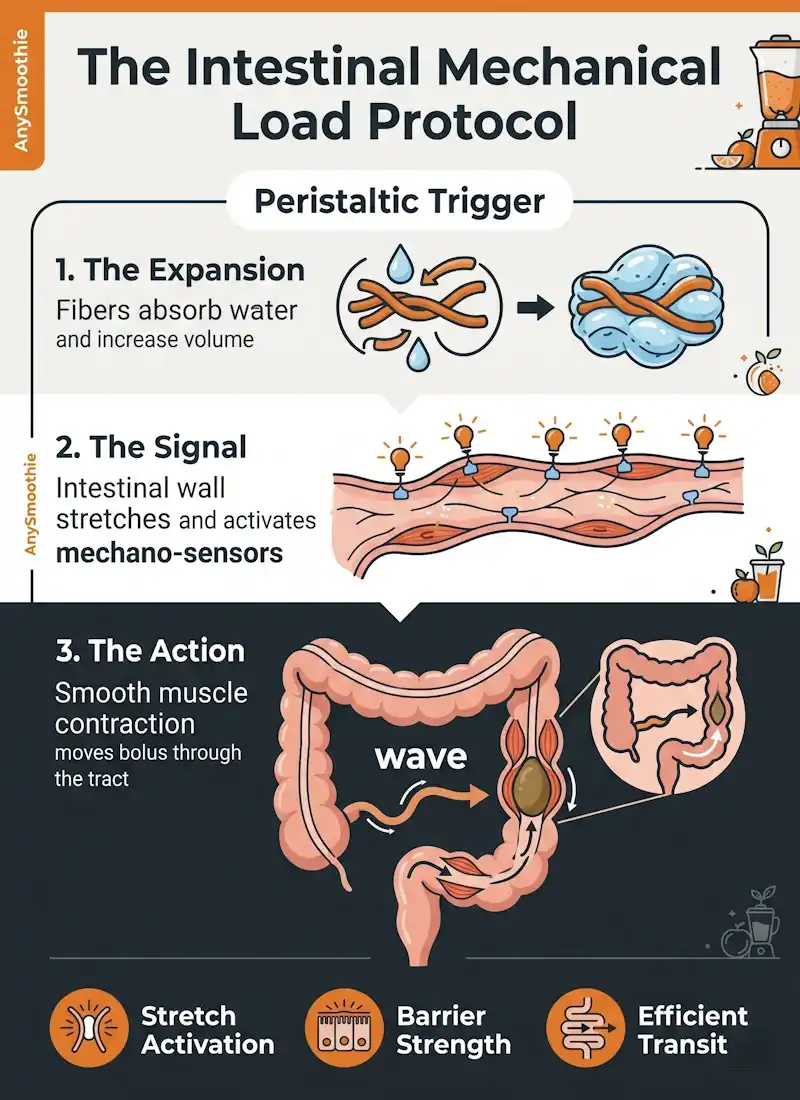
Gut motility is not only about what you eat, it’s also about what the gut feels. The lining of the intestine responds to stretch, pressure, and texture, then passes that information through the enteric nervous system. A good review of the physics of functional fibers explains how viscosity and structure shape that response, which is why fiber form matters as much as fiber amount.
When a smoothie has the right body, it creates a clean mechanical cue. When it’s too dense, the cue gets muddy.
Stretch Receptors: Triggering the Peristaltic Wave
Stretch receptors sit in the gut wall and respond when the lumen expands. That tension helps trigger peristaltic waves, the wave-like contractions that move contents forward. In plain terms, the intestine likes a gentle signal plus enough room to work.
A smoothie with moderate bulk and enough fluid can create that signal without feeling packed. That is the sweet spot for a useful mechanical load.
Why Too Much Thickness Can Work Against Transit
Too much thickness changes the job from movement to struggle. Dry powders, sticky nut butters, and oversized fiber doses can raise friction and slow flow.
Bulk should support movement, not trap it.
That’s the main mistake with thick gut-health smoothies. They can look efficient and still behave like paste.
Bulk Engineering: Balancing Insoluble and Soluble Fiber Ratios
The real issue is balance. A blend needs bulk to signal movement and lubrication to keep that bulk sliding.
| Mechanical load agent | Physiological mechanism | Primary impact on transit | Best smoothie pairing | Hydration ratio |
|---|---|---|---|---|
| Psyllium husk | Tensoreceptor stimulation through water binding and gel expansion | Builds soft bulk and clearer stretch signals | Thin fruit base, berries, cucumber, or citrus | 1 small serving in 12 to 16 oz liquid |
| Celery fiber | Insoluble sweeping fiber with little gel formation | Adds structure and helps move loose material | Watery greens, pear, or cucumber | Keep the blend fairly thin, about 14 to 18 oz liquid |
| Marshmallow root | Mucilage that lowers frictional stress | Improves glide and softens the blend | Banana, oat milk, or soft fruit | Pre-hydrate first, then blend with 8 to 12 oz liquid |
Psyllium gives expansion. Celery fiber adds a more abrasive sweep. Marshmallow root adds slide. A smart smoothie uses them for different jobs, not all at once in high amounts.
For context, psyllium has been studied for stool frequency and consistency in chronic constipation, which matches its role as a bulk-and-gel ingredient psyllium therapy study.
Hydration Kinetics: The Role of Mucilage in Mechanical Glide
Hydration is not just water on the side. It is how the ingredients hold, absorb, and release fluid inside the drink. Mucilage matters because it changes feel. It creates a slicker texture and lowers friction as the blend moves.
Marshmallow root is a good example. Recent work on its mucilage shows strong water-holding and solubility traits marshmallow root mucilage properties. That kind of structure can make a smoothie feel smoother without making it heavy.
The takeaway is simple. More fluid usually means less drag and better glide.
3 Load-Prime Smoothie Recipes
These are format ideas, not fixed formulas. Start small, then adjust texture and tolerance.
Enteric Nervous System: Signal Precision and Transit
The enteric nervous system likes clear inputs. That means the best smoothie is predictable. Start with a smaller serving, keep the recipe stable for a few days, and watch how your body responds.
Blending time matters too. Longer blending softens sharp edges from insoluble fiber. Pre-hydrating gels and seeds keeps the drink from thickening after it hits your stomach.
Common mistakes are easy to spot:
- Too much fiber too fast can make the blend feel dense.
- Too little liquid can turn a good formula into sludge.
- Stacking psyllium, dry seeds, and nut butter at once can overload the mix.
Mitochondrial Priming: Supporting Smooth Muscle Contraction Energy
Smooth muscle still needs fuel to do its work. A moderate fruit base gives the blend a lighter energy profile than a fat-heavy recipe, which can feel slow and sticky.
Keep the base simple. Then change one ingredient at a time so you can see what helps and what weighs the formula down. That’s how you tune signal precision without guessing.
Conclusion
A good intestinal mechanical load smoothie is not just high in fiber. It is built for the right texture, hydration, and glide. The best version gives the gut enough bulk to signal movement and enough lubrication to avoid friction and stasis.
Start with one balanced formula, then adjust the fiber, liquid, and thickness from there. When the blend feels light in the glass, it usually behaves better in the gut.
🛡️ Safety Notes & Contraindications: Intestinal load smoothies
Esophageal Obstruction: bulk-forming agents like psyllium must be consumed with at least 250-350ml of additional liquid; if not sufficiently hydrated, the gel can expand in the esophagus, creating a choking hazard or blockage.
Drug Absorption Interference: the high viscosity of these smoothies can trap medications (especially thyroid hormones, lithium, and diabetes drugs), delaying or reducing their absorption; consume the smoothie at least 2 hours before or after taking any medication.
Fecal Impaction: if you have a history of severe chronic constipation or “lazy bowel,” introducing high mechanical loads too quickly can lead to fecal impaction; start with 1/4 dose and ensure systemic hydration is optimal.
Bowel Obstruction/Strictures: individuals with known intestinal strictures (from Crohn’s or surgery) should avoid high-bulk smoothies, as the increased diameter of the intestinal contents could lead to a physical blockage.
Abdominal Distension: a rapid increase in mechanical load can cause transient bloating and “stretching pain” as the enteric nervous system adapts to the new volume; if pain is sharp or persistent, discontinue use.
FAQ
How does “Mechano-Transduction” influence the rate of intestinal transit?
The gut wall contains specialized sensory neurons that respond to physical stimuli such as stretch and pressure. Biochemically, this process of mechano-transduction converts physical force into electrical signals that trigger the enteric nervous system. Supporting this physiological system through smoothies with optimized bulk ensures the biochemical mechanics of the “peristaltic wave” are activated, facilitating a steady and predictable movement of contents through the lumen.
Why is the “Hydration Ratio” critical for preventing gut drag in fiber-rich smoothies?
Fiber agents like psyllium or flax require a high volume of water to form a functional gel. Biochemically, if the liquid-to-fiber ratio is too low, the mixture becomes a high-friction paste that increases “gut drag.” Supporting this physiological system with a hydration-first approach—using at least 14 to 18 oz of liquid—optimizes the natural pathways of lubrication, ensuring the biochemical mechanics of transit remain fluid rather than stagnant.
What is the role of “Mucilage” in reducing frictional stress during digestion?
Mucilage, found in ingredients like marshmallow root or hydrated chia seeds, is a thick, gluey substance that provides a “slick” coating to the food bolus. Biochemically, mucilage lowers the frictional stress between the intestinal contents and the mucosal lining. Supporting this physiological system optimizes the natural pathways of “mechanical glide,” ensuring the biochemical mechanics of transit are gentle on the gut wall while maintaining structural integrity.
How do “Tensoreceptors” respond to the bulk provided by soluble fiber?
Tensoreceptors are stretch-sensitive receptors located within the smooth muscle layers of the intestine. Biochemically, when soluble fibers like psyllium absorb water and expand, they provide the necessary volume to trigger these receptors. Supporting this physiological system through “bulk engineering” optimizes the natural pathways of luminal expansion, providing the clear mechanical cues required for the gut to recognize and move its contents.
Why is “Sequential Pre-Hydration” necessary for seeds and gel-forming fibers?
Adding dry seeds or powders directly to a blend can cause the smoothie to continue thickening after consumption, potentially leading to dehydration within the gut. Biochemically, pre-hydrating chia or psyllium ensures the fibers have reached their maximum expansion before entering the digestive tract. Supporting this physiological system facilitates the biochemical mechanics of “signal precision,” providing a stable mechanical load that the enteric nervous system can process without sudden changes in viscosity.

Medical Disclaimer: AnySmoothie content is for educational purposes only and is not a substitute for professional medical advice. Consult a healthcare provider for personalized guidance. See our full Disclaimer & Terms of Use. AI Transparency: AnySmoothie may use AI to support content development. All content undergoes human editorial review for accuracy, clarity, and editorial quality. See our full AI Transparency.