

A modified citrus pectin smoothie is a practical way to get a binder into a daily routine. People use it because it mixes easily, tastes better than a plain powder, and can fit into a simple morning habit.
The goal is support, not replacement for medical care. This kind of smoothie is meant to support the body’s natural clearance pathways, digestive comfort, and day-to-day consistency. Ingredient choice matters because it affects binding support, hydration, and how well you can stick with it.
The MCP Advantage: Systemic Binding Beyond the Gut
Modified citrus pectin, or MCP, is not the same as regular pectin from fruit. Standard pectin acts mostly as fiber in the gut. MCP is processed to a lower molecular size, which gives it better physiological reach.
A review of MCP’s effects in circulation explains why this matters for its broader use in the body, including support for detox-related pathways and galectin-3 activity. You can see that discussion in Pleiotropic Effects of Modified Citrus Pectin.
Why Molecular Size Changes Where Pectin Can Work
Size affects transport. Larger molecules tend to stay in the gut, where they can support stool bulk and fiber function. Smaller molecules have a better shot at interacting beyond the digestive tract.
That matters because some support strategies are designed for the gut lumen only, while others are discussed for the extracellular matrix and circulation. MCP gets attention here because its lower molecular weight may let it reach spaces where standard pectin cannot.
How MCP Fits a Smoothie Better Than a Capsule For Some People
A smoothie can make MCP easier to use. The powder blends into fruit, greens, or lemon-based drinks, and that helps mask the texture.
It also fits people who want hydration built into the routine. Instead of swallowing another pill stack, they can pair MCP with nutrient-dense foods and keep the whole process simple.
The best binder routine is the one you can repeat without friction.
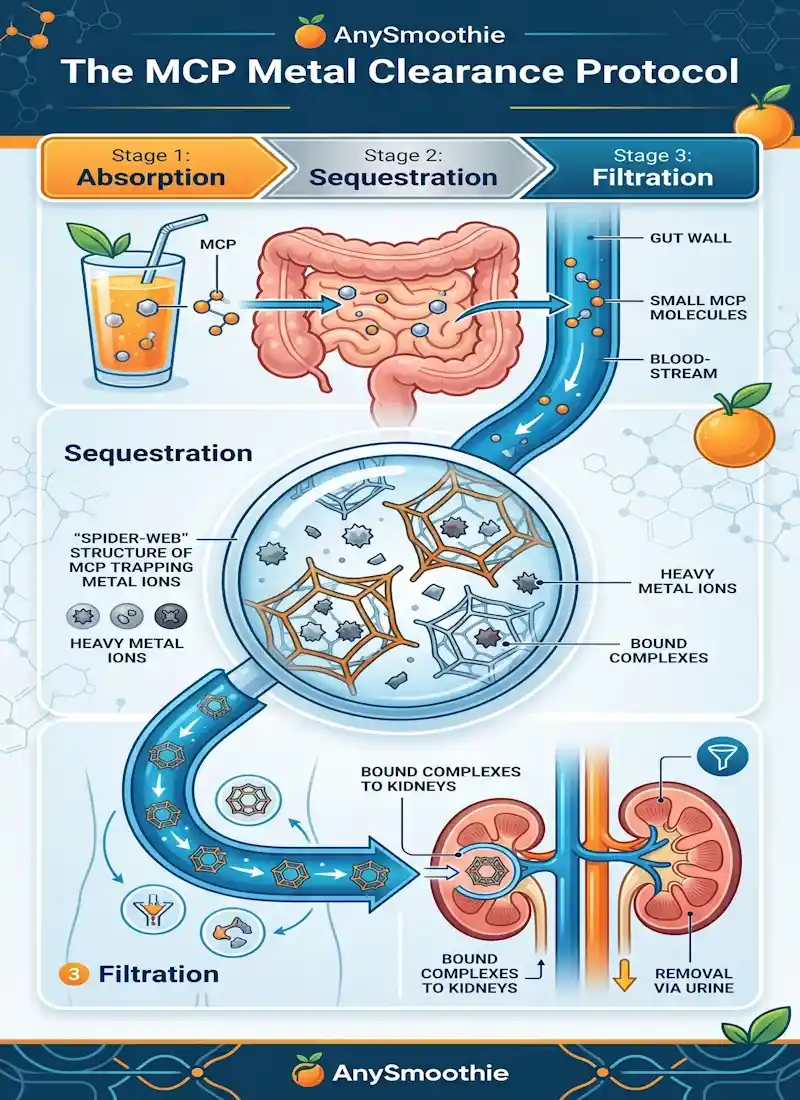
How MCP May Support Metal Clearance In The Body
The idea behind MCP is selective binding. In plain terms, it may help bind certain unwanted substances in the body while being less disruptive to essential minerals than broad-spectrum binders. That is one reason it appears in biohacker and integrative circles.
Human data has looked at urinary excretion of toxic elements after MCP use. One study is available through The effect of modified citrus pectin on urinary excretion of toxic elements. The main takeaway is simple, MCP is discussed as a gentler support tool, not a harsh pull-everything-out approach.
MCP, Zeolite, and ALA: How the 3 Systems Differ
These three options get grouped together, but they do different jobs. MCP is the most interesting when you want systemic reach plus smoothie compatibility.
| Systemic binder | Physiological reach | Primary binding mechanism | Impact on galectin-3 | Best smoothie pairing |
|---|---|---|---|---|
| Modified citrus pectin (MCP) | Extracellular matrix, bloodstream, and some gut support | Chelation-style support with selective affinity | Studied for galectin-3 antagonism | Citrus, berries, greens |
| Zeolite (clinoptilolite) | Mostly gut, with some products marketed for broader use | Adsorption | No known direct effect | Thick green smoothies |
| Alpha-lipoic acid (ALA) | Intracellular support | Redox-active chelation support | No direct galectin-3 focus | Light fruit or water-based blends |
MCP stands out when the goal is systemic support without a heavy feel in the gut.
Why Galectin-3 Comes Up in This Conversation
Galectin-3 is a signaling protein involved in cell interaction and matrix behavior. It gets discussed because it can shape how cells stick, move, and communicate.
MCP is studied for its relationship with healthy galectin-3 activity and cellular integrity. That makes it interesting in routines focused on cleaner internal signaling and tissue-level balance, not just digestive fiber.
Why Selective Binding Matters For Essential Minerals
A solid support plan should avoid unnecessary disruption of minerals like magnesium, calcium, and zinc. Those minerals matter for nerve function, muscle work, and daily energy.
Selective binding is better than broad, non-specific binding when you want support without stripping the body of what it needs. That balance is one reason MCP feels different from more aggressive options.
3 Smoothie Builds That Work Well With Modified Citrus Pectin
These three recipes keep the powder easy to drink and easy to repeat. Each one fits a different use case.
The “Systemic-Shield” MCP, Wild Blueberry, and Cilantro Extract Blend
Ingredients
- 1 tablespoon modified citrus pectin (MCP)
- 1 cup frozen wild blueberries
- 3/4 cup coconut water
- 1 tablespoon fresh lemon juice
- Cilantro extract, according to the product’s labeled serving
- 1/2 cup ice, optional
The berries add flavor and polyphenols, while coconut water keeps the texture light.
Cilantro extract often shows up in metal-focused routines, but it should not be treated as a stand-alone fix. In this blend, it supports the overall stack and makes the drink feel more purposeful.
Estimated Nutrition per Serving
- Calories: ~155 kcal
- Protein: ~2 g
- Carbohydrates: ~38 g
- Fat: ~1 g
- Fiber: ~8 g
- Sugars: ~19 g
A Calming Green Smoothie for Daily Use and Easy Digestion
Ingredients
- 1 cup baby spinach
- 1/2 medium cucumber
- 1/4 avocado
- 1 tablespoon fresh lemon juice
- 1 cup unsweetened almond milk
- 1 tablespoon modified citrus pectin (MCP)
- 1/2-inch piece fresh ginger, optional
This is the most beginner-friendly option. The avocado smooths the texture, the cucumber adds hydration, and the lemon helps the flavor stay clean.
Estimated Nutrition per Serving
- Calories: ~165 kcal
- Protein: ~5 g
- Carbohydrates: ~19 g
- Fat: ~9 g
- Fiber: ~10 g
- Sugars: ~4 g
I’d add the MCP while the blender is already running rather than letting it sit in the liquid first. Pectin can thicken quickly, so this makes it easier to get a smooth texture without small clumps.
A Berry-Citrus Version for People Who Want a Brighter Taste
Ingredients
- 1 cup frozen strawberries or raspberries
- 1 small orange, peeled and segmented
- 3/4 cup cold water
- 1 tablespoon chia seeds
- 1 tablespoon modified citrus pectin (MCP)
- 1/2-inch piece fresh ginger
This version works well if you want more antioxidant support and a sweeter profile. It also helps the powder disappear into a familiar fruit flavor.
Estimated Nutrition per Serving
- Calories: ~200 kcal
- Protein: ~5 g
- Carbohydrates: ~40 g
- Fat: ~4 g
- Fiber: ~15 g
- Sugars: ~16 g
How to Make the Smoothie Easier on Digestion and Better for Everyday Use
Start small with MCP, then adjust based on comfort. A smaller amount mixed with enough liquid is easier to tolerate, especially if you are new to fiber powders.
Hydration matters too. If the smoothie is too thick or too dry, it can feel heavy. Fiber-rich ingredients can help regularity, but too much at once may slow things down.
Hydration, Fiber, and Gentle Starting Amounts
Use enough water, coconut water, or unsweetened milk to keep the blend drinkable. If you add chia, flax, or a lot of greens, keep the MCP dose modest at first.
That makes the routine easier on the stomach and more sustainable over time.
When to Drink it For the Best Routine Fit
Many people like it in the morning, mid-afternoon, or away from large meals. Those windows often feel lighter and more convenient.
Consistency matters more than a perfect clock time. Pick the slot you can keep.
Conclusion
A modified citrus pectin smoothie is a simple way to build binding support into daily life. It can support hydration, digestive ease, and consistency, which is often where good routines succeed or fail.
The best recipe is the one you can repeat. Choose quality ingredients, keep the texture easy, and talk with a qualified professional if you have health concerns or a high metal burden.
⚠️ SAFETY NOTES: Modified Citrus Pectin
DRUG ADSORPTION: Although MCP is highly absorbable, its fiber-like properties can still interfere with the absorption of oral medications, particularly those with a narrow therapeutic window (e.g., Digoxin, Lithium, or Immunosuppressants). Take your MCP smoothie at least 2 hours away from any prescription medication.
GASTROINTESTINAL ADAPTATION: As a soluble fiber, MCP can cause bloating, loose stools, or flatulence in sensitive individuals or those with a compromised gut lining. Start with a 1/4 dose (approx. 1-2 grams) and increase slowly over 10 days to allow your microbiome to adapt.
POTASSIUM/SODIUM CONTENT: Many commercial MCP powders are buffered with sodium or potassium to aid solubility. If you have chronic kidney disease (CKD), congestive heart failure, or are on a sodium-restricted diet, calculate your total daily intake to avoid electrolyte overload.
HYDRATION REQUIREMENTS: MCP draws water into the intestinal lumen and systemic circulation to facilitate excretion. Failure to maintain high hydration levels (at least 2.5L of filtered water/day) can lead to constipation or the re-absorption of mobilized compounds.
CYTOTOXIC THERAPY: If you are undergoing chemotherapy or radiation, consult your oncologist before using MCP. While it supports cellular health, its interaction with specific cancer treatments is still being studied and requires professional oversight.
FAQ
How does the molecular weight of MCP influence its systemic bioavailability?
Standard citrus pectin consists of long-chain polysaccharides that are too large to bypass the intestinal barriera. Modified Citrus Pectin (MCP) undergoes a proprietary enzymatic process that reduces its molecular weight and de-esterifies its structure. Biochemically, this smaller size supports the physiological systems of absorption, allowing the molecules to enter the systemic circulation. This optimization ensures that the “biochemical mechanics” of binding can occur within the bloodstream and extracellular matrix, rather than being confined to the gut lumen.
What is the significance of Galectin-3 antagonism in cellular signaling?
Galectin-3 is a carbohydrate-binding protein involved in cellular adhesion and systemic signaling pathways. Excess levels are often associated with disrupted tissue repair and inflammatory signaling. MCP acts as a competitive antagonist by binding to the carbohydrate-recognition domain of Galectin-3. Supporting this physiological system optimizes the natural pathways of cellular communication, maintaining the structural integrity of the extracellular matrix and supporting a balanced metabolic environment.
Why is “Selective Binding” preferable for maintaining mineral homeostasis?
Unlike broad-spectrum adsorbents like activated charcoal, MCP exhibits a selective affinity for specific unwanted metabolites and toxic elements while showing minimal interaction with essential minerals like magnesium and zinc. This biochemical selectivity supports the physiological systems involved in mineral partitioning. By optimizing these natural pathways, the body can support clearance processes without disrupting the structural integrity of enzymatic co-factors necessary for daily energy production.
How does MCP synergy with Cilantro extract support metabolic clearance?
Cilantro extract is often discussed for its potential to mobilize certain circulating elements, while MCP provides the necessary binding capacity to sequester them within the gut or circulation. This biochemical synergy supports the physiological systems of Phase III elimination. By optimizing the natural pathways of transport and exit, this combination ensures that mobilized substrates are effectively moved toward elimination routes, preventing their re-incorporation into sensitive tissues.
In what way does MCP support the structural integrity of the “Metabolic Firewall”?
The liver and gut lining form a “metabolic firewall” that filters unwanted compounds from entering the systemic circulation. MCP supports the physiological systems of this barrier by providing a soluble fiber matrix that facilitates the transit of packaged waste. Biochemically, by reducing the systemic load of Galectin-3 and supporting biliary clearance, MCP optimizes the natural pathways of detoxification, ensuring that the body’s internal repair mechanisms can function without excessive metabolic burden.

Medical Disclaimer: AnySmoothie content is for educational purposes only and is not a substitute for professional medical advice. Consult a healthcare provider for personalized guidance. See our full Disclaimer & Terms of Use. AI Transparency: AnySmoothie may use AI to support content development. All content undergoes human editorial review for accuracy, clarity, and editorial quality. See our full AI Transparency.