
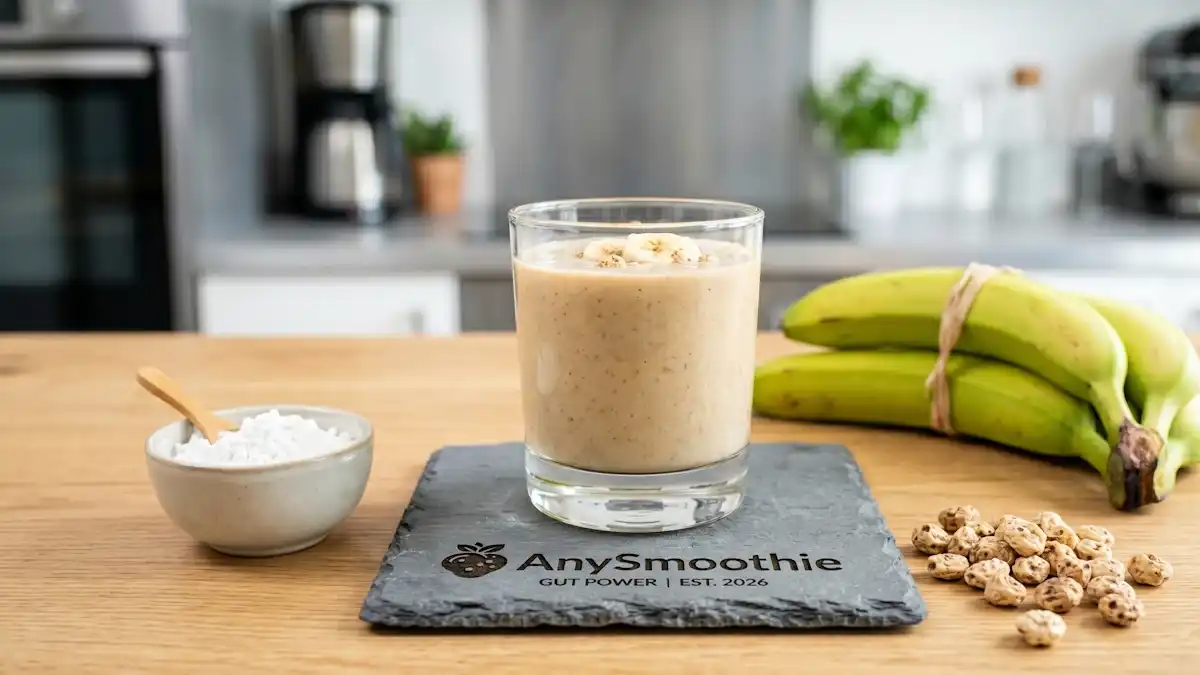
Butyrate is a short-chain fatty acid your colon cells use as fuel, and resistant starch helps your gut make more of it. In smoothie form, that matters because the right blend can support microbial fermentation without turning breakfast into a bloated mess.
The best butyrate boosting smoothies are built for slow release, steady SCFA production, and good tolerance. This is about practical food design, not medical treatment. If the recipe is right, you get a smoother path to colonocyte fuel and better digestion along the way.
Colonic Fermentation: How Resistant Starch Helps Your Gut Make More Butyrate
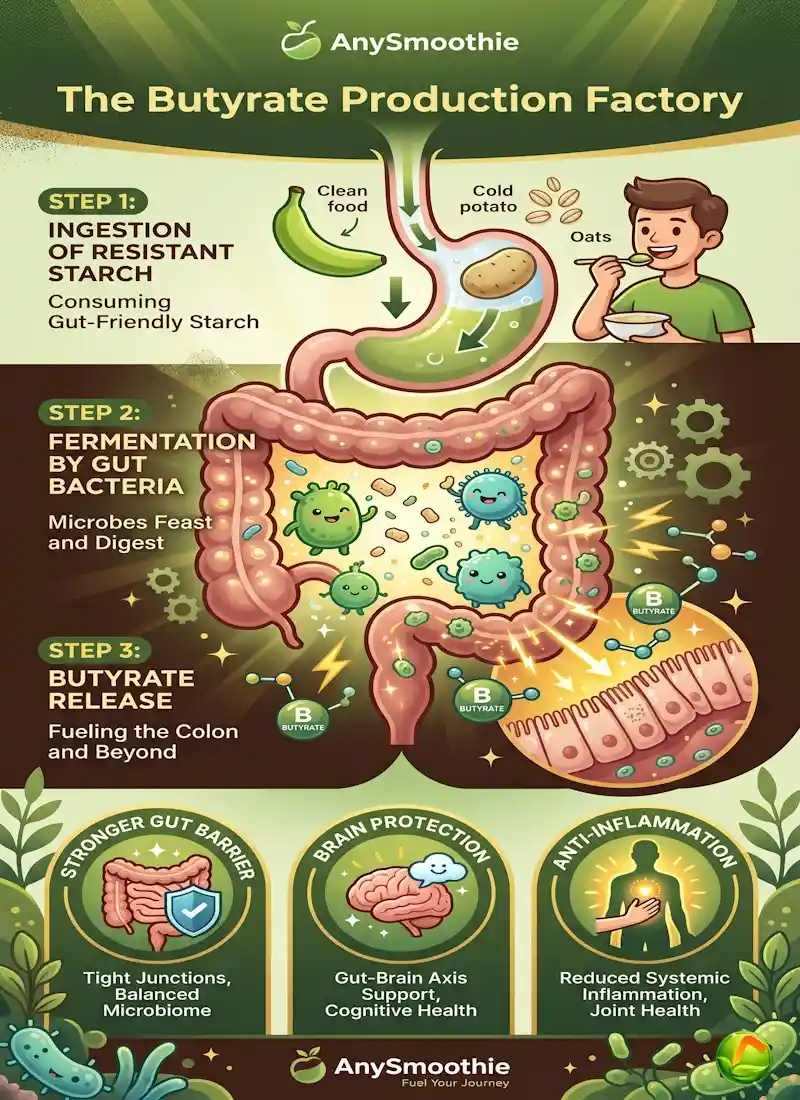
Resistant starch slips past much of the upper GI hydrolysis, so it reaches the colon intact. There, gut microbes break it down and produce acetate, propionate, and butyrate. For a clear overview of the microbiology, see the microbiology of butyrate formation.
Acetate to Butyrate Conversion in the Colon
Once resistant starch reaches the large intestine, it becomes slow fuel for the microbial community. Some bacteria ferment it directly, while others cross-feed on the first round of acids and turn acetate into more butyrate. That chain matters because a steadier SCFA intestinal influx is easier on the gut than a fast gas spike.
The pace also matters. Controlled fermentation usually means less luminal gas distension, better tolerance, and more predictable metabolic efficiency. Green banana flour tends to fit that pattern best because it ferments more slowly than faster prebiotic fibers.
Why Butyrate Supports Colonocyte Beta-Oxidation and Epithelial Health
Butyrate is a preferred energy source for colonocytes. When those cells oxidize it, they support their own mitochondria and help maintain epithelial tightness. That keeps the colon lining in a better state for normal barrier function.
Butyrate also fits the gut environment well because it supports anaerobic balance. In simple terms, the right fuel helps the cells at the wall stay strong while the deeper colon stays friendly to microbes that like low oxygen.
The Best Resistance Starch Ingredients for Smoothie Making
The substrate changes the outcome. Some fibers ferment slowly and feel calm. Others move fast and can trigger gas sooner, especially at larger doses.
| Substrate | Physiological mechanism | Fermentation kinematics | Best smoothie pairing | Primary target bacterial strain |
|---|---|---|---|---|
| Green banana flour or matrix (RS2) | Resists alpha-amylase digestion, then ferments in the cecum | Slow, controlled gas release | Almond milk, cacao, chia, cinnamon | Ruminococcus bromii |
| Uncooked rolled oats (beta-glucans + RS3) | Forms a viscous mesh that slows transit and feeds soluble fiber pathways | Moderate, steadier gas release | Berries, yogurt, flax, vanilla | Bifidobacterium spp. |
| Inulin (fructans) | Rapidly fermentable substrate for bifidobacteria | Fast gas release, more bloating risk | Small-dose fruit smoothie, kefir, citrus | Bifidobacterium adolescentis |
Green banana RS2 gives the most controlled fermentation rate, so it usually carries less risk of gas distension. Inulin can work well, but it asks more from your gut.
Slow fermentation usually beats a big prebiotic hit. Tolerance decides whether a smoothie helps or backfires.
Green banana flour, the most controlled RS2 option
Green banana flour is a strong choice because its starch resists alpha-amylase in the upper gut. That leaves more substrate for cecal fermentation later on. The flavor is mild, too, so it disappears into cocoa, cinnamon, or berries without much effort.
For a low-bloat strategy, this is the cleanest starting point. You get resistant starch without a loud taste or a sharp fiber feel. That makes it easier to use often.
Uncooked rolled oats and inulin, when and why they work
Oats bring a different profile. Their beta-glucans add thickness and slow transit, so the smoothie feels more grounded. They also ferment in a steadier way than inulin for many people.
Inulin is faster. It can be useful if you already handle fermentable fibers well, but it can feel abrupt in larger amounts. A human volunteer study on type 3 resistant starch found a shift toward butyrate-producing bacteria, which supports the idea that some grain-based fibers can fit a broader gut plan: type 3 resistant starch study.
How to Build a Butyrate-Boosting Smoothie That Actually Feels Good
Ingredient choice matters, but structure matters more. A good smoothie needs enough liquid, a little fat, some protein if you want satiety, and a resistant starch dose that your gut can handle.
How to adjust thickness, sweetness, and portion size
Start smaller than you think you need. One teaspoon of green banana flour can be enough for the first round if your gut is sensitive. Then move up slowly over several days.
Use enough liquid so the smoothie pours, rather than sits like paste. For flavor, berries, cinnamon, and cacao are gentle choices. Sweet fruit can help, but heavy sweeteners can make the mix feel less balanced.
Gradual dosing matters because your microbiome adapts. A slow step-up often reduces bloating and gives you a better read on what your gut actually likes.
Biohacking Epithelial Tightness: Sparing Oxygen for Anaerobic Eubiosis
A long-term rat trial found that resistant potato starch increased butyrate across the caecocolonic tract over time: resistant potato starch trial. The takeaway is simple, steady resistant starch can shift the fuel supply in the colon.
Mitochondrial Priming: Beta-Oxidation of Butyrate as the Primary Colonocyte Energy Drive
Colonocytes burn butyrate through beta-oxidation, which keeps their mitochondria well fed. That process helps spare oxygen at the mucosal surface, and that matters because lower oxygen supports anaerobic eubiosis.
This is one reason butyrate boosting smoothies work best when they are slow and measured. The goal is not a huge fiber blast. The goal is a repeatable dose that supports the colon environment without making the gut push back.
Conclusion
The best butyrate boosting smoothies are built for slow fermentation, steady SCFA production, and good tolerance. Green banana flour usually gives the cleanest RS2 start, while oats and inulin fill different jobs depending on how your gut handles fiber.
Start simple. Test one resistant starch at a time. Then keep the ingredient that fits your response best, because the right smoothie is the one you can drink again tomorrow.
🛡️ Safety Notes & Contraindications
🛡️ Don’t Chug Your Smoothie: Gulping a thick drink too fast shocks your stomach. It forces your body to divert all its blood flow to digestion, making you feel sluggish and heavy. Sip it slowly over 10 to 15 minutes.
🛡️ Watch the Caffeine Timing: Ingredients like matcha, green tea powder, or raw cacao are great, but they contain stimulants. If you are stressed or sensitive to caffeine, avoid them in the afternoon so they don’t mess with your sleep or give you late-night anxiety.
🛡️ Ease into Prebiotics & Fibers: Piling on huge scoops of green banana flour, raw oats, or chia seeds too quickly will turn your stomach into a gas factory. Start with just half a teaspoon and build up slowly over a few days so your gut microbes can adjust without bloating.
🛡️ Protect Your Kidneys (The Spinach Trick): Leafy greens like raw spinach and chard are high in oxalates, which can cause kidney stones if you eat them every single day. Always pair them with a source of calcium (like Greek yogurt, kefir, or calcium-fortified plant milk) to neutralize the oxalates before they enter your system.
FAQ
How does the structural classification of resistant starch dictate its intestinal transit velocity?
Not all starches are metabolized equally by human enzymes. Biochemically, type 2 resistant starch (RS2, found in green banana flour) possesses a tightly packed, crystalline granule architecture that resists upper gastrointestinal breakdown by alpha-amylase. Supporting this physiological system allows the starch molecule to arrive completely intact within the cecum, providing a slow-release prebiotic matrix that undergoes steady microbial cleavage rather than the rapid, explosive fermentation seen with simple sugars or short-chain fructans.
Why is the conversion of acetate to butyrate considered a multi-step microbial cross-feeding chain?
The production of butyrate in the colon is rarely a single-step bacterial event; it relies on a cooperative metabolic network known as cross-feeding. Biochemically, primary degraders like Ruminococcus bromii break down raw resistant starch granules, releasing simple sugars and acetate into the surrounding matrix. Supporting this physiological system allows specialized butyrate-producing bacteria (such as Faecalibacterium prausnitzii and Eubacterium rectale) to capture that free acetate and use the butyryl-CoA:acetate CoA-transferase pathway to convert it into butyrate, ensuring a balanced, steady short-chain fatty acid influx.
How does butyrate fuel colonocyte beta-oxidation to reinforce epithelial tight junctions?
The cells that line the colon wall have a highly unique metabolic preference, choosing localized short-chain fatty acids over circulating blood glucose. Biochemically, colonocytes pull butyrate from the intestinal cavity and transport it across their membranes via MCT1 (Monocarboxylate Transporter 1) channels straight into the mitochondria, where it undergoes intensive beta-oxidation to generate the bulk of the cell’s ATP. Supporting this physiological system supplies the high-velocity cellular energy required to continuously synthesize and repair paracellular tight junction proteins like claudin and occludin.
Why does a slow fermentation rate protect the gut wall from painful luminal gas distension?
When highly soluble, short-chain prebiotic fibers like inulin enter a sensitive microbial environment, resident bacteria ferment the loose structures rapidly, causing a sharp, sudden release of hydrogen and methane gases. Biochemically, this rapid gas accumulation creates a high osmotic pressure that draws water into the bowel, stretching the intestinal walls and triggering visceral pain pathways. Supporting this physiological system with slow-fermenting substrates (like green banana flour or uncooked rolled oats) spreads out the gas production over a much longer timeline, allowing the body to absorb and clear byproducts smoothly without painful stretching.
How does the beta-oxidation of butyrate maintain the anaerobic environment required for healthy microbes?
The beneficial bacterial strains that protect the human gut are obligate anaerobes, meaning they require an environment completely devoid of oxygen to survive and multiply. Biochemically, when colonocytes actively burn butyrate via mitochondrial beta-oxidation, they consume large amounts of local oxygen, creating a state of mucosal hypoxia at the cell surface. Supporting this physiological system keeps oxygen from leaking out into the deeper areas of the intestinal cavity, shielding the delicate, oxygen-sensitive microbial communities that keep the gut balanced and resilient against unwanted pathogens.

Medical Disclaimer: AnySmoothie content is for educational purposes only and is not a substitute for professional medical advice. Consult a healthcare provider for personalized guidance. See our full Disclaimer & Terms of Use. AI Transparency: AnySmoothie may use AI to support content development. All content undergoes human editorial review for accuracy, clarity, and editorial quality. See our full AI Transparency.