

The same smoothie can do very different jobs depending on when you drink it. In the morning, it may support clean energy. Around training, it can push more nutrients toward muscle and recovery.
That shift is the core of smoothie timing for optimal nutrient partitioning. Nutrient partitioning is about where calories and nutrients are most likely to go, energy, muscle repair, or storage. Timing, activity, and sleep all change that split, so the same banana and protein blend can behave differently at 7 a.m. than at 9 p.m.
The chrono-metabolic window: aligning smoothies with your body clock
Your body does not handle every hour the same way. Insulin sensitivity, cortisol, and activity level all move across the day, so the best smoothie timing changes with them.
Early in the day, many people are more insulin sensitive. That means carbs can be used well for fuel. Later in the day, especially after a long stretch of sitting, the same carb load may not feel as useful.
Training changes the picture again. Muscles become more ready to pull in glucose and amino acids. That is why nutrient timing around exercise still matters for people who want better recovery and cleaner fuel use. For a practical overview of that idea, Precision Nutrition’s nutrient timing guide gives a useful framework.
The best smoothie is often the one that matches the next demand on your body, not the one with the most ingredients.
Morning metabolism, insulin sensitivity, and why the first shake of the day matters
After an overnight fast, a morning smoothie can act like a gentle refeed. If you add fruit, oats, and protein, you can support alertness and energy without a heavy meal.
That said, morning is not a free pass for huge sugar loads. A balanced shake works better than a dessert-style blend. Protein helps steady the rise in blood sugar. Fiber slows the pace. A small amount of fat can smooth the ride.
Some people do well with a lighter morning smoothie that still tastes good. Others want more carbs because they train early or have a busy morning. The point is simple, morning often gives you enough metabolic room to use carbs well, especially if you are moving soon after.
Why the peri-workout window is the highest-efficiency time for carb partitioning
The highest-efficiency window for carbohydrate partitioning is usually around exercise. During and after training, muscles are primed to take up glucose and amino acids. That makes a smoothie in this window especially useful for glycogen refill and tissue repair.
This is where a smoothie can act like fast delivery fuel. The body is already asking for resources, so nutrients have a clear destination. That is why peri-workout smoothies often outperform the same blend taken at random times.
A review in the National Library of Medicine’s discussion of nutrient timing supports the idea that exercise windows change how nutrients are used. You do not need perfect timing every day. Still, if your goal is better muscle recovery, this is the window that deserves the most attention.
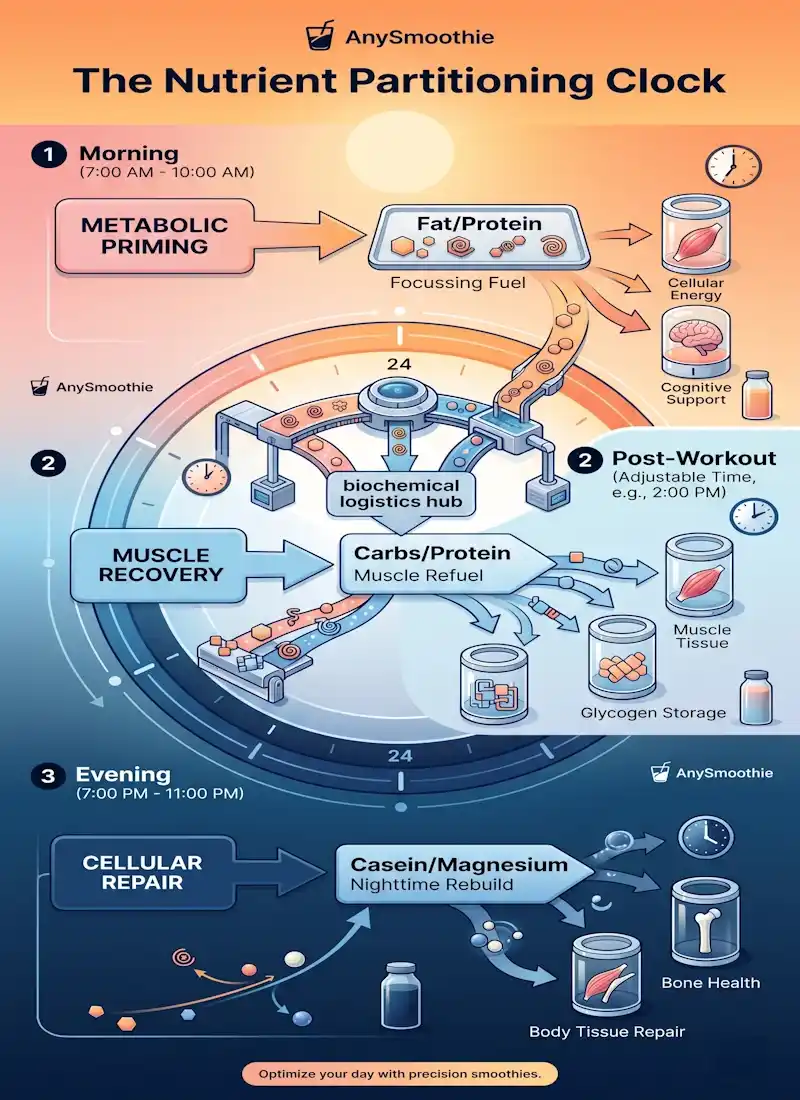
Pre-workout, post-workout, and overnight: when each smoothie type works best
| Timing window | Primary goal | Ideal macronutrient ratio | Dominant hormone | Best smoothie base |
|---|---|---|---|---|
| Fasted morning window | Fat oxidation, steady energy | Higher protein, moderate fiber, lower carb | Cortisol | Protein, greens, berries, MCT oil |
| Peri-workout window | Glycogen loading, muscle repair, highest efficiency for carb partitioning | Protein plus higher carbs, lower fat | Insulin | Banana, oats, whey or other protein, milk or yogurt |
| Pre-sleep window | Tissue repair, overnight support | Slow protein, low sugar, modest fat | Growth hormone | Casein, Greek yogurt, almond milk, chia |
The fasted morning window works best when you want light fuel. The peri-workout window is the best fit for fast recovery and better carb use. The pre-sleep window is about repair, not a big energy hit.
A 2025 review in the European Journal of Clinical Nutrition also notes that smoothies can have a different glycemic response depending on ingredients and structure. That is why the base matters as much as the clock.
Fasted morning smoothies for fat oxidation and clean energy
Use a lighter smoothie when you want steady energy without a big insulin rise. Protein, greens, berries, and a little MCT oil can work well here.
This kind of blend keeps digestion easier and energy more even. It fits people who train later, fast in the morning, or just want a clean start. Add oats or banana only if you need more fuel.
Post-workout smoothies for glycogen refill and muscle repair
After lifting, intervals, or long cardio, your smoothie should be simple. Pair protein with easy carbs. Banana, honey, oats, milk, or yogurt all work.
This is the best time to restore glycogen and support muscle protein synthesis. A smoothie here is not about restraint. It is about putting the right fuel in the right place.
Pre-sleep smoothies that support overnight repair without heavy digestion
Night smoothies should stay light. Use slower-digesting protein, low sugar, and easy-to-digest liquids. Greek yogurt, casein, or a protein blend works well.
The goal is to support overnight repair without a big energy spike before bed.
How to build a smoothie that matches your goal
Start with the timing, then choose ingredients. That order matters.
Protein sets the repair signal. Carbs shift more fuel toward training and recovery. Fats slow absorption and help a smoothie last longer. Fiber does the same, while also softening blood sugar swings. Liquid choice changes speed too, since milk, yogurt, and plant milks all behave a little differently.
Match carbs to your activity level, not just your cravings
Carbs are most useful when muscles can use them. That means around training, after training, or during a very active morning.
If you are sedentary, keep carbs lower and let protein and fiber do more of the work. If you are heading into a workout, or you just finished one, fruit, oats, honey, and yogurt make more sense.
Use fats and fiber to slow digestion when you want steadier release
Avocado, nut butter, chia, flax, and MCT oil all change the pace of a smoothie. Some slow absorption more than others, while MCT oil tends to feel lighter and faster.
That slower release can help with satiety and steady energy. It also gives you more control when you do not want a sharp blood sugar rise. Seed-rich smoothies can be a smart move here, especially earlier in the day.
3 time-optimized smoothie recipes for nutrient partitioning
Conclusion
Timing changes what a smoothie does. The ingredients matter, but the clock changes the outcome. Use lighter blends in the morning when you want clean fuel. Put your most carb-friendly smoothie around training, where nutrient partitioning is strongest. Keep night smoothies simple, slow, and recovery-focused. Match the next smoothie to the next 24-hour goal, energy, training, or repair, and the same blender becomes a much smarter tool.
⚠️ SAFETY NOTES & CONTRAINDICATIONS
GLYCEMIC SPIKES & SLEEP: Consuming high-glycemic fruit or sweeteners (honey, dates) late at night can inhibit melatonin and GH production, disrupting sleep quality and promoting morning insulin resistance.
DIGESTIVE LOAD & TRAINING: Drinking a nutrient-dense, high-fiber, or high-fat smoothie too close to intense exercise can lead to gastrointestinal distress as blood is diverted away from the muscles and toward the digestive tract.
CORTISOL & STIMULANTS: If adding coffee or green tea to your morning “Dawn-Bridge” smoothie, ensure proper hydration first. Excessive stimulants on an empty stomach can exacerbate the cortisol response, leading to jitteriness and blood sugar instability.
MEDICATION TIMING: Ingredients high in fiber or calcium (like Greek yogurt) can drastically interfere with the absorption of thyroid medications (Levothyroxine) or certain antibiotics. Always space these smoothies at least 2–4 hours away from medication intake.
GERD & PRE-SLEEP: For those with Gastroesophageal Reflux Disease (GERD), avoid consuming any liquid meal within 90–120 minutes of lying down, especially if it contains acidic or high-fat ingredients.
FAQ
What is Nutrient Partitioning and why does timing matter
Nutrient partitioning is the physiological process of determining where nutrients go after consumption—either toward energy production and tissue repair or toward storage. Timing is critical because your body’s hormonal environment, specifically insulin sensitivity, fluctuates throughout the day. By aligning your smoothie consumption with these natural rhythms, you support the body’s ability to partition fuel toward the brain and muscles when they need it most.
How does a morning smoothie support fat oxidation
In the morning, cortisol levels are naturally higher, which supports the mobilization of stored energy. Consuming a protein and lipid-based smoothie (avoiding high sugars) during this window supports the body’s natural pathways for fat oxidation. This biochemical environment encourages the body to use fatty acids for fuel, supporting mitochondrial priming and mental clarity without triggering an early insulin spike that could blunt fat-burning signaling.
Why is the post-workout window best for carbohydrate partitioning
After intense exercise, your muscle cells translocate GLUT4 transporters to the surface, making them highly receptive to glucose even without high insulin levels. This is the optimal time for a smoothie containing high-quality carbohydrates. This timing ensures that the sugars are partitioned directly into the muscle as glycogen rather than being stored in adipose tissue, supporting rapid recovery and structural integrity.
Can timing my smoothie improve my sleep quality
Yes. Consuming a smoothie rich in slow-digesting proteins (like casein) and minerals like magnesium in the evening window supports the physiological systems involved in nocturnal repair. This timing provides a steady stream of amino acids throughout the night, supporting the natural pathways of growth hormone secretion and tissue regeneration, while avoiding the digestive stress of a heavy solid meal.
Does “Smoothie Timing” apply to fiber intake
Absolutely. To optimize nutrient partitioning, high-fiber smoothies are best consumed during periods of lower activity or several hours away from intense exercise. Fiber slows down gastric emptying, which is excellent for prolonged satiety and glycemic stability during the work day, but might interfere with the rapid nutrient delivery required immediately after a workout. Balancing fiber timing ensures your digestive system supports your metabolic goals.

Medical Disclaimer: AnySmoothie content is for educational purposes only and is not a substitute for professional medical advice. Consult a healthcare provider for personalized guidance. See our full Disclaimer & Terms of Use. AI Transparency: AnySmoothie may use AI to support content development. All content undergoes human editorial review for accuracy, clarity, and editorial quality. See our full AI Transparency.