
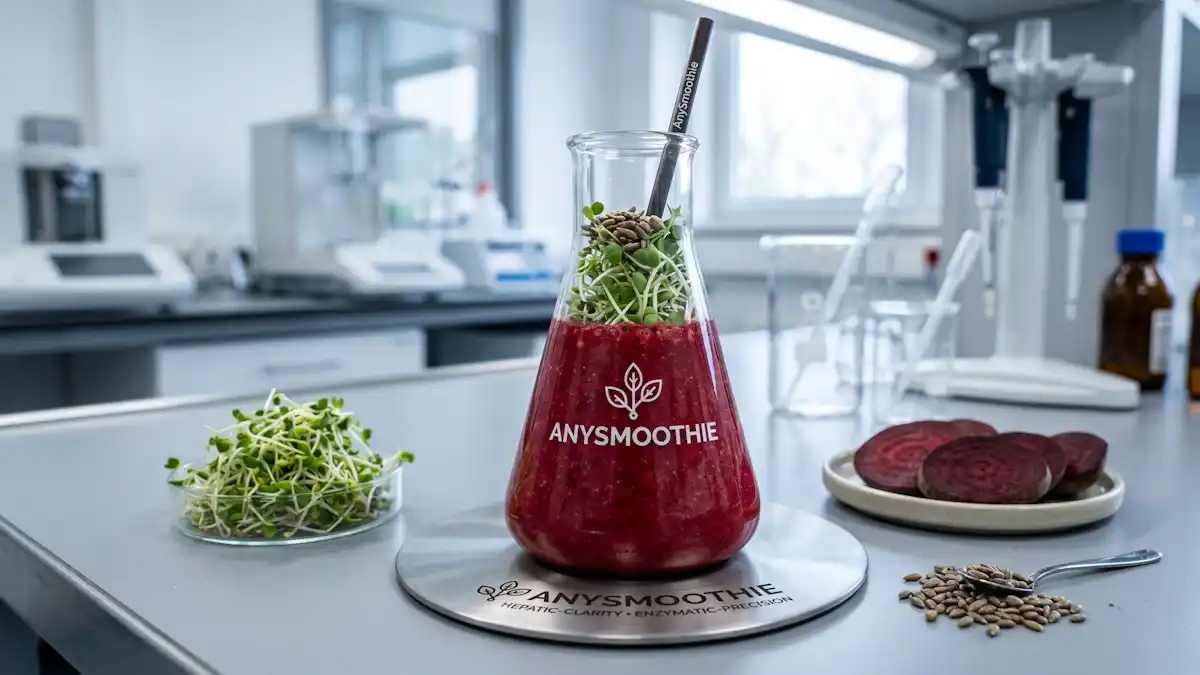
Morning smoothie protocols for hepatic Phase II support work best when breakfast does more than fill a gap. After an overnight fast, the liver shifts into daytime fuel handling, and its conjugation pathways need amino acids, sulfur compounds, and plant signals.
A smart smoothie can support natural clearance systems without turning into a sugar bomb. It can also sit easier on digestion, deliver nutrients fast, and give the day a cleaner metabolic start.
Beyond Filtration: The Enzymatic Engine of Phase II Conjugation
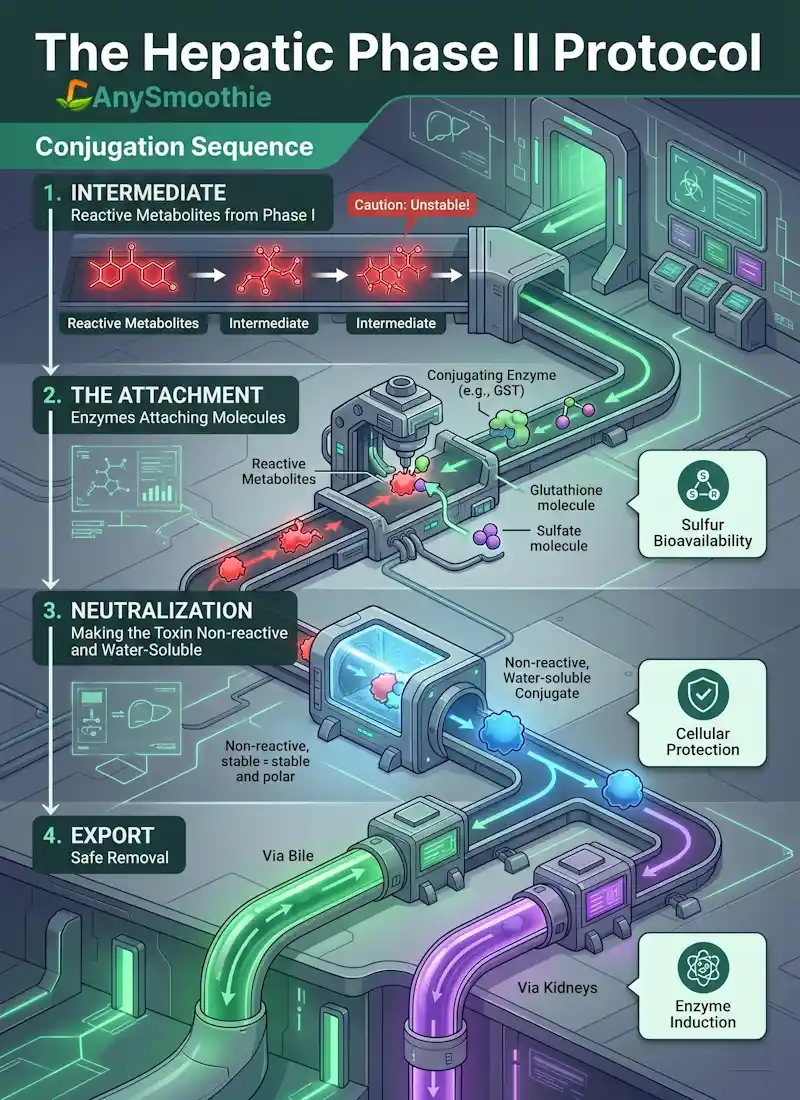
Phase II conjugation is the liver’s tagging system. It takes compounds that are already processed, or newly formed during metabolism, and adds a water-friendly handle so the body can move them out. The main routes that matter for smoothie planning are glutathione conjugation, sulfation, glucuronidation, and methylation.
Glutathione S-Transferase (GST): The Master Neutralizer
GST enzymes attach glutathione to reactive compounds. That makes them easier to manage and clear. Supporting glutathione availability helps the liver handle oxidative load and metabolic byproducts without asking one pathway to do all the work. For a quick scientific reference, see here.
Why conjugation needs raw materials, not just a healthy liver
A healthy liver still needs amino acids, sulfur compounds, methyl donors, and plant cues. A smoothie works best when it gives building blocks and enzyme support at the same time. Fruit alone can raise sugar without giving Phase II much to work with. For a plain-language look at liver function, see here.
The Ingredients That Make a Morning Smoothie Protocol Work
Think in categories, not miracle foods. Crucifers, beets, berries, protein, seeds, and a few functional extras give you more control than any single ingredient.
Sulforaphane, betaine, and calcium D-glucarate each do a different job
| Co-factor | Physiological mechanism | Primary detox pathway | Best smoothie pairing | Target metabolite |
|---|---|---|---|---|
| Sulforaphane | Biochemical signal that helps upregulate GST enzymes through Nrf2 and prepares the liver for upcoming metabolic loads | Phase II enzyme induction | Broccoli sprouts, lemon, greens | Reactive intermediates |
| Trimethylglycine (betaine) | Provides methyl groups for transfer reactions | Methylation | Beet, spinach, protein | Methylated compounds |
| Calcium D-glucarate | Helps balance beta-glucuronidase activity | Glucuronidation | Berries, flax, kefir | Glucuronidated metabolites |
The best smoothie gives the liver a signal, raw materials, and enough energy to use both.
Protein, fiber, and fat help the liver use the blend well
A smoothie built on only fruit can hit fast and fade fast. Protein supplies amino acids, fiber supports bowel transit and steadier glucose release, and fat helps absorption while smoothing the energy curve. That mix is what keeps a morning protocol practical.
How to Build a Sunrise Smoothie That Supports Sulfur and Methylation Flow
Start with a sulfur source, then add greens, then layer in methyl donors and protein. Broccoli sprouts, arugula, watercress, cilantro, and lemon all fit this pattern.
Sulfur donor logistics: what the body needs for sulfation
Sulfation depends on sulfur availability and overall nutrient status. Broccoli sprouts are the loudest signal, but they work best with enough protein, choline, and B vitamins. Eggs on the side can fit the same breakfast if you want more sulfur without crowding the blender.
Methylation cross-talk with COMT and DNA methyltransferases
Methyl donors feed more than one system. COMT uses methyl groups in neurotransmitter metabolism, and DNA methyltransferases use them in gene regulation. Betaine, folate-rich greens, and B vitamins help keep that flux moving, so the system stays balanced instead of strained.
3 Practical Hepatic-Prime Smoothie Recipes to Rotate Through the Week
A rotating protocol works better than a rigid formula. Use one blend for sulfur signaling, one for daily balance, and one for a lighter mineral reset.
Circadian Rhythm and Liver Flux
Circadian rhythm changes liver output, insulin sensitivity, and the push for morning fuel. After the overnight fast, the body is moving from storage mode to work mode. A smoothie fits that shift when it gives quick nutrients without a sugar flood.
Mitochondrial priming helps meet the energy cost of conjugation
Phase II activity uses energy, so the liver needs ATP as much as it needs substrates. Protein, minerals, and steady blood sugar help mitochondria keep pace. That is why breakfast timing matters as much as ingredient choice.
When to keep the smoothie light, and when to make it more robust
If you are not hungry, keep it smaller and more mineral-rich. If you train early or you broke a long fast, make it thicker with protein, fiber, and fat. Match the blend to the morning’s demand, and the routine stays sustainable.
Conclusion
The best morning smoothie protocol for Phase II support is simple, give the liver a signal, give it raw materials, and give it enough energy to use both. Start with one recipe, watch digestion and energy, then rotate based on appetite and activity.
A sulfur-forward blend, a berry-and-greens option, and a lighter mineral version cover most mornings. Consistency matters more than complexity, because the liver responds best to repeatable support.
🛡️ Safety Notes & Contraindications: Hepatic Phase II Smoothies
Thyroid Interaction (Goitrogens): Raw cruciferous vegetables in high doses can interfere with iodine uptake. If you have hypothyroidism, lightly steam your broccoli sprouts or greens to reduce goitrogenic activity while preserving enzyme precursors.
Biliary Obstruction: Ingredients that stimulate liver and bile flow (like beet or milk thistle) should be avoided by individuals with active gallstones or bile duct obstructions, as they may trigger biliary colic.
Medication Clearance (Phase I/II Competition): These smoothies strongly induce liver enzymes. If you are taking narrow-therapeutic-index medications (e.g., Warfarin, antiepileptics, or chemotherapy), consult your oncologist or hepatologist, as the increased clearance rate may lower medication efficacy.
Glutathione “Sulfur” Sensitivity: Some individuals have genetic variants (like CBS) that make them sensitive to high sulfur loads, leading to gas, brain fog, or skin irritation. Start with minimal doses of broccoli sprouts.
Oxalate Concerns: Spinach and beets are high in oxalates. If you have a history of calcium-oxalate kidney stones, rotate these with low-oxalate greens like arugula or watercress and ensure adequate calcium intake (e.g., from kefir) in the same blend.
FAQ
How does “Glutathione S-Transferase (GST)” act as the master neutralizer in Phase II?
GST enzymes are responsible for attaching glutathione to reactive intermediates formed during Phase I metabolism. Biochemically, this “tags” the compounds, making them more water-soluble and significantly easier for the body to manage and clear. Supporting this physiological system through sulfur-rich smoothie ingredients helps maintain glutathione availability, ensuring the liver can handle oxidative loads without straining any single pathway.
Why is “Sulforaphane Signaling” critical for upregulated Phase II enzyme induction?
Sulforaphane, a compound abundant in broccoli sprouts, acts as a potent biochemical signal that upregulates GST enzymes through the Nrf2 pathway. Biochemically, this prepares the liver for upcoming metabolic loads by inducing the production of protective enzymes. Supporting this physiological system by integrating raw crucifers or sprouts into a morning smoothie protocol optimizes the natural pathways of “enzyme readiness” before the day’s peak metabolic activity.
What is the role of “Methyl Donors” like Betaine in hepatic flux?
Methylation is a major Phase II route that involves the transfer of methyl groups to various metabolites, as well as neurotransmitters via the COMT enzyme. Biochemically, methyl donors like betaine (found in beets and spinach) provide the necessary raw materials for these transfer reactions. Supporting this physiological system optimizes the natural pathways of “methylation flux,” preventing systemic strain and supporting both gene regulation and metabolic clearance.
How does “Calcium D-Glucarate” influence the biochemical mechanics of glucuronidation?
Glucuronidation is a Phase II pathway used to neutralize a wide range of metabolites, including certain hormones. Biochemically, Calcium D-Glucarate helps balance the activity of beta-glucuronidase, an enzyme that can otherwise “un-tag” these metabolites and allow them to be reabsorbed. Supporting this physiological system through berry- and fiber-rich smoothies facilitates the biochemical mechanics of permanent clearance, ensuring glucuronidated metabolites are successfully eliminated.
Why is “Mitochondrial Priming” necessary for the energy cost of conjugation?
The biochemical process of conjugation is energy-intensive and requires a steady supply of ATP (adenosine triphosphate). Biochemically, the liver must efficiently process fuel to meet this energetic demand after the overnight fast. Supporting this physiological system with balanced protein, minerals, and steady glucose—rather than a “sugar bomb” of fruit alone—optimizes the natural pathways of “mitochondrial flux,” providing the liver with the cellular energy required for high-volume Phase II activity.

Medical Disclaimer: AnySmoothie content is for educational purposes only and is not a substitute for professional medical advice. Consult a healthcare provider for personalized guidance. See our full Disclaimer & Terms of Use. AI Transparency: AnySmoothie may use AI to support content development. All content undergoes human editorial review for accuracy, clarity, and editorial quality. See our full AI Transparency.