
Short, explosive work burns through fuel fast. A hard sprint, a heavy deadlift, or a jump set leans on the phosphagen system first, because it has to refill ATP in seconds.
That is where creatine smoothies can help. The right mix can support ATP resynthesis, creatine uptake, and easier daily use, especially when you pair creatine with carbs, fluid, and a little sodium.
These protocols keep the setup simple. You’ll see how creatine works, why smoothies often fit the job better than capsules alone, which form is best, and how to build a few practical blends at home.
The ATP-PCr cycle: fueling high-intensity output
ATP is the body’s immediate energy currency, but the supply is small. During brief, intense effort, your muscles spend ATP fast, then look for a quick refill.
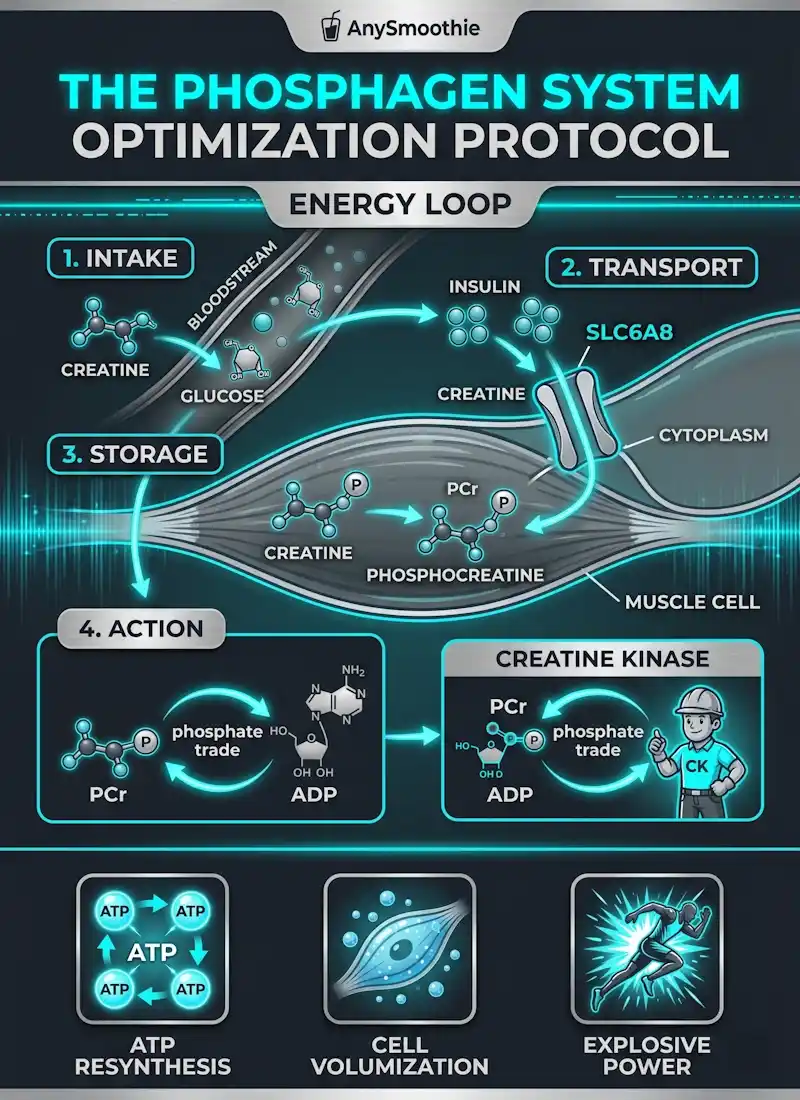
Phosphocreatine, or PCr, steps in next. It donates a phosphate to ADP so ATP can reform quickly. That refill keeps power output higher for longer, which matters when the work is short and sharp.
Creatine supplementation helps because it supports a fuller PCr pool over time. That does not mean endless energy. It means your rapid-response system has more room to work when the bar gets heavy or the pace spikes. For a clear overview of the system, see here.
Phosphocreatine is your rapid-response energy buffer
PCr acts like a backup battery with a fast discharge rate. When the first few seconds of effort hit, it helps regenerate ATP before slower systems catch up.
That is why creatine matters so much for repeated bursts. If PCr stores are higher, your muscles can recover faster between short efforts. For athletes, lifters, and anyone doing stop-start work, that support can matter a lot.
Why creatine loading with food can feel more useful than capsules alone
Smoothies make creatine easier to use every day. They also let you pair it with carbs, fluids, and sodium in one shake, which can support uptake and digestion comfort.
That matters because consistency drives results. A smoothie is easier to stick with than a dry scoop for many people, and the habit itself helps keep creatine stores topped off.
What makes a creatine smoothie work better for phosphagen support
A good creatine smoothie does more than hide the taste. It creates a better environment for absorption and repeat use.
Carbs raise insulin, which can help support creatine transport into muscle. Fluid volume also matters, because creatine use and good hydration work together. Sodium helps too, since it supports the same transport pathways your cells already use.
The goal is simple, create a better uptake environment and make the routine easy to repeat.
Insulin, sodium, and the SLC6A8 transporter explain the uptake edge
The main transporter for creatine is SLC6A8. It uses sodium-dependent transport, so sodium in the mix supports normal movement into the cell.
Carbs help in a different way. They create a stronger insulin response, and that can support the internal environment creatine likes. You do not need a huge sugar load. A moderate carb base is often enough.
Choose the right creatine form for your smoothie goal
This comparison keeps the choice simple.
| Creatine form | Physiological mechanism | Bioavailability | Best smoothie pairing | Target outcome |
|---|---|---|---|---|
| Creatine monohydrate | Supports saturation of the PCr pool over time | Highest evidence base, well absorbed | High-carb base for pre- or post-workout shakes | Power and phosphagen system saturation |
| Creatine HCL | Fast gastric dissolution and strong mixability | Good solubility, less outcome data | Small-volume fruit smoothie | Convenience and daily use |
| Buffered creatine | pH-resistant transit through the stomach | Limited advantage shown in practice | Neutral smoothie with milk or yogurt | Tolerance and simple routine |
Creatine monohydrate is still the standard. It is the most studied form for phosphagen system saturation, and it fits most smoothie protocols well.
3 simple power-prime smoothie protocols you can use
Each of these builds around a different training need. The common thread is the same, creatine plus a smoothie format that you can repeat.
The ATP-reload banana and dextrose blend for pre-workout power
Use this when you want fast fuel before training.
- 1 banana
- 20 to 30 g dextrose or honey
- 3 to 5 g micronized creatine monohydrate
- 12 to 16 oz water or coconut water
- Small pinch of salt
Drink it 30 to 60 minutes before training. The quick carbs support ATP resynthesis, while the fluid and sodium help the mix sit well and move fast.
The post-lift recovery smoothie for total daily saturation
Use this after training or with a meal.
- 3 to 5 g creatine monohydrate
- Greek yogurt or whey protein
- Berries or a banana
- Oats or another moderate carb source
- Milk or a milk alternative
This version supports recovery and daily creatine saturation. The carbs help refill glycogen, and the protein gives the shake more staying power. It works well when you want one habit that covers both recovery and creatine intake.
The low-sugar neural bioenergetics blend for busy days
Use this when you want a lighter shake without a big carb load.
- 3 to 5 g creatine monohydrate
- Mixed berries
- Unsweetened milk or a milk alternative
- Chia seeds or nut butter
- Optional cocoa powder
This blend fits busy days and easier calorie control. It still supports daily creatine intake and can support mitochondrial priming by keeping energy input steady. The creatine kinase shuttle also benefits from regular creatine availability, because it helps move high-energy phosphate where it is needed.
How to time, dose, and stack your smoothie for the best results
Most people do well with 3 to 5 g of creatine daily. If you want faster saturation, some people use a loading phase, then drop to a maintenance dose. Daily use matters more than any single workout window.
Use daily consistency first, then adjust around training
If your schedule is stable, take the smoothie at the same time each day. If you train early, a pre-workout blend makes sense. If you train later, post-workout is fine too.
The main point is simple. Creatine works best when muscle stores stay topped off.
Watch blending, temperature, and digestion comfort
Fine blending helps distribute creatine evenly. Very hot liquids are not a good idea, and very acidic mixes may bother some people.
Hydration matters too. Creatine works best when your fluid intake is solid, so keep water in the picture throughout the day.
Conclusion
Creatine smoothies are an easy way to support the phosphagen system without adding much friction to your routine. They help with ATP-PCr cycling, daily creatine saturation, and a smoother path to consistent use.
The best setup starts with creatine monohydrate, then adds the right mix of carbs, fluid, and sodium for your goal. From there, the choice is simple, pre-workout speed, post-lift recovery, or a lower-sugar daily blend.
The best protocol is the one you can follow every day.
🛡️ Safety Notes & Contraindications: Creatine Smoothies
Hydration and Fluid Retention: Creatine is osmotically active and draws water into the muscle cells. While this is beneficial for cell volumization, it requires a significant increase in daily water intake (+500ml/day) to prevent dehydration or systemic cramping.
Renal Health Pre-check: In healthy individuals, creatine does not damage the kidneys. However, if you have pre-existing chronic kidney disease (CKD) or are taking nephrotoxic medications, avoid supplementation as it can complicate the monitoring of serum creatinine levels.
Gastric Irritation (HCL vs. Monohydrate): Creatine Monohydrate can cause bloating or diarrhea if not fully dissolved. Ensure high-speed blending for at least 30 seconds. If distress persists, try a “micronized” version or Creatine HCL for better solubility.
Weight Gain Expectancy: Initial saturation often leads to a 1-2kg increase in body weight due to intracellular water retention. This is not fat gain, but a functional increase in muscle volume.
Loading Phase Necessity: A loading phase (20g/day for 5 days) is effective but optional. A steady dose of 3-5g daily in your smoothie will achieve full muscle saturation within 3-4 weeks with much less risk of GI upset.
FAQ
How does the “ATP-PCr Cycle” provide fuel for explosive physical output?
Adenosine triphosphate (ATP) is the immediate energy currency of the cell, but stored levels are exhausted within seconds of intense effort. Biochemically, phosphocreatine (PCr) acts as a high-energy phosphate donor that rapidly reattaches a phosphate group to ADP, reforming ATP. Supporting this physiological system through creatine-rich smoothies facilitates the biochemical mechanics of “rapid-response refueling,” ensuring the phosphagen system has a larger reservoir for short, high-intensity bursts.
Why is “Sodium-Dependent Transport (SLC6A8)” critical for creatine uptake?
The transport of creatine into muscle cells is primarily mediated by the SLC6A8 transporter, which relies on a sodium gradient to function. Biochemically, this means that the presence of sodium co-factors can assist the movement of creatine across the cell membrane. Supporting this physiological system by adding a pinch of salt or utilizing electrolyte-rich bases (like coconut water) in a smoothie optimizes the natural pathways of “transporter efficiency,” ensuring more of the creatine reaches its target tissue.
What is the role of “Insulin Modulation” in creatine partitioning?
Insulin acts as a powerful anabolic signal that can stimulate the activity of the creatine transporter. Biochemically, a moderate glucose load—achieved through ingredients like a banana or honey—triggers a physiological insulin response that facilitates the uptake of creatine into the sarcoplasm. Supporting this physiological system through balanced carb-to-creatine ratios optimizes the natural pathways of “nutrient partitioning,” helping to saturate muscle stores more effectively than creatine taken in isolation.
How does the “Creatine Kinase Shuttle” support mitochondrial priming?
The creatine kinase shuttle is the biochemical mechanism that transports high-energy phosphates from the site of production (mitochondria) to the site of use (muscle fibers). Biochemically, maintaining a full pool of phosphocreatine allows this shuttle to operate at peak efficiency. Supporting this physiological system through daily smoothie protocols facilitates the biochemical mechanics of “energy flux,” providing a more resilient buffer against cellular energy depletion during repeated bouts of work.
Why is “Daily Saturation” more important than acute pre-workout timing?
While pre-workout timing can provide immediate glucose for a session, the benefits of creatine are cumulative. Biochemically, the goal of supplementation is to reach and maintain total muscular saturation of the PCr pool. Supporting this physiological system through a repeatable daily smoothie protocol—regardless of the specific training window—optimizes the natural pathways of “phosphagen maintenance,” ensuring the biochemical mechanics of ATP resynthesis are supported 24/7.

Medical Disclaimer: The information on AnySmoothie is for educational and informational purposes only. It is not intended as medical advice or a substitute for professional consultation with a healthcare provider. Always consult your physician before starting any new nutritional protocol, especially if you have underlying health conditions or are taking medication. By using this site, you agree to our full Disclaimer & Terms of Use.