
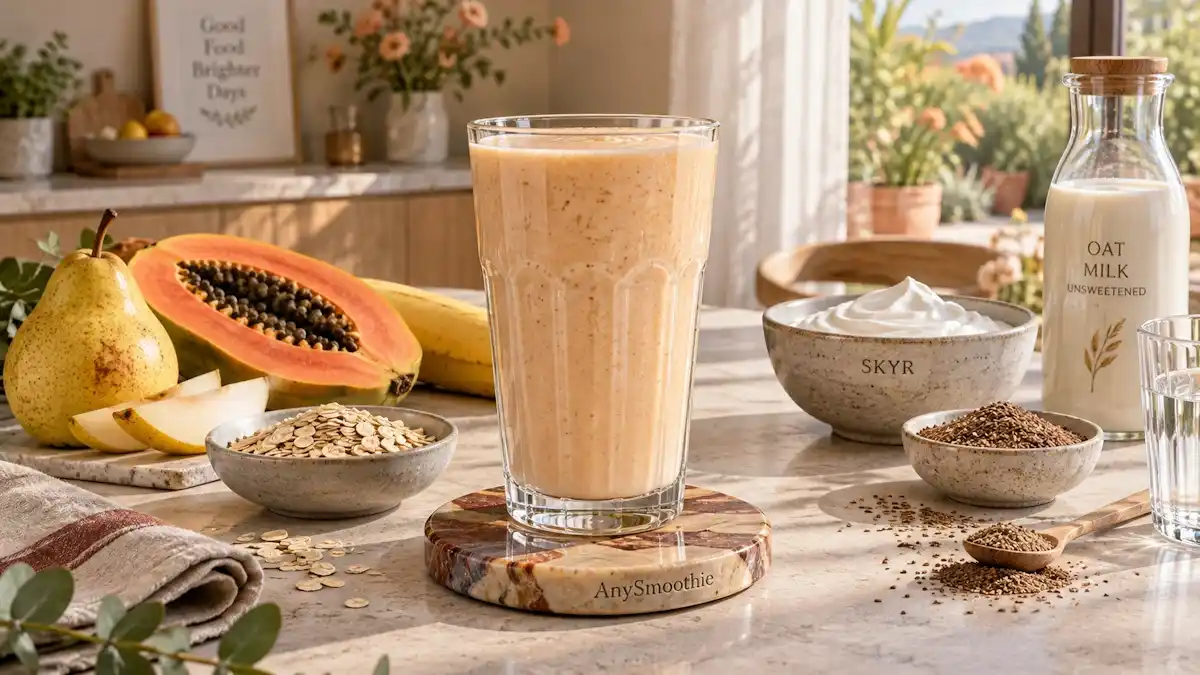
They don’t treat gallstones, inflammation, or other gallbladder conditions. However, well-balanced ingredients can fit a fiber-rich eating pattern while keeping total fat moderate according to individual tolerance.
How Smoothies Can Support Gallbladder-Friendly Nutrition
A balanced smoothie starts with whole foods that provide fiber, fluid, and energy. Fruits, vegetables, oats, chia seeds, and ground flax offer different types of fiber. Soluble fiber absorbs water and can form a gel-like texture during digestion, while insoluble fiber contributes bulk to stool.
Bile helps with the digestion and absorption of dietary fat. For people who find richer meals uncomfortable, keeping a smoothie moderate in total fat may be more practical than combining several concentrated fat sources at once.
The NIDDK’s dietary guidance for gallstones recommends fiber-rich foods, including fruits, vegetables, and whole grains, along with healthier fats while limiting unhealthy fats and refined carbohydrates.
Choose Ingredients That Support Fiber, Hydration, and Steady Energy
Use whole fruit instead of juice whenever possible. Blending changes a food’s texture, but the drink can still retain fiber from the whole ingredients. Berries, pears, spinach, cucumber, and oats are useful bases because they provide fluid or fiber without needing added sugar.
Choose water, unsweetened soy milk, or plain lower-fat dairy milk as a liquid base. Plain Greek yogurt can add protein if you tolerate dairy. Unsweetened soy milk is another practical protein source.
For more ideas centered on whole-food fiber, smoothie for satiety signaling and nutrient density provides additional combinations using fruit, oats, and other fiber-rich ingredients.
Use Fat Carefully Instead of Removing It Completely
Dietary fat is part of a balanced eating pattern, but individual tolerance and total quantity matter. If richer ingredients tend to bother you, begin with a modest amount of seeds, nut butter, or avocado rather than stacking several fat sources in one drink.
Avoid loading one smoothie with avocado, coconut cream, oil, seeds, and nut butter at once. Those ingredients can quickly make a drink substantially higher in fat.
People with diagnosed gallbladder disease, gallstones, recent gallbladder surgery, or a prescribed low-fat diet should follow the nutrition guidance provided by their clinician or registered dietitian.
A smoothie’s total fat and your individual tolerance matter more than whether one ingredient is labeled “healthy.”
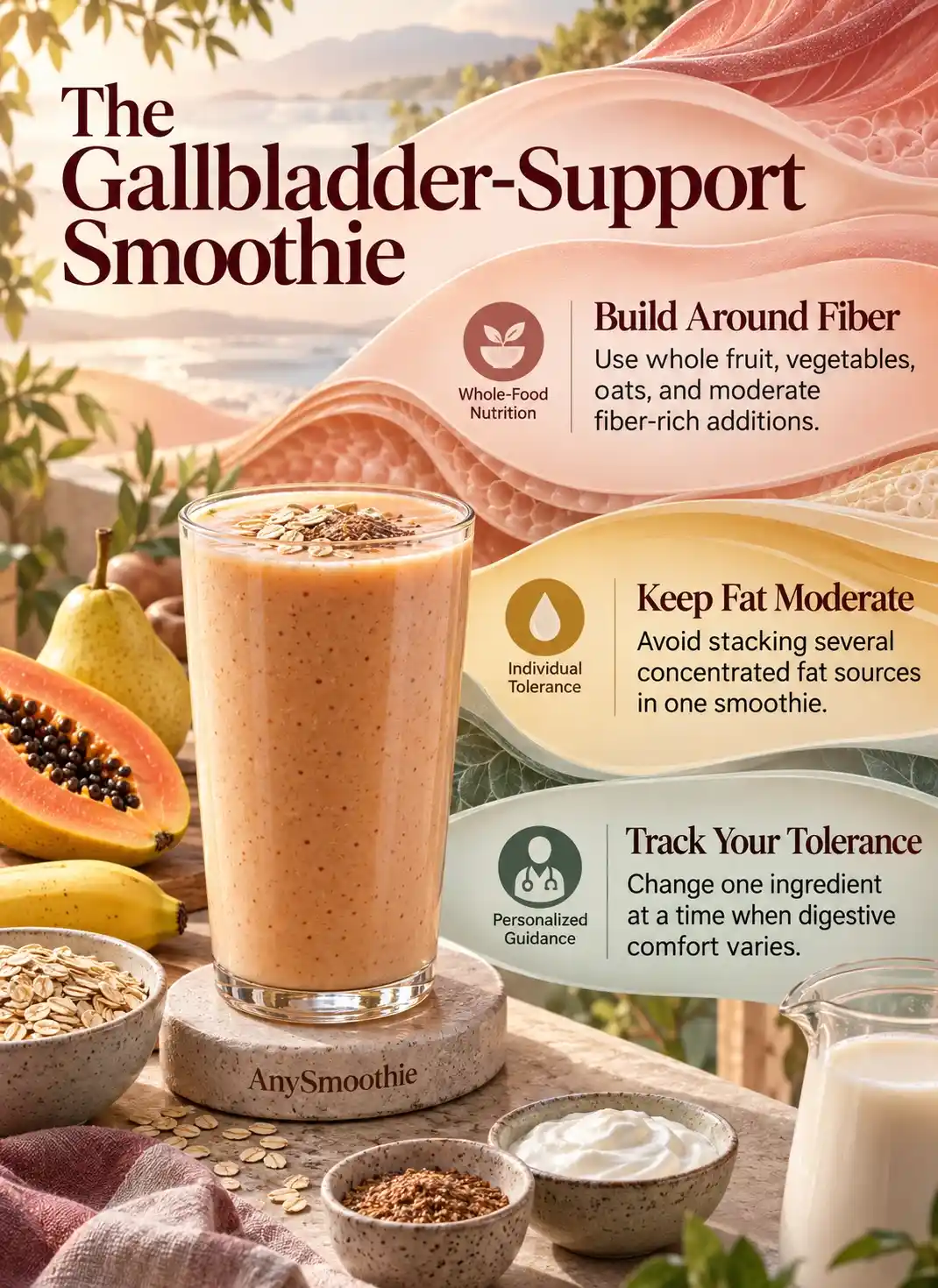
3 Smoothies for Gallbladder Nutrition Support
These smoothies for gallbladder nutrition support use unsweetened liquids and moderate portions. Each makes about 8 to 12 ounces, depending on the amount of water and ice used.
| Smoothie | Key Ingredients | Fiber or Protein Sources | Preparation Note | Best Nutrition Focus |
|---|---|---|---|---|
| Berry-Oat Fiber | Berries, oats, Greek yogurt | Oats, berries, yogurt, flax | Blend until oats soften | Fiber and protein |
| Pear and Greens | Pear, spinach, cucumber, chia | Pear, greens, chia | Add water gradually | Hydration and produce |
| Avocado-Cocoa Protein | Avocado, banana, cocoa, soy milk | Soy milk, yogurt, avocado | Keep avocado portion modest | Protein and unsaturated fat |
The first two recipes emphasize fiber and hydration, while the third includes a measured amount of creamy unsaturated fat.
Berry-Oat Fiber Smoothie
Ingredients
- 3/4 cup frozen blueberries or mixed berries
- 2 tablespoons rolled oats
- 1/2 cup plain nonfat Greek yogurt
- 1/2 cup cold water
- 1 teaspoon ground flaxseed
- Ice as needed
- Cinnamon or vanilla extract, optional
Steps
Add the water and Greek yogurt first, followed by the berries, oats, flaxseed, and optional flavoring.
Blend until the oats and berries are completely broken down. Add more water if you prefer a thinner texture.
Berries and oats contribute fiber, while Greek yogurt adds protein. If you want a sweeter drink, a few slices of banana can add sweetness without relying on syrup or fruit juice.
Estimated Nutrition per Serving
- Calories: ~220 kcal
- Protein: ~15 g
- Carbohydrates: ~35 g
- Fat: ~3 g
- Fiber: ~7 g
- Sugars: ~15 g
Estimate uses plain nonfat Greek yogurt, mixed berries, and includes the teaspoon of ground flaxseed.
For additional ways to build protein into a smoothie without automatically relying on powders, naturally high-protein smoothies offers useful whole-food options.
Pear and Greens Hydration Smoothie
Ingredients
- 1 small ripe pear
- 1 packed cup baby spinach
- 1/2 cup peeled cucumber
- 1 teaspoon fresh lemon juice
- 3/4 cup cold water
- 1 teaspoon chia seeds
Steps
Add the water first, followed by the cucumber, spinach, pear, lemon juice, and chia seeds.
Blend until completely smooth, then add more water if you prefer a thinner texture.
This combination provides fluid and produce-based fiber with a mild, fresh flavor. If you don’t usually eat much fiber, introduce fiber-rich additions gradually rather than increasing several ingredients at the same time.
Estimated Nutrition per Serving
- Calories: ~120 kcal
- Protein: ~3 g
- Carbohydrates: ~27 g
- Fat: ~2 g
- Fiber: ~7 g
- Sugars: ~17 g
Estimate uses one small pear and one teaspoon of chia seeds.
If I were trying to identify which ingredients felt easiest to tolerate, I’d start with this simpler blend and change only one ingredient at a time.
Avocado-Cocoa Protein Smoothie
Ingredients
- 1/4 small avocado
- 1/2 medium banana
- 3/4 cup unsweetened fortified soy milk
- 1 tablespoon unsweetened cocoa powder
- 1/4 cup plain nonfat Greek yogurt
- Cold water and ice as needed
Steps
Add the soy milk first, followed by the Greek yogurt, banana, avocado, cocoa powder, and ice.
Blend until completely smooth. Add cold water gradually if you want a thinner consistency.
Avocado contributes unsaturated fat and a creamy texture, so only a small amount is needed. Unsweetened soy milk and Greek yogurt provide protein without turning the recipe into a high-fat dessert.
Estimated Nutrition per Serving
- Calories: ~200 kcal
- Protein: ~14 g
- Carbohydrates: ~25 g
- Fat: ~8 g
- Fiber: ~6 g
- Sugars: ~10 g
Estimate uses unsweetened fortified soy milk, plain nonfat Greek yogurt, and 1/4 of a small avocado.
How to Make Smoothies Easier to Tolerate
Start with a moderate serving and drink it at a comfortable pace. That approach can make it easier to notice whether a particular ingredient, portion size, or fat level feels different from what you normally tolerate.
Keep notes if symptoms repeatedly appear after particular foods or meal patterns. A consistent record can give a clinician or registered dietitian more useful information than eliminating several foods at once.
For broader ideas about adjusting smoothie ingredients around digestive comfort, smoothies for better digestion and gut health provides another food-first perspective.
Portions, Timing, and Ingredient Swaps That Keep Recipes Balanced
A practical formula includes fruit or vegetables, a protein source, liquid, and an optional small fiber- or fat-containing add-in. Combining several fruits, sweetened yogurt, fruit juice, and honey can create a drink with substantially more added or free sugar than a simpler blend.
Use lactose-free yogurt if lactose is a known problem for you. Swap soy milk for dairy milk, or use oats instead of seeds when chia and flax feel too filling.
Smoothies work best as part of an overall eating pattern rather than as a restrictive cleanse or a replacement for medically recommended dietary care.
When Gallbladder Symptoms Need Medical Attention
Smoothies cannot dissolve gallstones or replace diagnosis and treatment.
Seek prompt medical care for severe or rapidly worsening abdominal pain, especially in the upper-right abdomen, or symptoms such as fever with chills or yellowing of the skin or eyes. Mayo Clinic lists intense abdominal pain, jaundice, and high fever with chills among warning signs of serious gallstone complications in its overview of gallstone symptoms.
Dark urine or unusually pale or clay-colored stools can also occur when bile flow is obstructed and should not be managed by dietary experimentation alone.
Ask a clinician or registered dietitian before making substantial dietary changes if you have known gallstones, recent gallbladder surgery, pancreatitis, liver disease, persistent digestive symptoms, or a prescribed low-fat diet.
Conclusion: A Balanced Place for Smoothies
The most useful smoothies for gallbladder nutrition support are moderate in size, built on unsweetened liquids, and based on whole-food ingredients that provide fiber. Add protein and a measured amount of unsaturated fat according to your individual tolerance and medical guidance when relevant.
Begin with one simple recipe, then adjust one ingredient at a time. Comfort and consistency matter more than packing every possible health food into one glass.
🛡️ Safety Notes & Dietary Interactions
- Fat Tolerance Varies: Even unsaturated fats from avocado, nut butter, chia, or flax can trigger discomfort in some people with gallbladder problems. Start with small amounts and avoid stacking several fat-rich ingredients in one smoothie.
- Increase Fiber Gradually: Berries, pears, oats, greens, chia, and flax can make these blends fiber-dense. If your usual intake is low, increase portions slowly and drink enough fluid to reduce the chance of bloating or digestive discomfort.
- Known Gallbladder Disease: People with diagnosed gallstones, recent gallbladder surgery, pancreatitis, liver disease, or a prescribed low-fat diet should follow individualized medical or dietetic guidance rather than relying on a general smoothie formula.
- Warning Symptoms: Severe or worsening right-upper-abdominal pain, repeated vomiting, fever, jaundice, dark urine, or pale stools require prompt medical attention. Dietary adjustments or smoothies should not be used to manage symptoms that may indicate a complication.
FAQs
Which smoothie is likely to be easiest to tolerate with gallbladder sensitivity?
The Pear and Greens Hydration Smoothie is the lightest starting point because it uses water, pear, spinach, cucumber, and only a small amount of chia or flax. If fiber itself causes discomfort, reduce or omit the seeds initially. Individual tolerance matters more than choosing the recipe with the fewest calories or ingredients.
Should I avoid all fat in a gallbladder-supportive smoothie?
Not necessarily. Fat is part of a balanced diet, but large amounts may be harder to tolerate for some people with gallbladder concerns. A small portion of avocado, seeds, or nut butter may fit well, while combining several rich ingredients at once can make the smoothie unnecessarily heavy. Follow any clinician-prescribed fat limits.
Are oats better than chia or flax for gallbladder-friendly smoothies?
They serve different roles. Oats provide soluble fiber and can thicken a smoothie without adding much fat, while chia and flax add both fiber and fat. If richer ingredients tend to cause discomfort, oats may be the simpler choice. If seeds are already well tolerated, a small amount can still fit the recipe.
Can these smoothies help dissolve gallstones?
No. Smoothies cannot dissolve gallstones or treat gallbladder inflammation. Their role is nutritional: they can provide fluids, fiber, produce, protein, and modest amounts of fat within a balanced eating pattern. Diagnosed gallstones and recurring symptoms need proper medical assessment and treatment rather than a food-based intervention.
What should I do if a smoothie causes pain or nausea?
Stop drinking it and note which ingredients, portion size, and fat content were involved. Try a smaller, simpler recipe only if symptoms are mild and your clinician has not advised otherwise. Recurrent pain, significant nausea, vomiting, fever, jaundice, or severe upper-right abdominal pain should be evaluated medically rather than managed through repeated dietary experiments.

Medical Disclaimer: AnySmoothie content is for educational purposes only and is not a substitute for professional medical advice. Consult a healthcare provider for personalized guidance. See our full Disclaimer & Terms of Use. AI Transparency: AnySmoothie may use AI to support content development. All content undergoes human editorial review for accuracy, clarity, and editorial quality. See our full AI Transparency.