
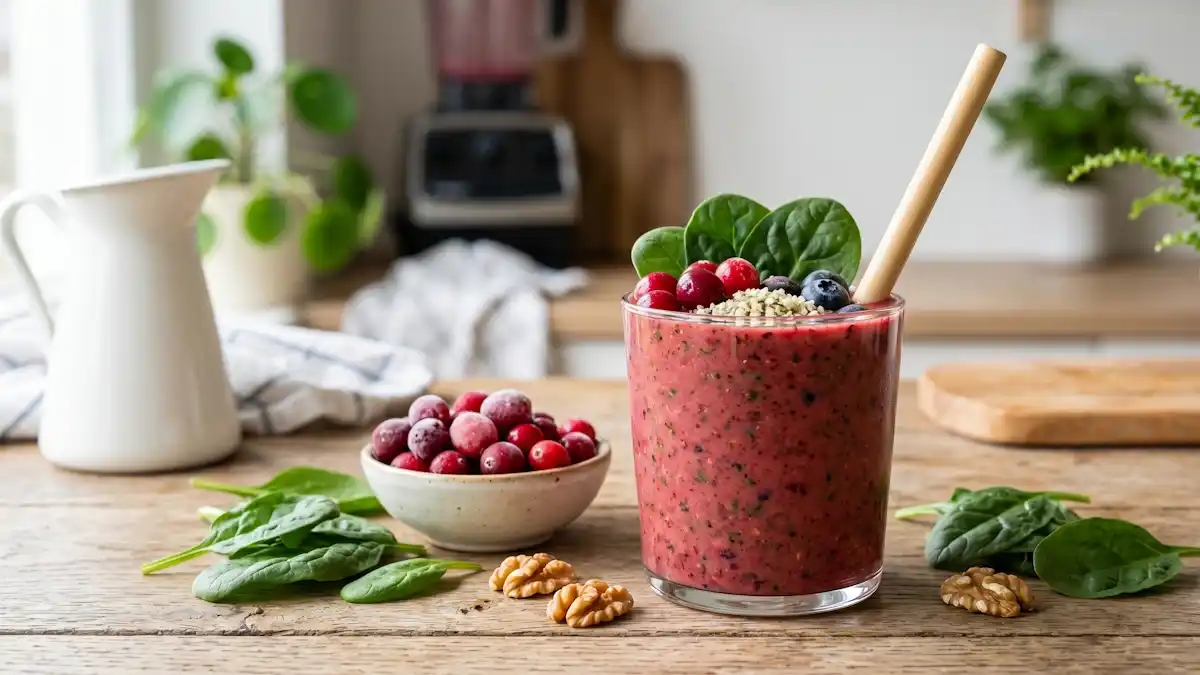
A Cranberry and Spinach Smoothie is a precise formulation engineered to support cellular defense mechanisms and optimize the physiological systems governing post-exertion recovery. By combining the distinct bioactive profiles of raw cranberries and dark leafy greens, this blend delivers a concentrated influx of phytochemicals designed to support natural clearance pathways, making it an ideal strategy for early-morning physiological priming or post-workout cellular maintenance.
This guide provides a structurally optimized protocol to balance the potent, tart organic acids of cranberries with nutrient-dense baby spinach. You will learn the exact sequence of substrate layering to maximize enzymatic preservation during blending, ensure a smooth rheological texture, and prevent the breakdown of key volatile compounds.
Cranberry Spinach Smoothie Recipe
This cranberry spinach smoothie is simple, creamy, and balanced. The cranberry brings a bright tart note, while the spinach keeps the flavor mild and fresh. With the right mix, it stays tart but still easy to drink. It makes one large smoothie or two smaller ones, depending on how you serve it.
| Oxylipin Modulator | Physiological Mechanism | Primary Pathway Target | Best Smoothie Pairing | Target Physiological Outcome |
|---|---|---|---|---|
| Cranberry PACs (A-Type Proanthocyanidins) | Help modulate inflammatory signaling, including NF-kB activity, which can support lower COX-2 expression | COX-2 related inflammatory signaling | Cranberry, berry, or citrus smoothies | Support a calmer inflammatory response |
| Spinach Thylakoids | Help slow fat oxidation and support satiety through membrane-based effects | Lipid handling and membrane interaction | Green smoothies with banana, apple, or yogurt | Support steadier fullness and a smooth texture |
| Alpha-Linolenic Acid (ALA from Flaxseed) | Acts as a direct structural competitor to arachidonic acid in the oxylipin pathway, and can shift enzyme use toward less inflammatory oxylipins | Lipoxygenase and related oxylipin pathways | Berry, banana, or cocoa smoothies with ground flaxseed | Support a more balanced oxylipin profile |
If you want the smoothie to taste less sharp, a banana or a little yogurt helps soften the cranberry edge. If you prefer a brighter blend, keep the fruit higher and the greens lighter.
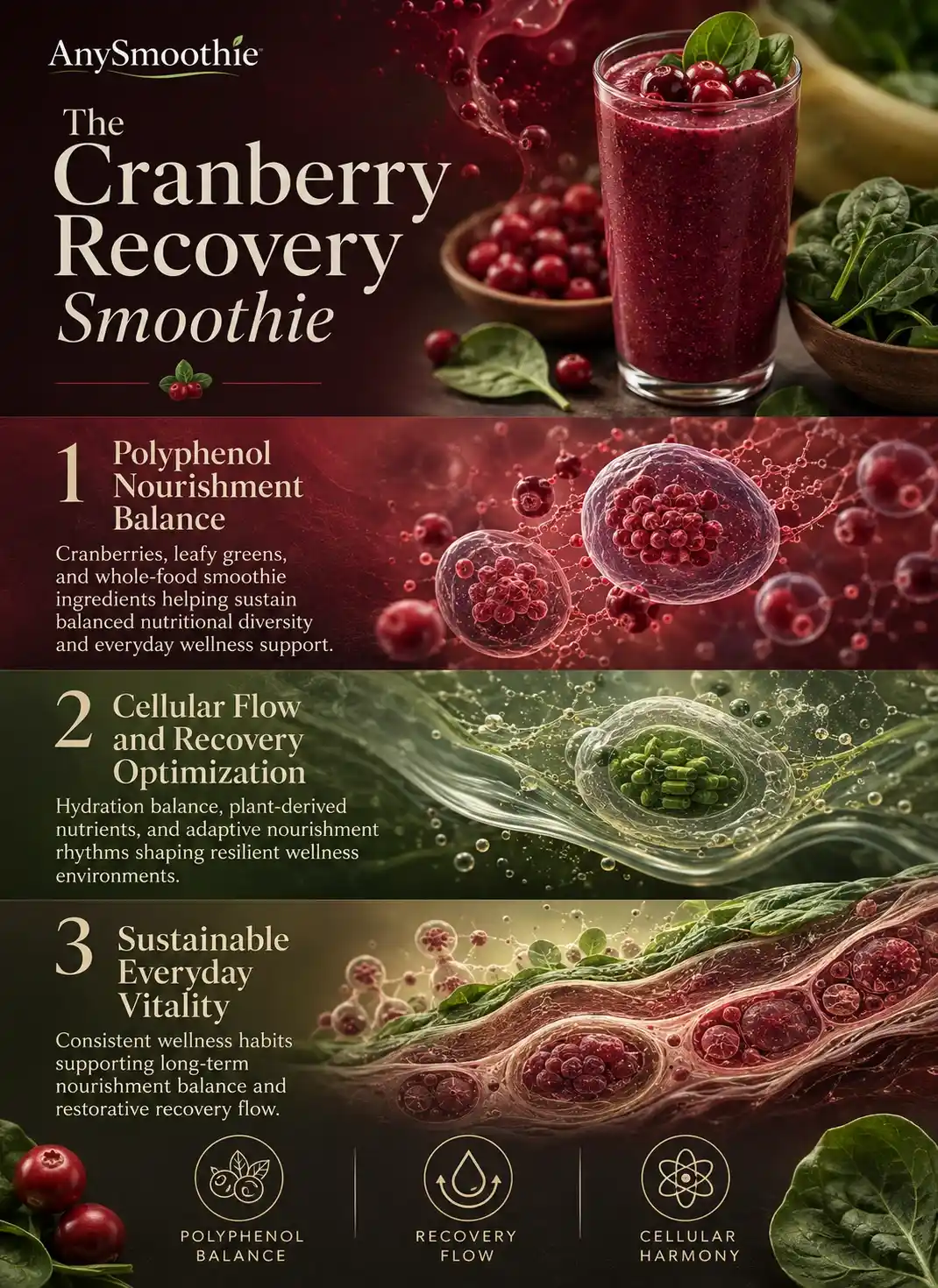
Ingredients (1 large serving)
- 1 cup frozen cranberries (fresh works too, but frozen makes it thicker)
- 1 packed cup baby spinach (about a big handful)
- 1 small ripe banana (fresh or frozen)
- 1/2 cup plain Greek yogurt (or kefir for a drinkable, tangy base)
- 3/4 cup milk of choice (dairy milk, almond milk, oat milk, or soy)
- 1 to 2 teaspoons honey or maple syrup (optional, to taste)
- 1/2 teaspoon vanilla extract (optional, helps round out tartness)
- Pinch of salt (optional, tiny amount helps the fruit taste sweeter)
If you like citrus with cranberry, you can swap part of the milk for orange juice. For another flavor idea, this Cranberry, Orange, Spinach and Pineapple Smoothie shows how well cranberry and orange play together.
Best blender order (so it blends fast)
- Pour in the liquid first.
- Add spinach.
- Add Greek yogurt (or kefir).
- Add banana.
- Add frozen cranberries last.
Putting frozen fruit on top helps push everything down into the blades as it blends.
Step-by-step instructions
- Blend spinach + liquid first for 15 to 20 seconds, until the greens look fully broken down. This small step helps prevent spinach flecks.
- Add yogurt, banana, and frozen cranberries.
- Start on low speed for 10 seconds, then increase to high.
- Blend on high for 30 to 45 seconds, until creamy and thick.
- Taste, then adjust.
- Too tart? Add 1/2 banana, a date, or a drizzle of honey or maple syrup.
- Too thick? Add a splash more milk, 1 to 2 tablespoons at a time.
- Too thin? Add more frozen fruit or another spoonful of yogurt.
What the finished smoothie should look like
You’re aiming for a deep pink to magenta color, thick enough to cling to the sides of the glass for a moment. It should pour, but slowly, like melted soft serve.
If you want a similar base idea with a different fruit pairing, this Cranberry Apple Spinach Smoothie is another tasty direction.
One-sentence base ratio to remember: fruit + greens + liquid + creaminess (then sweeten to taste).
Ingredients you need (and why each one helps)
- Cranberries: Bring the tart, bright punch and that ruby color.
- Spinach: Adds a mild green flavor and blends smoothly, especially baby spinach.
- Banana (or mango): Softens tartness and makes the smoothie taste naturally sweet.
- Greek yogurt or kefir: Makes it creamy and gives the drink some staying power.
- Liquid (milk, almond milk, orange juice, or water): Controls thickness and changes the flavor fast.
If you’re curious about cranberry nutrition beyond smoothies, this overview on why you should add more cranberries to your diet gives helpful context.
Step-by-step blending tips for the best texture
- Add liquids first so the blender blades catch and move everything.
- Blend greens with liquid before anything else to reduce spinach bits.
- Pack spinach down lightly (don’t jam it), so it blends evenly.
- Start low, then go high so frozen cranberries don’t bounce around.
- Use frozen fruit for thickness, not a bunch of ice, which can water it down.
- Stop and scrape once if needed, especially with smaller blenders.
How to customize your Cranberry Spinach Smoothie for your goals
The best part about this smoothie is how flexible it is. Cranberries have a strong personality, so small changes can shift the drink from sharp and refreshing to sweet and dessert-like.
Think in three “dials” you can turn: sweetness, creaminess, and thickness. Adjust one at a time, taste, then decide if it needs more. That habit saves ingredients and keeps you from ending up with a smoothie that’s weirdly flat or overly sweet.
Here are a few common directions:
Want it brighter and lighter? Use kefir and a splash of orange juice, then keep sweetener minimal.
Want it thicker and more filling? Use frozen banana, Greek yogurt, and skip water.
Need it dairy-free? Use unsweetened soy milk or oat milk, and swap yogurt for a plant-based yogurt. Frozen banana and a spoon of peanut butter can bring back the creamy feel.
A simple rule that helps: frozen fruit thickens, liquid thins. Ice is fine, but too much makes the flavor fade.
For another green-and-cranberry combo that leans creamy, the Green Cranberry Smoothie uses avocado as the rich base.
Make it sweeter, less tart, or more fruity
Cranberry flavor gets stronger quickly, so increase cranberry amounts slowly if you’re experimenting.
Quick fixes that work fast:
- Add half a banana or a few chunks of frozen mango.
- Add pineapple for a brighter, candy-like fruit note.
- Blend in 1 pitted date for a deeper sweetness.
- Add a tiny drizzle of honey or maple syrup.
- Try 1/2 teaspoon vanilla or a pinch of cinnamon to soften sharp edges.
If you love a greener, less fruity version, this Cranberry Green Smoothie Recipe is a good reference point for keeping it simple.
Boost protein and stay full longer (easy add-ins)
If you want your Cranberry Spinach Smoothie to hold you over until lunch, protein and healthy fats help.
Easy add-ins:
- Greek yogurt (or extra yogurt)
- Cottage cheese (mild flavor, very creamy when blended well)
- Protein powder (vanilla tends to work best with cranberry)
- Chia seeds or hemp hearts
- Peanut butter or almond butter
- Rolled oats (a spoonful makes it thicker and more filling)
To keep it smooth, blend a bit longer and add a small splash of liquid if it starts to seize up. Taste after adding protein powder since some brands are sweetened and can take the smoothie from “fresh” to “dessert” fast.
Prep, storage, and common smoothie mistakes (so it tastes great every time)
Smoothies are easiest when you remove the morning friction. A little prep turns this into a 2-minute habit.
Freezer smoothie packs and make-ahead options
Portion your fruit and greens into freezer bags, then store them flat so they stack easily. For each pack, add frozen cranberries and banana (or mango), plus a handful of spinach. When you’re ready, dump the pack into the blender and add liquid and yogurt.
Freezer packs keep well for about 2 to 3 months if sealed tightly. Easy spinach prep tip: freeze fresh spinach in loose handfuls so you can grab what you need without thawing a whole bag.
Fix common problems: too bitter, too sour, too thin, or too thick
- Too bitter: use baby spinach, add banana, add more yogurt.
- Too sour/tart: add sweet fruit, or a little honey or maple syrup.
- Too thin: add more frozen fruit, or another spoonful of yogurt.
- Too thick: add liquid 1 to 2 tablespoons at a time.
If fresh spinach tastes earthy, rinse and dry it before freezing or blending.
Conclusion
A Cranberry Spinach Smoothie is a simple way to get a bright, satisfying drink without a lot of prep. Start with the base recipe, then adjust sweetness and thickness until it fits your taste. Once you find your ideal balance, it becomes an easy routine, not a special project. Try it tomorrow morning, and if you want to make life even easier, portion a few freezer packs today so your next smoothie is basically already made.
🛡️ Safety Notes & Contraindications
Oxalate Entrapment and Nephrolithiasis Metrics: CRITICAL: Raw baby spinach is a major dietary source of soluble oxalic acid. When consumed daily in highly bioavailable liquid forms, oxalates can quickly saturate renal transport mechanisms, precipitating into calcium-oxalate crystals. Pro-Tip: The inclusion of plain Greek yogurt or kefir in this exact baseline ratio provides dense, ionized Calcium ($Ca^{2+}$). The calcium binds directly to the oxalic acid inside the intestinal lumen, forming insoluble calcium oxalate that is safely excreted via the GI tract, bypassing renal filtration entirely.
Anticoagulant and Vitamin K Counter-Signaling: Spinach contains highly dense pools of Phylloquinone (Vitamin K1), an essential co-factor for the hepatic synthesis of clotting factors. If you are prescribed vitamin K antagonists (such as Warfarin/Coumadin), sudden spikes in green-vegetable consumption can directly neutralize the pharmacological efficacy of your medication. Maintain absolute consistency in your daily green flooring.
Salicylate Sensitivity and Mucosal Flares: Cranberries naturally concentrate high amounts of organic salicylates. Individuals with a diagnosed systemic allergy or hypersensitivity to Aspirin (acido acetilsalicilico) or those presenting with Samter’s Triad must handle raw cranberry formulations with extreme caution to avoid localized mucosal irritation, urticaria, or bronchospasm.
Urea Cycle and Gastric Distress from Excess Protein Stacking: Stacking cottage cheese, protein powders, and Greek yogurt simultaneously to maximize satiety can inadvertently overload upper GI peptide absorption channels. This can cause transient hyperammonemia or gastric stagnation. Limit extra amino acid loading to a single concentrated source per blend.
Fructose and Acid-Induced Enamel Erosion: The concentrated combination of organic acids from cranberries paired with the simple sugars of ripe bananas or optional orange juices creates a highly erosive environment for dental enamel. To guarantee long-term oral health safety, never brush your teeth immediately after drinking this smoothie. Rinse your mouth with plain water and wait at least 30 minutes.
FAQ
How do “A-Type Proanthocyanidins” in cranberries support the biochemical mechanics of cellular defense?
Raw cranberries contain exceptionally high concentrations of unique A-type proanthocyanidins (PACs). Biochemically, these complex polyphenols serve as targeted signaling molecules that interact with mucosal surfaces and alter the systemic redox terrain. Supporting this physiological system through raw or flash-frozen cranberry infusions optimizes the natural pathways of “cellular vigilance,” providing an intensive shield that quenches free radicals before they can induce lipid peroxidation in cell membranes.
Why does the “Thylakoid Matrix” of baby spinach require a two-stage mechanical shear sequence?
Spinach leaves contain thylakoid membranes rich in chlorophyll, lipophilic vitamins, and essential cations like magnesium. Biochemically, if greens are blended concurrently with dense, frozen substrates, the cellular walls are unevenly fractured, resulting in incomplete nutrient liberation and rapid oxidation. Supporting this physiological system with a targeted two-stage blending sequence—liquefying the spinach first—facilitates the biochemical mechanics of “particle-size reduction,” maximizing the bioavailability of the encapsulated chloroplasts.
What is the role of “Ascorbic Acid” when pairing cranberry organic acids with leafy greens?
Cranberries are abundant in native organic acids, including ascorbic, citric, and malic acids. Biochemically, these acids lower the overall pH of the smoothie emulsion, protonating vulnerable micronutrients and creating an unfavorable environment for degradative enzymes like Polyphenol Oxidase (PPO). Supporting this physiological system with a low-pH matrix acts as a sacrificial stabilizer that preserves the active folate and mineral pools within the spinach during the thermodynamic stress of blending.
How does “Rheological Density” modify the intestinal uptake velocity of simple sugars?
A smoothie’s physical thickness and viscosity (rheology) directly alter how it interacts with the digestive brush border. Biochemically, utilizing a dense, emulsified matrix of viscous banana fibers and Greek yogurt proteins slows down gastric emptying and delays carbohydrate cleavage. Supporting this physiological system through macro-nutrient stratification optimizes the natural pathways of “glycemic influx attenuation,” ensuring a steady, metered delivery of glucose to recovering tissues instead of a disruptive insulin spike.
Why is “Mitochondrial Priming” enhanced by adding a mineral-and-amino-acid anchor like Greek yogurt?
The processes of post-exercise muscle repair and active nutrient transport across the intestinal wall are highly energy-dependent operations that consume significant ATP. Biochemically, if the cytosol is flooded with simple fruit fructose without an accompanying amino acid and electrolyte anchor, the cells experience energetic friction. Supporting this physiological system with the amino acid substrate pool and calcium ions found in Greek yogurt or kefir facilitates the biochemical mechanics of “bioenergetic stability,” giving mitochondria the necessary foundations for efficient cellular turnover.

Medical Disclaimer: AnySmoothie content is for educational purposes only and is not a substitute for professional medical advice. Consult a healthcare provider for personalized guidance. See our full Disclaimer & Terms of Use. AI Transparency: AnySmoothie may use AI to support content development. All content undergoes human editorial review for accuracy, clarity, and editorial quality. See our full AI Transparency.