
Your spine likes two things more than most people realize: steady movement and enough fluid. This home stretching and smoothie guide pairs both, so you can support daily spinal comfort without chasing extreme fixes.
Discs are the soft cushions between your vertebrae. They depend on water, pressure changes, and healthy tissue chemistry to keep their spring. This is general wellness advice, not a fix for severe pain, numbness, or weakness. Still, a few minutes a day can help many stiff backs feel less compressed.
The Bio-Mechanical Spine: Why Movement and Nutrients Must Sync
When you sit for long stretches, your spine stays under a fairly constant load. Over time, discs can feel flatter and stiffer, and the muscles around them often tighten to protect the area. Gentle movement changes that pressure. It gives tissues a better chance to exchange fluid, and it can reduce the sense of being “stuck.”
As of April 2026, research keeps pointing to aggrecan, a major part of glycosaminoglycans (GAGs), as a key reason discs hold water. When aggrecan breaks down or drops, discs lose some of their sponge-like pull on water. Current studies do not show that home stretches directly rehydrate damaged discs, but they can still help with pressure relief, motion, and comfort. A recent disc regeneration review shows why GAG loss matters so much in this process.
Intervertebral Disc Hydration: The Role of GAGs and Water Retention
The center of a disc is called the nucleus pulposus. It is a gel-like core that needs water to absorb shock. Aggrecan helps trap that water. When GAG content falls, the disc may lose height, bend less easily, and absorb impact less well.
That sounds technical, but the practical takeaway is simple. Drink enough water, get up often, and avoid locking your spine into one position for hours. Movement will not rebuild a worn disc overnight. Still, it may help the tissues around the spine move and feel better.
A quick nutrient guide for cartilage, ligaments, and tight back muscles
Food and supplements can support spinal tissues indirectly, especially cartilage, ligaments, and muscle tone. However, evidence does not strongly show that supplements alone rehydrate spinal discs.
| Nutrient | Main Function | Target Tissue | Best Time for Intake | Best Smoothie Pairing |
|---|---|---|---|---|
| Glucosamine sulfate | Supports cartilage building blocks | Cartilage and joint surfaces near the spine | With breakfast or lunch | Berry and spinach smoothie |
| MSM (methylsulfonylmethane) | Sulfur supply for connective tissue, the “sulfur powerhouse” for spinal ligaments | Ligaments, fascia, connective tissue | Earlier in the day, with food | Turmeric pineapple blend |
| Magnesium malate | Helps muscle relaxation and energy use | Paraspinal muscles and tight back tissue | Late afternoon or evening | Aloe and cucumber cooler |
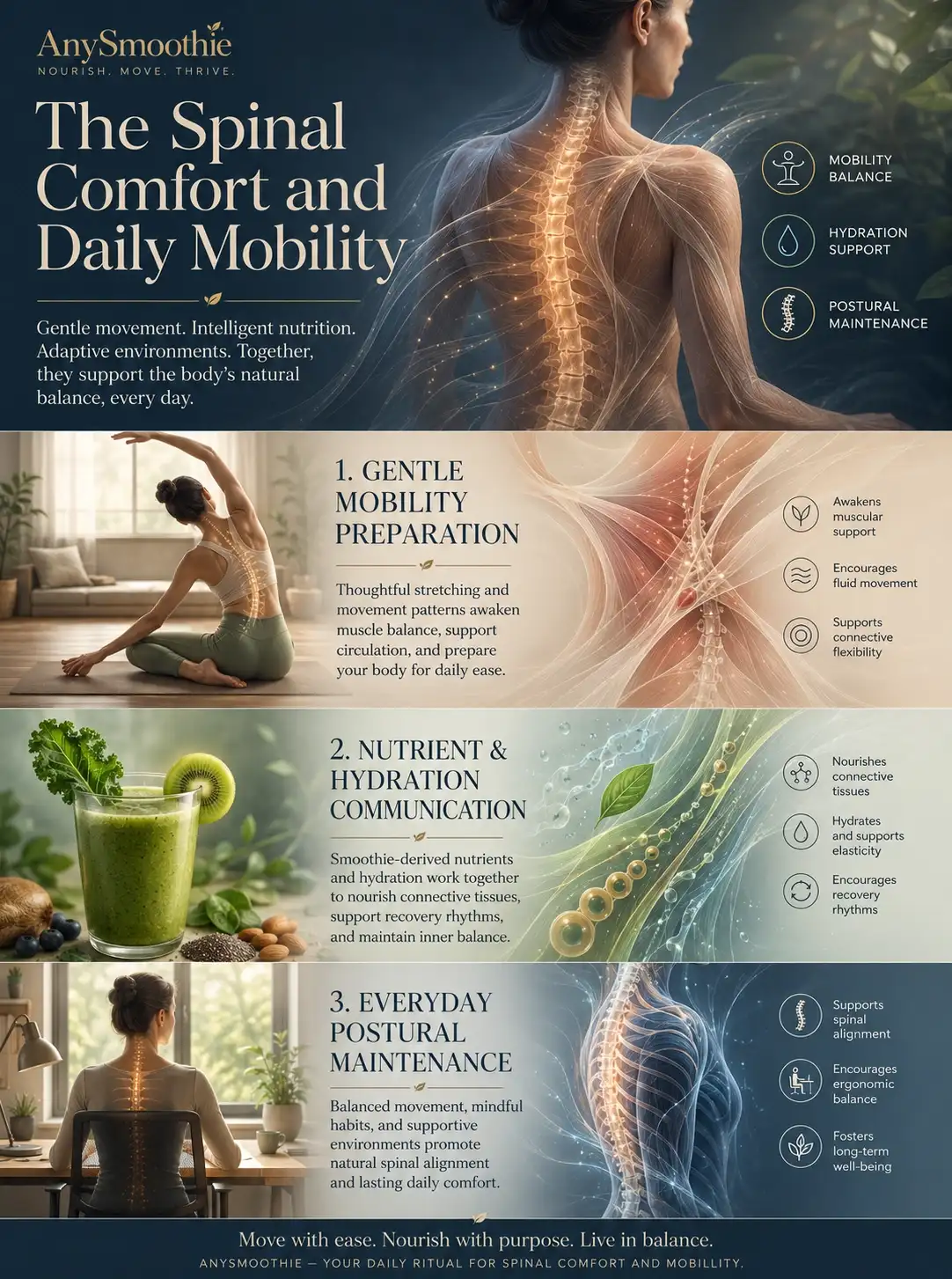
The “Spinal Flow” Routine: 3 Essential Home Stretches
This short routine is about space, breath, and less guarding around the spine. Move slowly. Never force range. If pain gets sharper, stop.
Decompression Mechanics: Creating Space Between the Vertebrae
These stretches change spinal load for a moment, which may ease compression and muscle bracing. They also pair well with myofascial release, because tight fascia can pull on the back like a snug shirt. For a general overview of safe options, at-home spinal decompression basics can help.
Child’s Pose for gentle vertebral decompression
Start on hands and knees. Bring your hips toward your heels, then reach your arms forward and let your chest soften toward the floor. Breathe into your low back for 20 to 40 seconds.
You should feel a broad stretch through the mid-back and lower back, not a pinch. If your knees complain, place a pillow behind them or widen them apart. Skip it if you feel sharp back pain.
Knees-to-chest to unload the lower back
Lie on your back with both feet down. Pull one knee toward your chest and hold for 20 seconds, then switch sides. If that feels good, bring both knees in and rock a little.
This can reduce lumbar pressure and help the lower back stop gripping. If mobility is limited, loop a towel behind one thigh and guide the leg in without straining your hands or neck.
Cat stretch and light myofascial release for stiff spinal muscles
Start on all fours. As you exhale, round your back gently and let your shoulder blades spread. As you inhale, return to neutral, not a deep sway. Repeat for 6 to 8 slow rounds.
After that, use a foam roller or massage ball beside the spine, not on the bones themselves. Roll the paraspinal muscles with light pressure for 30 seconds each side. This can ease fascial tightness and help the back tolerate decompression work better.
3 Anti-Inflammatory Smoothies for Spinal Support
Smoothies won’t “fix” a disc, but they can support hydration, recovery, and calmer tissue tone. They work best when sleep, walking, and stretching are already in place.
The “Disc-Hydrator” Aloe and Cucumber Cooler
Ingredients:
- 1/2 cup aloe vera juice
- 1 cucumber
- 1 cup spinach
- Juice of 1/2 lemon
- 1 small piece ginger
- 1 cup cold water
Blend 1/2 cup aloe vera juice, 1 cucumber, 1 cup spinach, juice of 1/2 lemon, a small piece of ginger, and 1 cup cold water. This mix is light, hydrating, and easy after morning stiffness.
Aloe, cucumber, and water help fluid intake. Ginger and lemon add a mild anti-inflammatory edge. Keep expectations grounded, because hydration supports comfort but doesn’t directly repair discs.
Estimated Nutrition per Serving
Estimated with unsweetened aloe vera juice and one medium cucumber.
- Calories: ~75 kcal
- Protein: ~3 g
- Carbohydrates: ~17 g
- Fat: ~1 g
- Fiber: ~3 g
- Sugars: ~7 g
This is a very light blend, so don’t expect the texture of a typical breakfast smoothie. Chilling the cucumber and aloe juice first makes it noticeably more refreshing without needing much ice.
A Turmeric Pineapple Blend for Everyday Back Comfort
Ingredients:
- 1 cup pineapple
- 1/2 banana
- 1/2 tsp turmeric
- Pinch black pepper
- 1 cup coconut water or unsweetened almond milk
Blend 1 cup pineapple, 1/2 banana, 1/2 teaspoon turmeric, a pinch of black pepper, and 1 cup coconut water or unsweetened almond milk. Use it earlier in the day or after light movement.
Pineapple contains bromelain, and turmeric is widely used for soreness support. Black pepper helps turmeric absorption. Broader anti-inflammatory eating guidance for back pain lines up with this kind of simple recipe.
Estimated Nutrition per Serving
Estimated with unsweetened coconut water.
- Calories: ~225 kcal
- Protein: ~3 g
- Carbohydrates: ~55 g
- Fat: ~1 g
- Fiber: ~6 g
- Sugars: ~38 g
A Berry and Spinach Smoothie to Support Calm Nerves and Muscle Recovery
Ingredients:
- 1 cup mixed berries
- 1 cup spinach
- 1/2 banana
- 1/4 avocado
- 1 tbsp chia seeds
- Water or almond milk, as needed
Blend 1 cup mixed berries, 1 cup spinach, 1/2 banana, 1/4 avocado, 1 tablespoon chia seeds, and water or almond milk. This one fits well later in the day.
Berries bring antioxidants. Spinach and chia add magnesium, while banana and greens add B vitamins that support normal nerve function and muscle recovery. That won’t treat sciatica, but it may support a calmer system during general back-care habits.
Estimated Nutrition per Serving
Estimated with 1 cup unsweetened almond milk.
- Calories: ~300 kcal
- Protein: ~7 g
- Carbohydrates: ~45 g
- Fat: ~12 g
- Fiber: ~14 g
- Sugars: ~20 g
Frozen berries work especially well here because avocado and chia already give the smoothie plenty of body. If it becomes too thick after sitting, add the liquid gradually rather than blending in more fruit.
Structural Support: Glucosamine, MSM, and Magnesium Stacking
Some people pair glucosamine sulfate, MSM, and magnesium to cover different needs at once. The idea is simple: cartilage support, connective-tissue sulfur, and muscle relaxation. That stack may help some adults feel better, but it is not a proven disc rehydration method.
Neural Calm: Reducing Sciatic Irritation Through B-Vitamin Rich Blends
If leg tension or nerve irritation tags along with back stiffness, food can still help. Spinach, banana, avocado, and berries bring magnesium, folate, and other B-vitamin support. Pairing those foods with gentle stretching often feels more sustainable than relying on supplements alone. B-vitamins, particularly B12 and Folate found in leafy greens, are essential for maintaining the myelin sheath—the protective coating of your nerves—which is crucial when dealing with minor sciatic irritation.
Conclusion
Spinal comfort usually improves through small, repeatable habits. A few minutes of decompression-focused stretching, steady hydration, and one supportive smoothie can do more for daily comfort than a short burst of extreme effort.
The main point is plain: disc support, pressure relief, and muscle relaxation work together. Movement changes load, fluids support tissue function, and better muscle tone gives your spine a calmer environment.
If symptoms keep building, don’t wait it out. Get medical care for numbness, severe pain, weakness, bowel or bladder changes, or back pain that keeps getting worse instead of settling down.
🛡️ Safety Notes & Dietary Interactions
- Intervertebral Disc Hydration and Mechanical Load Distribution: Spinal discs rely heavily on water balance, pressure changes, and glycosaminoglycan-rich structures like aggrecan to maintain flexibility and shock absorption. Long periods of sitting or static posture may reduce fluid exchange dynamics, which is why regular movement and hydration often feel more supportive than aggressive stretching or forceful decompression routines alone.
- Myofascial Tension and Paraspinal Muscle Guarding: Tight fascia and chronically contracted spinal muscles can increase the sensation of compression even when structural damage is minimal. Gentle decompression movements, slower breathing, and light myofascial release may help reduce protective muscle guarding and improve movement tolerance without pushing irritated tissues into sharper discomfort.
- Connective Tissue Nutrition and Sulfur-Dependent Structural Support: MSM, glucosamine sulfate, magnesium, and collagen-supportive nutrients are frequently discussed because connective tissues depend on sulfur-containing compounds, hydration balance, and mineral availability to maintain resilience. These strategies support general tissue quality and recovery rhythms, but current evidence does not show that smoothies or supplements directly “rebuild” spinal discs.
- Neural Calm and Inflammatory Load Management: Smoothies rich in magnesium, polyphenols, omega-3 fats, and hydration-supportive ingredients may help support calmer neuromuscular signaling and steadier tissue tone during periods of stiffness or postural stress. However, severe numbness, weakness, worsening pain, or bowel and bladder changes require proper medical evaluation rather than home-based wellness experimentation.
FAQ
Why does sitting for long periods often make the spine feel tighter or more compressed?
Extended sitting places relatively constant mechanical load on spinal tissues while reducing movement-driven fluid exchange inside and around the discs. Over time, surrounding muscles may tighten protectively, creating the sensation of stiffness or compression. Gentle mobility work, walking, hydration, and position changes help interrupt that static loading pattern and often make the spine feel less restricted.
How do hydration and glycosaminoglycans relate to disc comfort?
Spinal discs contain water-attracting compounds called glycosaminoglycans, especially aggrecan, which help maintain cushioning and flexibility. When hydration status or tissue quality declines, discs may lose some of their shock-absorbing resilience. While hydration alone cannot reverse degeneration, steady fluid intake combined with movement may support healthier pressure exchange and daily spinal comfort patterns.
Why are magnesium and MSM commonly used in spinal wellness routines?
Magnesium participates in muscle relaxation and cellular energy production, while MSM provides sulfur compounds associated with connective tissue structure and flexibility. In wellness-focused routines, these nutrients are often paired together because spinal comfort depends not only on joints and discs, but also on fascia, ligaments, and surrounding muscle tone that influence how tension distributes across the back.
How can smoothies support spinal recovery without claiming to “heal” discs?
Hydration-focused smoothies can provide minerals, antioxidants, polyphenols, and connective tissue-supportive nutrients that contribute to broader recovery and tissue comfort patterns. Ingredients like berries, spinach, chia, cucumber, aloe, turmeric, and avocado support hydration balance and oxidative stability while also making nutrient intake easier during stressful or physically demanding periods.
Why do gentle stretches often work better than aggressive spinal cracking or forcing mobility?
The spine usually responds better to gradual decompression and nervous-system calming than forceful manipulation when tissues are irritated or guarded. Slow stretches like child’s pose, knees-to-chest movements, and controlled cat stretches temporarily change spinal loading patterns while helping surrounding muscles reduce protective tension. Consistency and comfort generally matter more than intensity for long-term mobility habits.

Medical Disclaimer: AnySmoothie content is for educational purposes only and is not a substitute for professional medical advice. Consult a healthcare provider for personalized guidance. See our full Disclaimer & Terms of Use. AI Transparency: AnySmoothie may use AI to support content development. All content undergoes human editorial review for accuracy, clarity, and editorial quality. See our full AI Transparency.