

Smoothies feel light, but your gut does not treat them as background noise. When you want support for migrating motor complex function, meal timing matters as much as ingredients.
The migrating motor complex, or MMC, works best when your digestive tract gets real breaks between meals. A smoothie can fit that rhythm, but it can also interrupt it if it shows up too often, tastes too sweet, or gets loaded with fat and fiber.
The good news is simple. With the right formula, a smoothie can stay useful without turning into constant grazing. The sections below cover how the MMC works, what to build with, what to avoid, and three recipes that keep the balance right.
What the migrating motor complex does between meals
The migrating motor complex is a repeating wave of muscle activity in the stomach and small intestine. During fasting periods, it helps move leftover particles and other debris forward. A PubMed review on MMC control mechanisms describes it as a cyclic motility pattern that happens between meals.
In plain language, this is the gut’s cleanup cycle. It does not run at full speed when food keeps arriving.
Constant snacking can keep the digestive system in a fed state. That includes liquid calories. A smoothie every hour still counts as eating, so the gut never gets the same kind of pause.
Liquid meals still count. A smoothie can support your routine, or keep the cleanup cycle from starting.
Why long gaps between meals matter for gut motility
Longer gaps between meals give the digestive tract room to reset. The stomach empties, the small intestine clears residue, and motility shifts back toward a fasting pattern. That pause is when the MMC can do its work.
If you want smoothies for migrating motor complex support, timing matters just as much as the recipe. A smoothie works better when it replaces a meal or fits inside a real eating window. Sipping one all afternoon keeps the system busy.
Why smoothies can help or hurt depending on how they are built
Smoothies are easy to overrate because they are liquid. Still, the body responds to sugar load, fat level, fiber type, and portion size.
A large fruit smoothie can hit fast and hard. Too much sweetness can leave you hungry again soon, and too much fat can slow digestion more than you want. On the other hand, a balanced blend with protein and moderate fiber can feel steady and satisfying. The difference is the formula, not the blender.
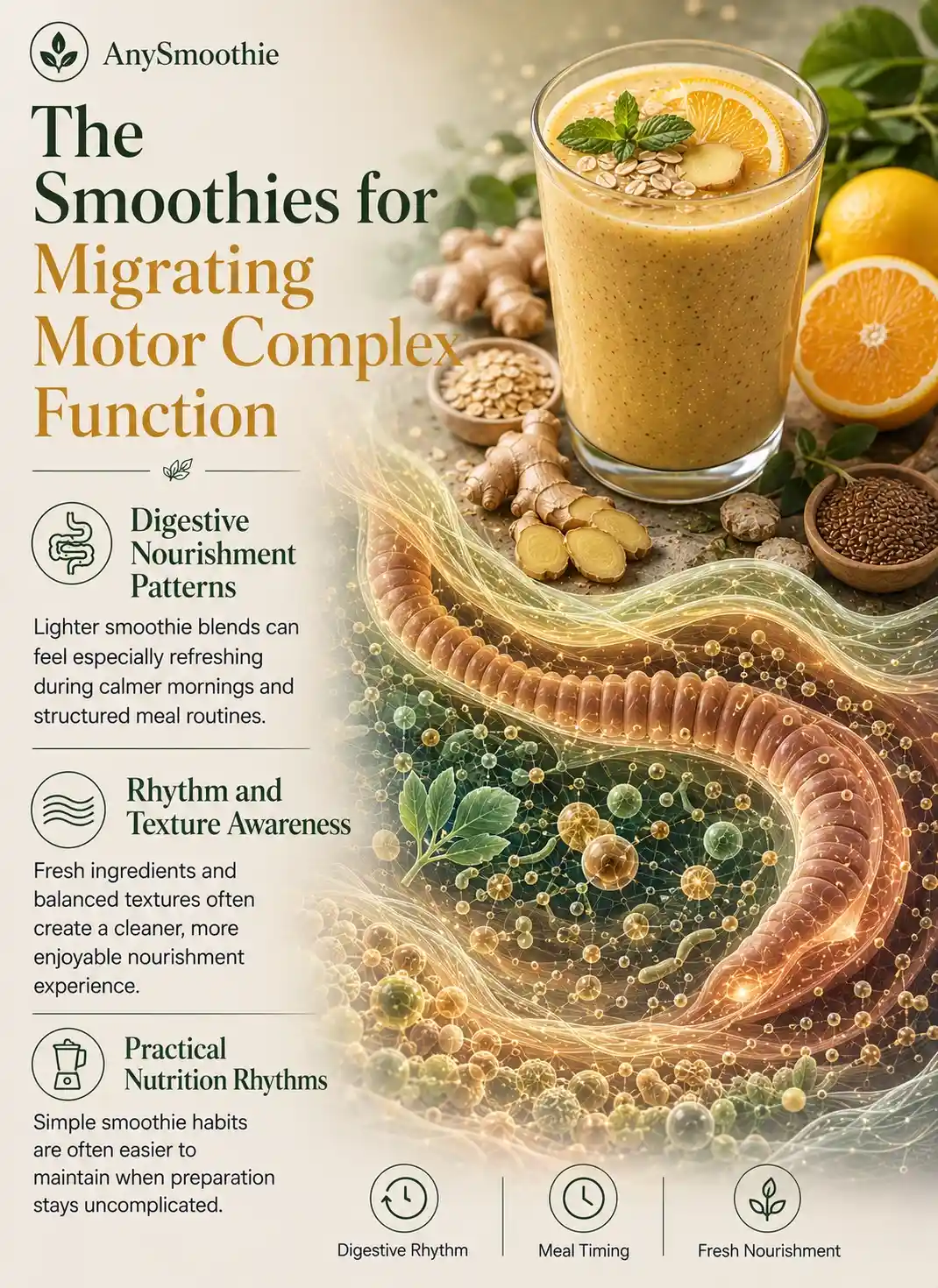
How to build smoothies for digestive motility support
A good MMC-friendly smoothie starts with restraint. Keep the ingredient list short, the serving size moderate, and the sugar load under control. A useful reference point is the ScienceDirect overview of the migrating motor complex, which describes the MMC as the small intestine’s housekeeping pattern.
Choose a protein source that digests well. Collagen peptides, a clean protein powder, kefir if you tolerate dairy, or a yogurt alternative can all work. Protein helps balance the drink and keeps it from turning into a fruit-only blend.
Use fiber in a smart way. Small amounts of chia, ground flax, berries, spinach, or cucumber can add structure and smooth out the blood sugar curve. Too much insoluble fiber can feel rough for sensitive digestion, so start light.
Keep fats and sweeteners moderate. A spoonful of nut butter, a little avocado, or a touch of coconut can make the smoothie more filling. Too much of any of them can slow digestion more than you want. The same goes for honey, juice, and dried fruit.
If the smoothie tastes like dessert, it probably needs less fruit and fewer extras.
3 Smoothie recipes for migrating motor complex function
The recipes below keep the same basic shape, then shift the flavor and texture. They work best as templates, not rules.
| Recipe | Main benefit | Key ingredients | Best time to use | Digestion profile |
|---|---|---|---|---|
| Berry Collagen | Light and lower in sugar | Almond milk, collagen, berries, flax or chia | Morning between meals | Light, smooth, easy |
| Green Protein | Steadier energy | Spinach, protein, avocado, almond milk | Mid-morning or post-workout | Balanced, moderate |
| Cinnamon Cacao | More filling | Protein, cacao, cinnamon, almond butter | When you need a more substantial option | Richer, slower |
All three keep sugar in check and avoid the add-in pileup that can make a smoothie feel heavy.
Common smoothie mistakes that can interrupt MMC-friendly eating
The biggest mistake is assuming any healthy smoothie fits the same job. A smart blend can support your routine, but a sloppy one can keep you in a constant eating pattern.
Hidden sugar and oversized portions
Mango, banana, juice, dates, and large pours can push a smoothie toward a high sugar load. That matters when the goal is to give the gut a real break. A smaller serving with one sweet element usually works better than a giant blended bowl.
Too many add-ins that make digestion harder
More ingredients do not always improve the result. Protein powder, nut butter, seeds, greens, supplements, and fiber boosters can pile up fast. The drink can end up heavy, gritty, or hard to tolerate. If your smoothie needs a spoon, it may be too dense for this purpose.
Conclusion
Smoothies can fit MMC-friendly eating when they stay simple, balanced, and tied to real gaps between meals. The best versions use modest protein, controlled fiber, and only a small amount of fat or sweetener.
The berry collagen, green protein, and cinnamon cacao recipes give you three clean starting points. Try one, watch how your digestion responds, and adjust the size before changing everything else. A good smoothie should support your routine and still leave room for the gut’s cleanup cycle to do its job.

Medical Disclaimer: AnySmoothie content is for educational purposes only and is not a substitute for professional medical advice. Consult a healthcare provider for personalized guidance. See our full Disclaimer & Terms of Use. AI Transparency: AnySmoothie may use AI to support content development. All content undergoes human editorial review for accuracy, clarity, and editorial quality. See our full AI Transparency.