
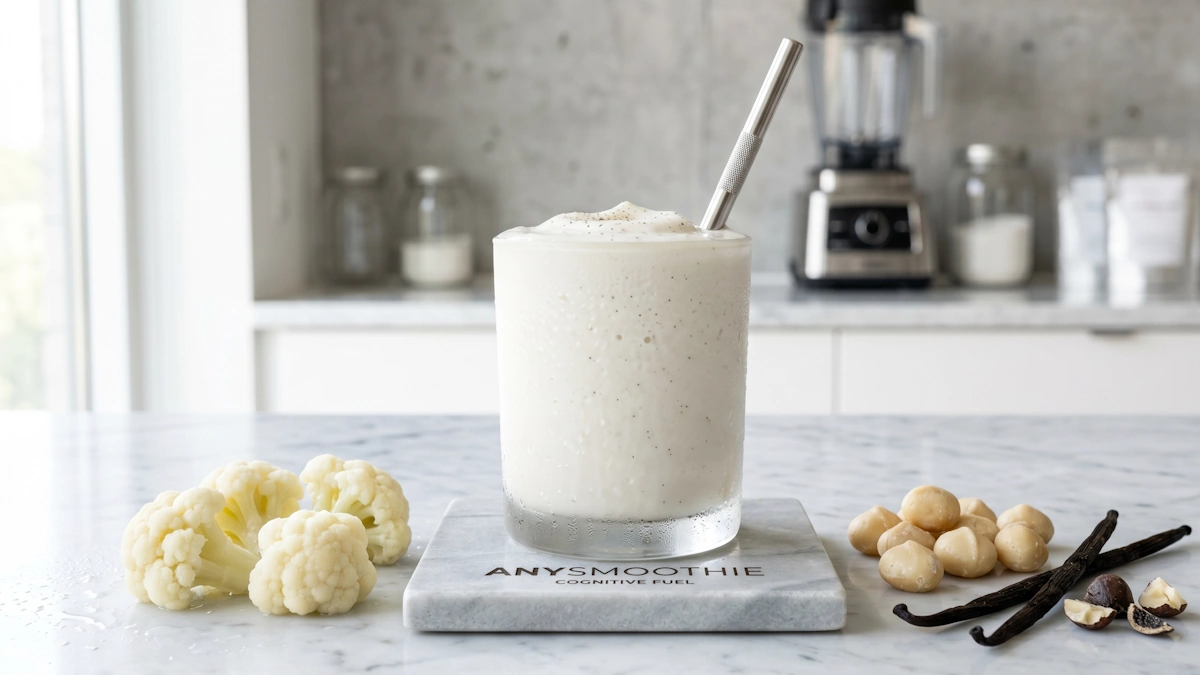
A smoothie can do more than taste good in the morning. With the right base, it can also support a nutrient pattern that fits brain-focused eating. Cauliflower smoothies for choline work well because cauliflower brings body, mild flavor, and a gentle way to pack more food into the glass without a heavy taste.
That matters when you want support for focus and memory without a strong vegetable note. Choline helps make acetylcholine, and it also helps build phospholipids for cell membranes. The trick is making the blend taste good enough to repeat. That is where steamed cauliflower, fats, and smart flavor pairings come in.
The White Crucible: Why Cauliflower Is a Brain-Power Essential
Cauliflower is easy to underestimate. It is mild, low in sugar, and highly adaptable, which makes it useful in a smoothie built for consistency. Steamed cauliflower adds thickness without the grassy edge that can show up in raw greens.
It also brings fiber and a soft, creamy texture. That matters if you want a smoothie that feels filling but still light. For a plain-language overview of choline in food, Harvard’s choline overview is a good reference point.
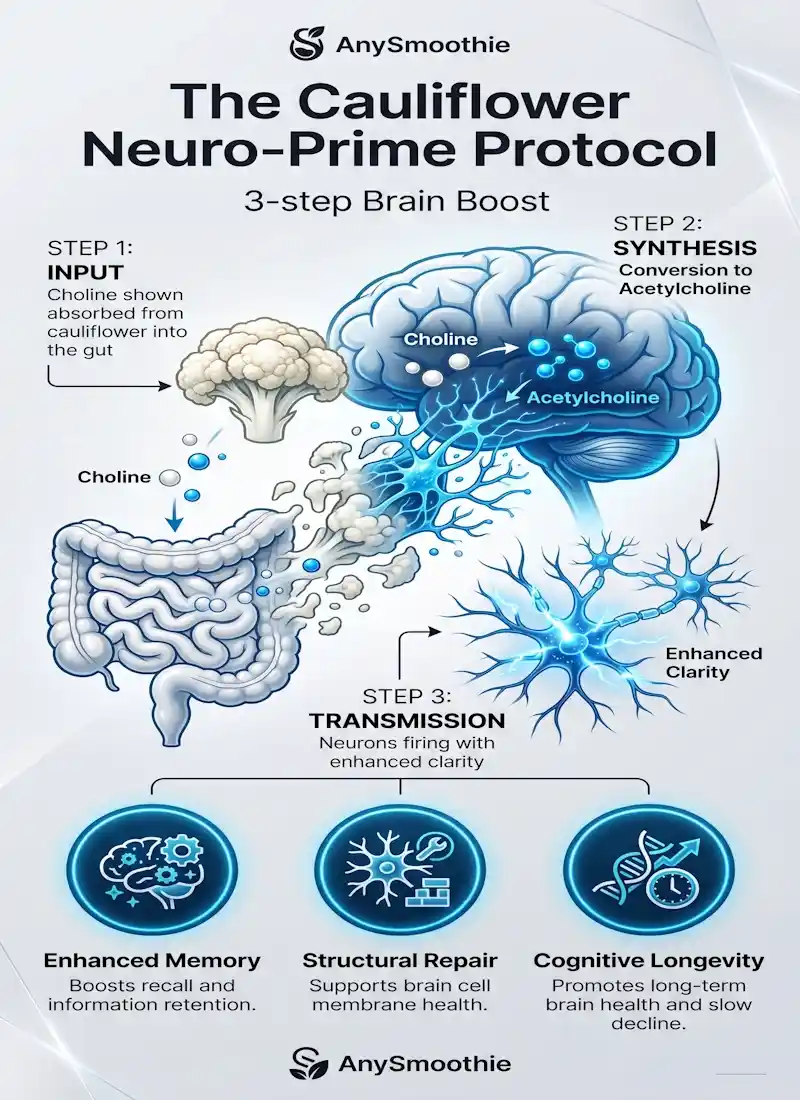
Choline Dynamics: Fueling the Neurotransmitter of Focus
Choline is a nutrient your body uses in several ways. One job is supporting acetylcholine, a neurotransmitter tied to attention and memory. Another is helping build phospholipids, which are part of healthy cell membranes.
That is why choline shows up in brain-health conversations so often. It helps support normal nervous system function, and it fits well in a food-first routine. Cauliflower does not match egg yolks for choline density, but it does add a useful base for a blend you can drink often.
Steamed cauliflower as a neural-neutral base for high-potency blends
Steamed cauliflower is almost neural-neutral in flavor. That means it stays out of the way and lets other ingredients do the heavy lifting. Once steamed, it blends smoother, tastes softer, and works better with fats like nut butter or avocado.
A mild base is useful because it gives you room to add more nutrient-dense ingredients without making the smoothie taste like vegetables.
That same soft texture helps the drink feel more substantial. For people who want a lighter smoothie that still satisfies, cauliflower is hard to beat.
How Cauliflower Compares With Other Choline Sources in Smoothies
Here is a simple side-by-side look at common smoothie options.
| Choline source | Choline density | Dietary fit (vegan/allergy-friendly) | Impact on lipid profile | Best smoothie texture contribution |
|---|---|---|---|---|
| Egg yolks | High | Not vegan, common egg allergy | Adds dietary cholesterol and more fat | Rich, but can taste savory |
| Cauliflower (steamed) | Moderate | Vegan, egg-free, dairy-free | Low impact on lipid profile | Adds body and a mild, neural-neutral base |
| Soy or sunflower lecithin | Moderate | Usually vegan, watch soy allergy | Adds phospholipids, little whole-food bulk | Strong emulsifier, very smooth |
Egg yolks are the most choline-dense of the three. Lecithin is useful when you want a smoother mouthfeel. Cauliflower wins on daily ease because it fits many diets and does not change the flavor much. Cleveland Clinic also lists cooked cauliflower among practical choline foods, alongside better-known sources like eggs and legumes. See their choline food list for a simple reference.
When cauliflower makes more sense than eggs or lecithin
Cauliflower is the better choice when you avoid eggs, want a vegan base, or need a milder flavor. It also works well when you want more volume without a rich lip profile. Eggs still bring more choline per serving, but they are not as flexible in a sweet smoothie.
Lecithin can help with emulsification, yet it does not give you the same whole-food body. Cauliflower gives you texture, fiber, and room to build the rest of the drink around it.
Build a Smoothie That Supports Choline Use and Brain Fuel
Choline works best in a recipe that does not stop at choline alone. Pairing matters. In plain terms, some nutrients are easier to use when they ride with fats and protein. That is the basic idea behind nutrient partitioning in a smoothie.
Pair cauliflower with fats that help create a smoother blend
Fat improves mouthfeel fast. Avocado, nut butter, coconut milk, and lecithin make the blend creamier and more satisfying. They also support lipid transport, which matters when you are building a smoothie meant to feel balanced.
A small amount is enough. You want enough fat to smooth the texture, not so much that the drink feels heavy. A spoon of almond butter or a few chunks of avocado usually does the job.
Use fruit, spices, and protein to make the flavor work
Fruit covers cauliflower’s mild taste well. Banana adds sweetness, berries add brightness, and cocoa or cinnamon adds depth. Vanilla softens the edge, while protein powder helps the smoothie feel like a meal.
The best recipe is one you want to finish. If the texture is pleasant and the flavor is balanced, you will use it more often.
3 Cauliflower Smoothies for Brain-Friendly Mornings
The “Smart-Cream” cauliflower, macadamia, and vanilla blend
This is the richest option. Steamed cauliflower, macadamia butter, vanilla, and a touch of cinnamon make a silky drink with a mellow taste. It is a good pick when you want breakfast to feel steady and dense without being heavy.
Ingredients
- 100 g cauliflower (steamed, cooled)
- 1 tbsp (15 g) macadamia butter
- 200 ml plant milk (almond or oat)
- ½ tsp vanilla extract
- Pinch of cinnamon
- 1–2 tsp maple syrup (optional)
- 3–4 ice cubes (optional)
Instructions
Blend until smooth and creamy (30–45 seconds). Adjust thickness with ice if needed.
Estimated Nutrition per Serving
- Calories: ~190 kcal
- Protein: ~5 g
- Carbohydrates: ~16 g
- Fat: ~13 g
- Fiber: ~4 g
- Sugars: ~7 g
Berry-cauliflower blend for a bright, fresh flavor
This version uses blueberries or mixed berries to hide the vegetable base. The color stays vivid, and the taste stays light. It works well for anyone who wants a fruit-first smoothie with more body than a standard berry blend.
Ingredients
- 80 g cauliflower (steamed, cooled)
- 120 g blueberries or mixed berries (fresh or frozen)
- 200 ml plant milk or water
- 1 tbsp (10 g) chia seeds
- 1 tsp honey or maple syrup (optional)
- Juice of ¼ lemon
Instructions
Blend until smooth and evenly colored. Use frozen berries for a thicker texture.
Estimated Nutrition per Serving
- Calories: ~165 kcal
- Protein: ~5 g
- Carbohydrates: ~27 g
- Fat: ~5 g
- Fiber: ~9 g
- Sugars: ~13 g
I’d use frozen blueberries here if possible. They give the smoothie enough thickness to make the cauliflower almost disappear into the texture without needing additional sweetener.
Mocha-style cauliflower smoothie for a focused start
Cocoa, coffee or decaf coffee, steamed cauliflower, and a creamy fat source make a strong morning blend. Keep it lightly sweet. The result tastes closer to a café drink than a vegetable smoothie, which makes it easy to repeat.
Ingredients
- 100 g cauliflower (steamed, cooled)
- 1 tsp unsweetened cocoa powder
- 60 ml brewed coffee (or decaf, cooled)
- 140 ml plant milk
- 1 tbsp almond butter or coconut cream
- 1–2 tsp maple syrup (optional)
- 3–4 ice cubes (optional)
Instructions
Blend until smooth and slightly frothy. Taste and adjust sweetness if needed.
Estimated Nutrition per Serving
- Calories: ~180 kcal
- Protein: ~6 g
- Carbohydrates: ~17 g
- Fat: ~11 g
- Fiber: ~5 g
- Sugars: ~7 g
Steaming, Freezing, and Blending Tips that Make the Texture Better
Raw cauliflower can work, but steamed cauliflower usually blends better. Steaming softens the fiber, mutes the sulfur note, and helps the smoothie feel less grainy. For many people, it also feels easier on the stomach.
Freezing steamed florets makes prep easier later. Batch steam a few heads, portion them into freezer bags, and keep smoothie packs ready. That small habit turns a good idea into a routine.
Raw vs. steamed cauliflower for smoother blends and better flavor
Raw cauliflower gives a sharper taste and more bite. Steamed cauliflower gives a smoother finish and a cleaner blend. If you want a creamy drink, steamed is the better move.
Simple prep habits that save time during the week
Freeze one-cup portions. Add fruit, protein, and fat to small containers ahead of time. Then blend and go. Routine beats perfection here.
Conclusion
Cauliflower smoothies for choline make sense because they are mild, flexible, and easy to use often. Cauliflower gives you a neutral base, while fats and protein help the smoothie feel complete and balanced.
Steaming matters too, because it improves texture and softens the flavor. Start with one simple recipe this week, then adjust the fruit, fat, and spice until it fits your morning well.
⚠️ Safety Notes for Cauliflower Brain-Health Smoothies
Goitrogens and Thyroid Health: Raw cauliflower contains goitrogens that can interfere with iodine uptake. Always steam or cook your cauliflower before freezing it for smoothies. Heat deactivates most goitrogens, making it much safer for individuals with thyroid sensitivities.
Digestive Comfort (FODMAPs): Cauliflower is high in mannitol (a polyol). If you have IBS or follow a low-FODMAP diet, even small amounts of cauliflower can cause significant bloating and gas. Start with a very small portion (1/4 cup) to test your tolerance.
Sulfur Sensitivity: If you are sensitive to sulfur-rich foods, the compounds in cauliflower may cause digestive distress or skin flare-ups. Pair it with ginger or mint to help soothe the digestive tract and neutralize sulfur notes.
Choline Intake Limits: While rare from food alone, excessive choline intake (above 3.5g/day) can lead to a “fishy” body odor, sweating, or low blood pressure. Stick to 1-2 cups of cauliflower per day as part of a balanced diet.
Oxalates: Like many vegetables, cauliflower contains oxalates. If you are prone to kidney stones, ensure you include a source of calcium (like dairy or fortified milk) in your smoothie to bind oxalates in the gut.
FAQ
How does steamed cauliflower support the endogenous production of Acetylcholine?
Cauliflower provides a dietary source of free choline, a foundational precursor for the neurotransmitter acetylcholine. Biochemically, choline is transported into the brain via specific carrier systems where it undergoes acetylation. Supporting this physiological system through a fiber-rich, steamed vegetable base ensures a steady delivery of precursors, optimizing the natural pathways of cognitive signaling and supporting long-term memory maintenance without the glycemic spikes associated with fruit-heavy blends.
Why is the presence of dietary lipids essential for choline partitioning?
Choline is a water-soluble nutrient, but its integration into cellular structures—specifically phospholipids like phosphatidylcholine—requires a balanced lipid environment. Including healthy fats such as macadamia butter or avocado in a cauliflower smoothie supports the physiological systems involved in lipid transport and nutrient partitioning. This biochemical synergy ensures that choline is efficiently directed toward the repair of neuronal membranes and the maintenance of structural integrity within the central nervous system.
How does steaming cauliflower influence its sulfur compounds and digestive transit?
Steaming cauliflower reduces the concentration of goitrogens and softens the complex cellulose fibers. Biochemically, this heat treatment mutes the sulfur-active compounds (glucosinolates) that can interfere with flavor and digestive efficiency. By optimizing the texture and chemical profile of the base, you support the physiological systems of the gut, ensuring that nutrient absorption is maximized and the “biochemical mechanics” of digestion remain smooth and non-irritating.
What is the role of choline in supporting the structural integrity of cell membranes?
Choline is a primary component of phosphatidylcholine, a phospholipid that makes up a significant portion of the eukaryotic cell membrane. Supporting the body’s choline pool through whole-food sources like cauliflower supports the physiological systems responsible for membrane fluidity and cellular signaling. This optimization ensures that natural pathways of waste removal and nutrient influx remain efficient, protecting the structural integrity of both hepatic and neural tissues.
In what way does Sunflower Lecithin complement cauliflower as a “Phospholipid Potentiator”?
While cauliflower provides whole-food choline, sunflower lecithin adds concentrated phospholipids that act as natural emulsifiers. Biochemically, this combination supports the physiological systems of lipid delivery, creating a more bioavailable “metabolic package.” This synergy optimizes natural pathways of brain-focused nutrition by ensuring that choline is delivered in multiple forms, supporting both neurotransmitter synthesis and the structural mechanics of the myelin sheath.

Medical Disclaimer: AnySmoothie content is for educational purposes only and is not a substitute for professional medical advice. Consult a healthcare provider for personalized guidance. See our full Disclaimer & Terms of Use. AI Transparency: AnySmoothie may use AI to support content development. All content undergoes human editorial review for accuracy, clarity, and editorial quality. See our full AI Transparency.