
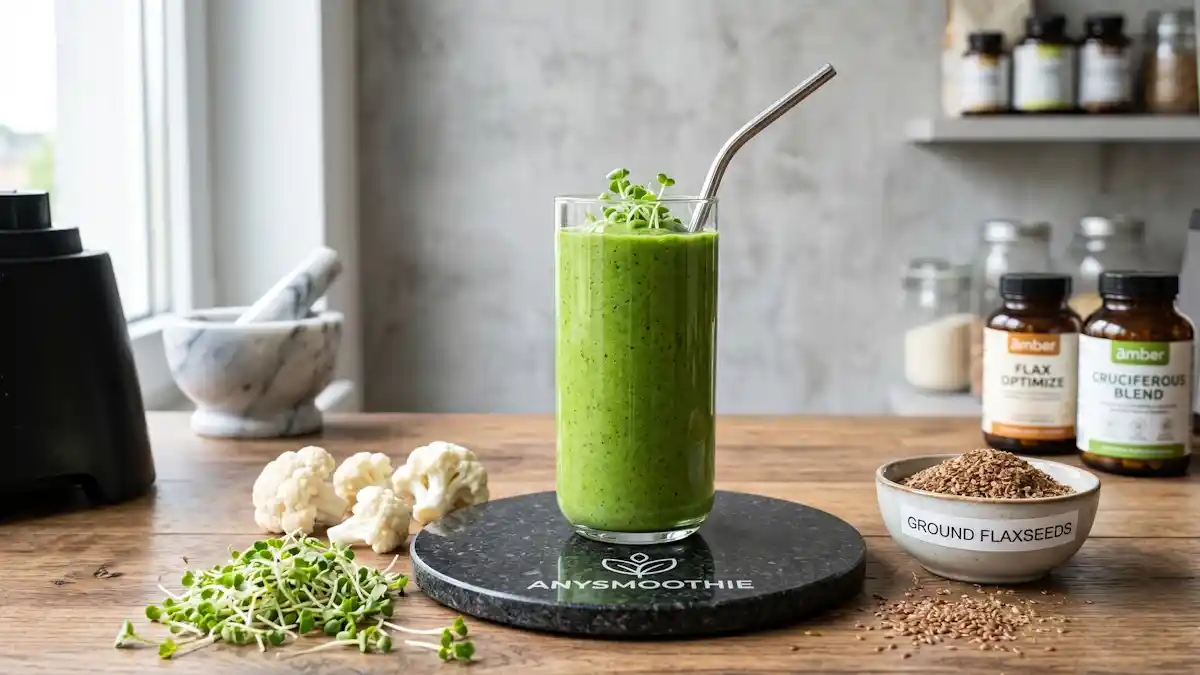
A smoothie can do more than taste good. With the right mix, it can support natural estrogen processing without turning breakfast into a science project.
That matters because your body has to break down, move, and clear hormones every day. In this article, the focus is on practical support, not medical promises. You’ll see how DIM, I3C, fiber, and cruciferous foods work together in smoothies that are easy to make and easy to repeat.
The estrogen pathway: why 2-OH and 16-alpha-OH matter
Estrogen does not leave the body in one piece. The liver first breaks it into smaller metabolites, then sends them through paths that make them easier to clear. Two of the best-known paths are 2-OH and 16-alpha-OH.
People pay attention to that balance because the 2-OH route is often viewed as a lighter, less active form, while the 16-alpha-OH route is more persistent. Better metabolism supports hormone balance and normal elimination.
The liver does the first pass, but the gut and bowel matter too. If the body makes metabolites but does not clear them well, the process backs up. That is why smoothie ingredients need to do more than add flavor.
Cytochrome P450: the enzyme system that starts the process
Cytochrome P450 enzymes start the breakdown. They act like the first filter in a cleanup line. Once they begin hydroxylation, the rest of the clearance process can move forward.
This is where cruciferous foods come in. Broccoli, cabbage, kale, and sprouts contain compounds that support this enzyme activity. For a deeper technical view, the Metagenics review on estrogen metabolism lays out the Phase I and Phase II pathway clearly.
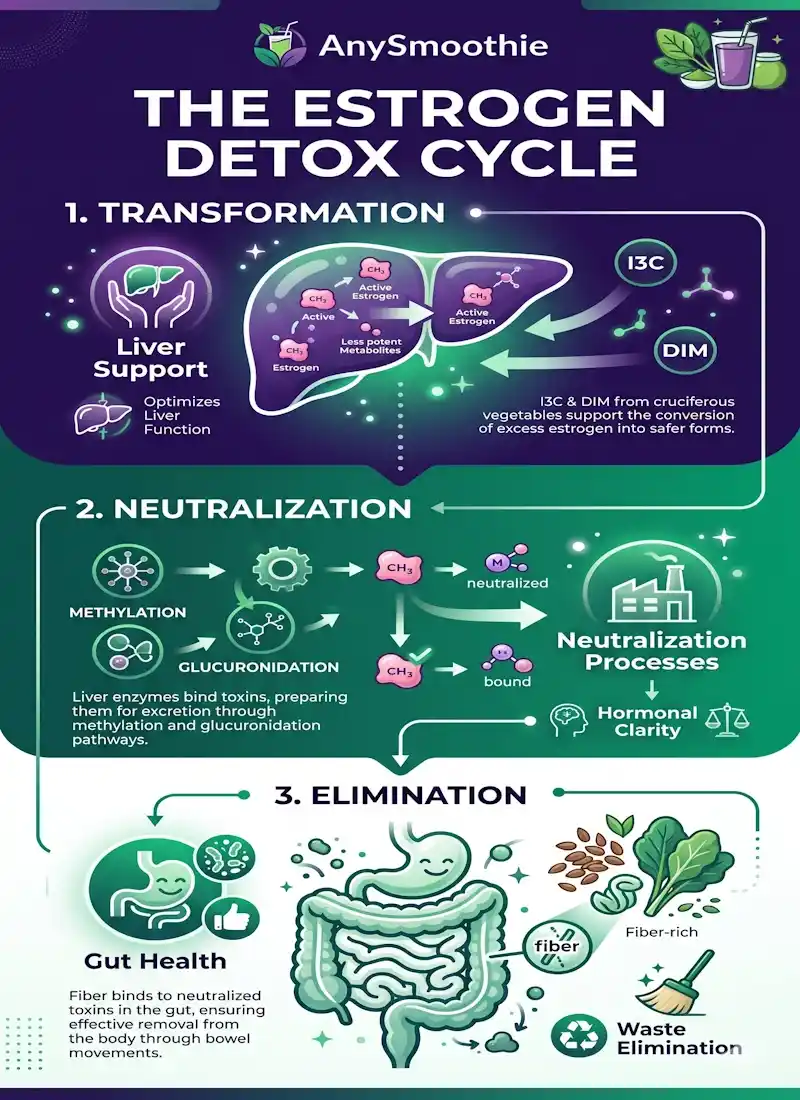
How DIM and I3C work in the body
I3C, or indole-3-carbinol, comes from cruciferous vegetables. In the stomach, it converts into several compounds, including DIM. That conversion matters because DIM is the form most people talk about when they discuss estrogen balance.
Both compounds support Phase I detox and help steer estrogen metabolism in a better direction. The point is not to force hormones down. The point is to support the body’s own processing system with the right raw materials.
The basic comparison is simple:
| Compound | Biochemical mechanism | Target phase | Best food source | Synergistic smoothie pairing |
|---|---|---|---|---|
| DIM | Supports healthy CYP modulation and estrogen metabolite balance | Phase I | Broccoli, cabbage, kale, Brussels sprouts | Brassica smoothie with broccoli sprouts and pineapple |
| I3C | Precursor to DIM, supports CYP activity after digestion | Phase I | Raw or lightly cooked crucifers | Green smoothie with sprouts, citrus, and flax |
| Calcium D-glucarate | Supports beta-glucuronidase inhibition, helps keep conjugated metabolites moving out | Elimination support | Apples, oranges, and supplement form | Berry-flax smoothie with high fiber and citrus |
Calcium D-glucarate matters because it fits the elimination stage. If clearance slows in the gut, support upstream loses value.
A useful review on indoles and hormone signaling is available through PubMed Central. It gives a solid sense of how I3C and DIM interact with estrogen metabolism.
Sulforaphane and glucosinolates: the cruciferous backup team
Broccoli sprouts, kale, cabbage, and cauliflower also bring glucosinolates. When these break down, they can support sulforaphane formation, which helps activate Nrf2, a cell defense signal tied to cleanup and repair.
That is why cruciferous greens are so useful in smoothies. They do not work alone. They stack with DIM-style support and add a second layer of metabolic help.
The best smoothie ingredients for estrogen support
The best smoothies for this goal are not huge. They are balanced. Think of them as a delivery system for nutrients, fiber, and steady energy.
- Cruciferous greens like kale, cabbage, and broccoli sprouts help support hormone-processing enzymes.
- Berries add polyphenols and taste, which makes the smoothie easier to repeat.
- Ground flaxseed adds fiber and helps the gut move metabolites out.
- Citrus supports flavor and adds a bright, clean finish.
- Protein or healthy fat helps with nutrient partitioning and keeps the smoothie from becoming a sugar hit.
If the smoothie has great ingredients but no fiber, it only solves half the job.
The fiber-estrobolome link: why elimination matters
Fiber helps move waste through the gut. That matters because some estrogen metabolites can be reprocessed and sent back into circulation if they sit too long.
That gut microbes and estrogen system is often called the estrobolome. It is a simple idea with real consequences. Low fiber, slow bowels, and frequent constipation can work against your goal.
This is also where calcium D-glucarate fits again. It supports the clearance side of the process, especially when the rest of the routine is solid.
3 hormone-balance smoothie recipes you can actually make
The Brassica-Boost smoothie with broccoli sprouts, pineapple, and flax
Ingredients
- 1 cup unsweetened almond milk
- 1/2 cup frozen pineapple
- 1/2 cup steamed and chilled broccoli florets or cauliflower
- 1/4 cup broccoli sprouts
- 1 tbsp ground flaxseed
- 1 scoop plain protein powder
Pineapple softens the flavor, flax adds fiber, and broccoli sprouts make this the most direct DIM and I3C-style option.
Estimated Nutrition per Serving
- Calories: ~275 kcal
- Protein: ~29 g
- Carbohydrates: ~28 g
- Fat: ~8 g
- Fiber: ~8 g
- Sugars: ~12 g
The Berry-Methylation smoothie for daily phase II support
Ingredients
- 1 cup frozen mixed berries
- 1 cup spinach
- 1 tbsp chia seeds
- Juice of 1/2 lemon
- 1 cup unsweetened kefir
- 1 scoop plain protein powder, optional
This one supports methylation, fiber intake, and steady energy. It also tastes less “green,” which helps with consistency.
Estimated Nutrition per Serving
- Calories: ~270 kcal
- Protein: ~16 g
- Carbohydrates: ~38 g
- Fat: ~8 g
- Fiber: ~12 g
- Sugars: ~20 g
I’d blend the spinach with the kefir first, then add the frozen berries and chia. It breaks down the greens more completely and keeps the finished texture from becoming leafy or uneven.
The Citrus-Greens smoothie for a lighter, easier option
Ingredients
- 1 cup romaine or kale
- 1/2 cucumber
- Juice of 1 lemon or lime
- 1/4 avocado
- 1/2-inch piece fresh ginger
- 3/4 cup cold water
- 1/2 cup ice
This version is light, hydrating, and easy on the palate. It is a good starter smoothie when cruciferous flavors feel like too much.
Estimated Nutrition per Serving
- Calories: ~120 kcal
- Protein: ~3 g
- Carbohydrates: ~15 g
- Fat: ~8 g
- Fiber: ~6 g
- Sugars: ~4 g
How to build a smarter smoothie routine
Start with one smoothie a day or a few each week. Consistency matters more than loading the blender with every ingredient in the kitchen.
If cruciferous foods are new to you, begin with small amounts. Too much too soon can feel rough on digestion. Also, keep the rest of the day steady with protein, normal meals, sleep, and enough water. A smoothie works best as part of a routine, not as a rescue plan.
Conclusion
Smoothies can be an easy way to support natural estrogen processing when they are built with the right foods. DIM, I3C, fiber, and calcium D-glucarate all fit into the bigger picture of Phase I, Phase II, and elimination support.
Keep the formula simple. Use cruciferous foods, add fiber, and pick one recipe that fits your taste. Then repeat it often enough for the habit to work.
⚠️ Safety Notes for Estrogen Detox Smoothies
Hormonal Interaction: DIM and I3C are potent modulators. If you are on hormonal contraceptives (the pill), HRT, or treatments for estrogen-sensitive cancers (like Tamoxifen), consult your oncologist or gynecologist, as these ingredients can alter medication efficacy.
Goitrogens and Thyroid: Raw cruciferous vegetables contain goitrogens that can interfere with iodine uptake. If you have Hypothyroidism, steam your broccoli or cauliflower before blending to deactivate these compounds while preserving the indoles.
DIM and Headaches: A common side effect of DIM is a “detox headache” or changes in urine color (darker/orange). This is often due to the rapid shift in metabolites. Start with small amounts of cruciferous sprouts and ensure high water intake.
Glucuronidase and Gut Health: Calcium D-glucarate works best when the gut is healthy. If you have severe IBD or IBS, the high fiber and cruciferous load might cause temporary distress; introduce these smoothies gradually.
Interaction with P450 Meds: Since these smoothies induce Cytochrome P450 enzymes, they may speed up the metabolism of other drugs (e.g., painkillers or anti-seizure meds). Check with your pharmacist for potential interactions.
FAQ
How does DIM support the 2-OH hydroxylation pathway in Phase I?
Diindolylmethane (DIM) acts as a selective modulator of the Cytochrome P450 enzyme system, specifically favoring the 2-hydroxylation pathway over the 16-alpha-hydroxyestrone route. Biochemically, this supports the physiological systems of hormonal clearance by directing estrogen metabolites toward more stable, less proliferative forms. This optimization ensures that the natural pathways of steroid hormone turnover remain balanced, promoting systemic metabolic efficiency at a cellular level.
Why is the “Stomach-Acid” conversion of I3C to DIM critical for bioavailability?
Indole-3-Carbinol (I3C) is a precursor molecule that requires exposure to gastric acid to undergo condensation into bioactive oligomers, primarily DIM. Supporting this biochemical conversion is essential because DIM is the more stable compound responsible for the majority of estrogen-modulating effects. Including raw cruciferous sprouts in a smoothie supports the physiological systems of nutrient delivery, ensuring that the biochemical mechanics of digestion facilitate the production of these key hormonal co-factors.
What is the role of Calcium D-Glucarate in inhibiting Beta-Glucuronidase?
Calcium D-Glucarate is a salt of glucaric acid that supports the physiological systems of Phase II and Phase III detoxification. Biochemically, it inhibits the enzyme beta-glucuronidase, which is produced by certain gut bacteria and can “de-conjugate” estrogen, allowing it to be reabsorbed into the bloodstream. By maintaining the conjugation of estrogen metabolites, it optimizes the natural pathways of elimination and prevents the recycling of hormones through the enterohepatic circulation.
How does the “Estrobolome” influence systemic hormonal clearance?
The estrobolome is the collection of gut microbial genes specifically involved in the metabolism and excretion of estrogens. Supporting a healthy estrobolome through fiber-rich smoothie inputs like flaxseed and citrus pectin optimizes the natural pathways of metabolite exit. This biochemical environment ensures that once the liver has packaged estrogen for removal, the physiological systems of the gut effectively transport these compounds out of the body, maintaining overall hormonal homeostasis.
Why is Sulforaphane-induced Nrf2 activation vital for Phase II conjugation?
Sulforaphane, derived from glucosinolates in broccoli sprouts, is a potent inducer of the Nrf2 transcription factor. Biochemically, Nrf2 activation upregulates the production of enzymes involved in Phase II conjugation, such as glutathione S-transferases and UDP-glucuronosyltransferases. This enzymatic priming supports the physiological systems of cellular defense, ensuring that Phase I estrogen intermediates are rapidly neutralized and prepared for a clean exit through the body’s natural elimination routes.

Medical Disclaimer: AnySmoothie content is for educational purposes only and is not a substitute for professional medical advice. Consult a healthcare provider for personalized guidance. See our full Disclaimer & Terms of Use. AI Transparency: AnySmoothie may use AI to support content development. All content undergoes human editorial review for accuracy, clarity, and editorial quality. See our full AI Transparency.