
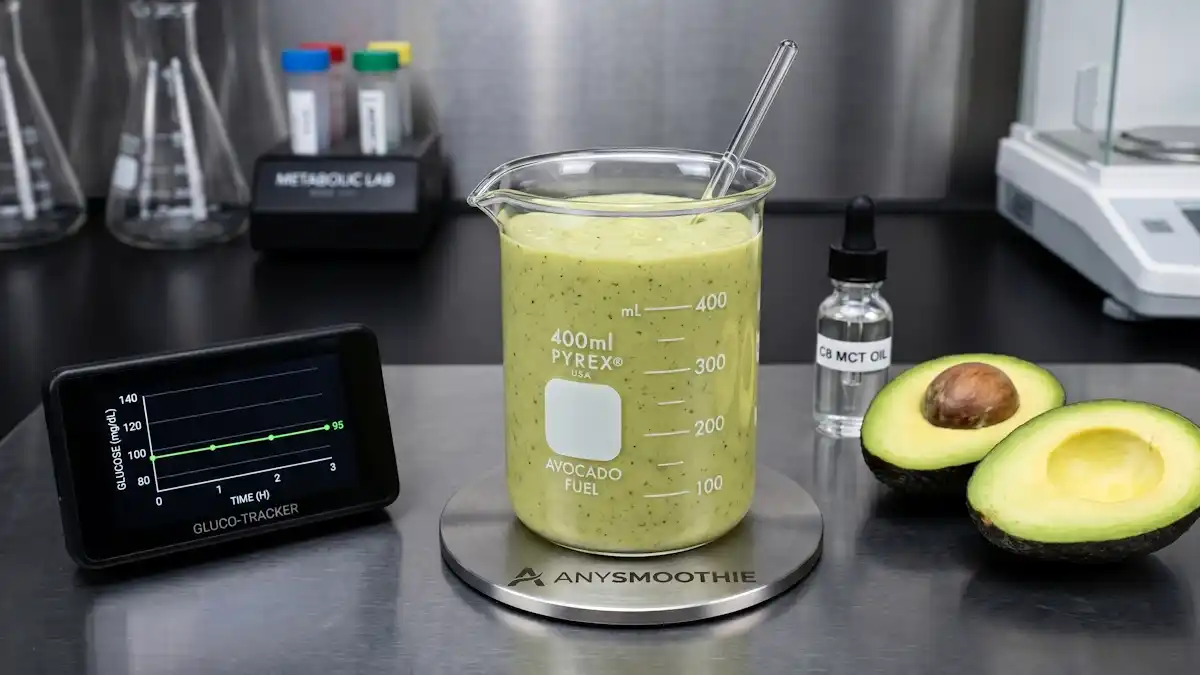
A smoothie can hit your bloodstream faster than a bowl of food if the formula is loose and fruit-heavy. That’s why low-carb smoothie formulations for glycemic stability work best when they slow sugar entry instead of chasing zero carbs.
The goal is simple. Keep the curve smoother, support fuel use beyond glucose, and make the drink satisfying enough that you don’t rebound an hour later. Ingredient choice matters more than the blender itself.
What makes a smoothie glycemic-friendly?
A glycemic-friendly smoothie is built like a brake system. Carbs, fat, fiber, and protein all change how fast the drink leaves the stomach and how quickly glucose reaches the blood.
Why liquid carbs can raise glucose faster than solid food
Blending breaks food structure apart. That matters because the gut has less work to do, so sugars can move through faster.
When the texture is thin, gastric emptying often speeds up too. The result is a faster glucose rise, which can feel like a quick lift followed by a dip.
The balancing act, carbs, fiber, fat, and protein
Fiber slows transit and adds bulk. Fat slows stomach emptying and can blunt the rush of sugar into the small intestine. Protein adds satiety, supports tissue repair, and gives the smoothie more staying power.
A thicker smoothie with fewer free sugars usually behaves more predictably than a thin, fruit-heavy one.
That is the basic logic behind glycemic-friendly blends. The formula is less about restriction and more about pacing.
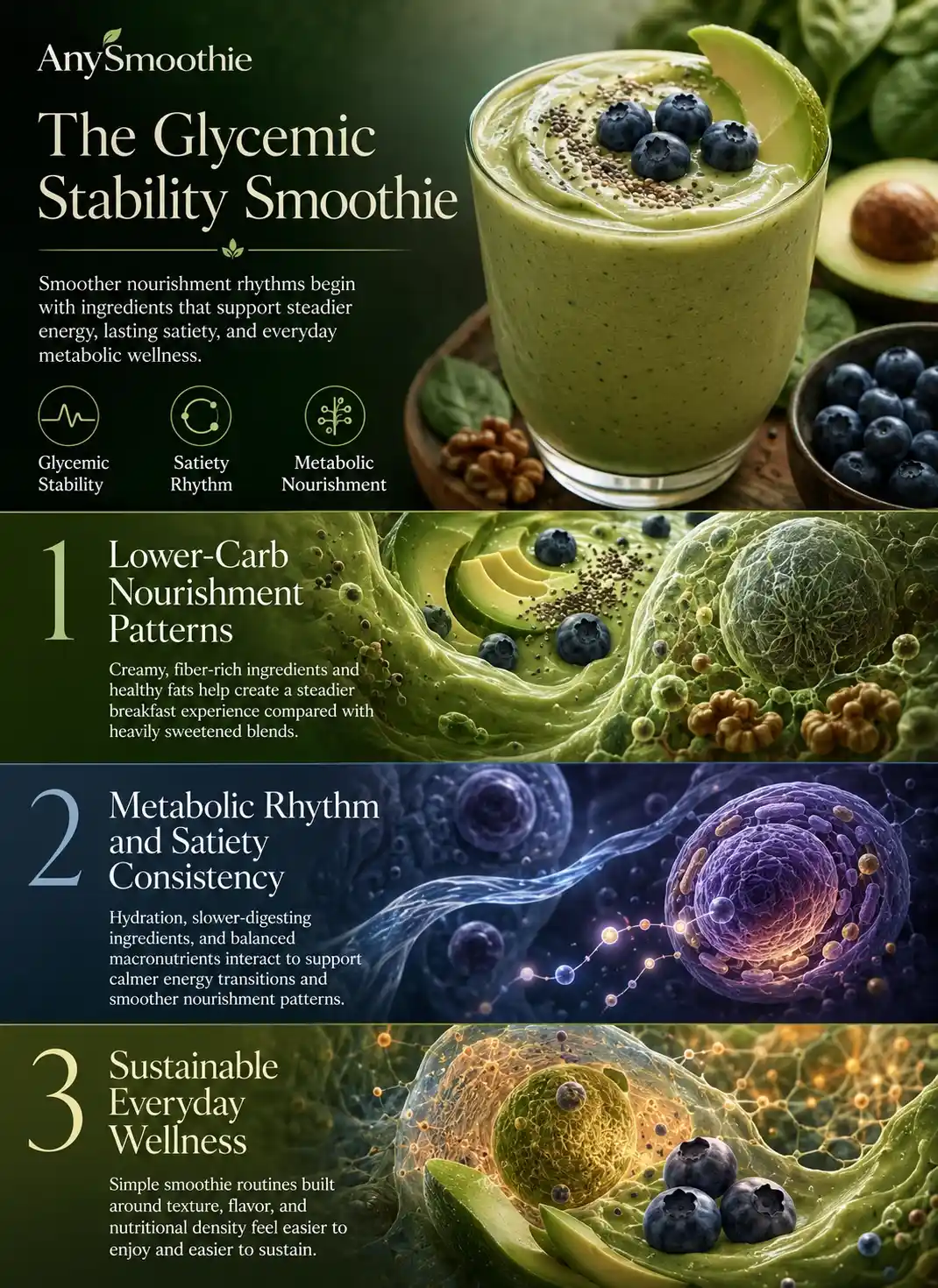
Substrate partitioning: Lipids and amino acids as alternative energy vectors
Once a smoothie includes enough fat and protein, the body does not need to rely so hard on rapid glucose. That shift in fuel use is the real win.
Medium-chain fats can be especially useful here. They are absorbed and used quickly, so they can support energy without a big carb load. Complete proteins help too, because they add amino acids that support satiety and steady fuel availability.
Hepatic glycogen satiation with medium-chain fats
C8 MCT oil is a practical example. It can provide a fast non-glucose fuel source, which may help reduce the sense that every sip needs to turn into sugar.
That matters for metabolic efficiency. When the body has more than one fuel stream available, it does not have to chase glucose as aggressively. The smoothie feels more like fuel and less like a sugar delivery system. For a simple primer on MCTs, see here.
The 3 best low-carb stabilizers
The best stabilizers do different jobs. Fats slow the run-up. Protein improves fullness. Viscous fiber slows the exit.
| Stabilizer | Physiological mechanism | Impact on insulin secretion | Best smoothie pairing | Target downstream consequence |
|---|---|---|---|---|
| C8 MCT oil | Provides immediate medium-chain fat that becomes acetyl-CoA quickly | Usually modest compared with carbs | Coffee, cocoa, or casein blends | Faster non-glucose fuel availability |
| Avocado phospholipids | Adds monounsaturated fat and helps delay gastric emptying through gut signaling | Mild to moderate | Green, vanilla, or berry smoothies | Slower nutrient release and longer fullness |
| Soluble viscous fiber, like glucomannan or inulin | Forms a gel-like matrix that traps free sugars and slows enterocyte access | Often low, because sugar enters more slowly | Berry, cocoa, or high-protein smoothies | Physical blockade that blunts remaining sugar kinetics |
Viscous fiber is the most direct brake. It does not just add fiber in a general way, it changes the texture of the gut contents. That slows absorption at the source.
Used together, these stabilizers help keep SGLT-1 and GLUT2 from getting slammed by a sugar rush. In plain terms, the entry gates move at a calmer pace.
3 “glyco-flatline” smoothie formulas that keep carbs low
These are frameworks, not strict recipes. Each one uses a different balance of fat, protein, and fiber so you can match the drink to the moment.
How to keep your smoothie steady after you drink it
The final result depends on more than ingredients. Texture, order, and portion size all change how fast the drink acts.
Blend order, texture, and portion size matter more than people think
Start with liquid and greens, then add fiber, protein, fat, and fruit last. That usually creates a thicker texture, which slows drinking speed and often improves satiety.
Smaller fruit portions help too. A smoothie that is easy to chug is often the fastest to absorb, so a spoonable or thicker build is usually more stable.
Simple ways to test and adjust your formula
Pay attention to how you feel 30 to 90 minutes later. If you get hungry fast or feel a dip, reduce fruit, add fiber, or increase protein.
If you use a glucose tracker, compare versions one change at a time. That makes it easy to see whether the bigger win comes from fat, fiber, or protein. Small adjustments matter here.
Conclusion
The best low-carb smoothie formulations for glycemic stability use the same core logic every time. They combine smart fats, enough protein, and the right kind of fiber so glucose enters more slowly.
That makes the drink easier on the post-meal curve and more useful as real fuel. If it tastes good, stays low in carbs, and supports a smoother energy flow, the formula is doing its job.
🛡️ Safety Notes & Contraindications
Acute Gastrointestinal Distension from Glucomannan Hydration: CRITICAL: Viscous soluble fibers, specifically glucomannano, possess an exceptional water-binding capacity, expanding up to 50 times their dry volume. If blended with insufficient base liquid ($<250\text{ml}$), the powder will rapidly absorb internal vascular fluids post-ingestion, potentially causing acute mechanical compaction in the esophagus or stomach, severe flatulence, and altered transit kinetics.
MCT-Induced Gastric Irritation and Osmotic Distress: Rapid titrations of C8 MCT oil directly into an empty stomach can trigger immediate mucosal irritation in the gastric fundus. Because medium-chain fatty acids are cleaved and metabolized with high kinetic speed, excessive initial doses ($>1\text{ tablespoon}$) can cause acute upper GI nausea, pyrosis, or temporary osmotic cramping. Start strictly with 1 teaspoon and scale based on internal tolerance.
Hypoglycemia Risk with Concomitant Anti-Diabetic Therapeutics: Because this entire matrix focuses on suppressing upper GI carbohydrate cleavage while maximizing insulin sensitivity through MUFAs and chromium-dense greens, it intensely flattens the post-prandial glucose curve. If you manage Type 1 or Type 2 Diabetes utilizing prescription anti-diabetic medications (e.g., exogenous Insulin, Sulfonylureas), this low-carb flux can cause sudden unmanaged hypoglycemic drops.
Oxalate Nephropathy in Dairy-Free Green Implementations: Utilizing dense pools of leafy greens (spinach/kale) within the berry-green variations without a concurrent calcium factor removes the protective intestinal entrapment mechanism. Free oxalates pass directly into systemic circulation, increasing the filtration workload of the kidneys and elevating calcium-oxalate kidney stone formation risks.
Casein Allergenic Cross-Reactivity in Silent Gut Mucosal Inflammation: Micellar casein is a high-molecular-weight dairy protein that coagulates slowly. In phenotypes managing active Inflammatory Bowel Disease (IBD) or severe intestinal permeability (“leaky gut”), the incomplete proteolysis of casein fractions can trigger localized IgE/IgG4-mediated mucosal inflammation or systemic flares. Substitute with egg white protein or pure collagen isolates if milk protein sensitivity is suspected.
FAQ
How does mechanical blending accelerate enterocyte glucose transporter kinetics?
In whole foods, simple sugars are physically locked inside an intricate lattice of cellular cellulose. Blending performs this physical deconstruction before ingestion, creating a high-surface-area liquid suspension that demands minimal gastric processing. Biochemically, this allows free sugars to arrive at the intestinal brush border membrane with high kinetic velocity, rapidly crowding SGLT-1 (Sodium-Glucose Cotransporter 1) and GLUT2 channels, which can trigger sharp, counter-regulatory insulin-glucagon surges.
Why do medium-chain lipids like C8 MCT oil serve as efficient, alternative energy vectors?
Caprylic Acid (C8) possesses a unique structural layout that allows it to bypass traditional, slow lipid digestion pathways. Biochemically, C8 medium-chain triglycerides are absorbed directly via the portal vein and travel straight to hepatocytes, where they undergo rapid beta-oxidation to generate acetyl-CoA and ketone bodies independently of the carnitine palmitoyltransferase shuttle. Supporting this physiological system provides the mitochondria with a fast, non-glucose fuel source, reducing the systemic signaling requirement for glucose mobilization.
What is the mechanical advantage of “Viscous Gelation” against accelerated gastric emptying?
Soluble, highly viscous fibers—such as glucomannan, inulin, or the mucilage found in flax and chia seeds—expand spontaneously into a dense molecular network when hydrated. Biochemically, this gelation creates a cross-linked viscoelastic hydrogel that physically encapsulates remaining carbohydrate fractions. Supporting this physiological system increases the physical diffusion distance required for sugars to reach microvilli disaccharidases, optimizing the natural pathways of “delayed gastric emptying” to ease downstream glycemic flux.
How do avocado phospholipids alter the rheological transit of enterocyte nutrient delivery?
Avocados deliver a rich matrix of monounsaturated fatty acids complexed with polar phospholipids. Biochemically, the presence of these healthy lipids triggers the secretion of gut hormones like Oleoylethanolamide (OEA) and Cholecystokinin (CCK) from specialized enteroendocrine cells. Supporting this physiological system slows down pyloric sphincter transit, creating a steady, metered nutrient release that extends the postprandial satiety cascade while blunting acute insulin secretion.
Why does cellular “Mitochondrial Priming” fail when processing unbuffered liquid carbohydrate surges?
When an unbuffered wave of simple fruit sugars floods hepatic tissue, it forces a rapid cellular conversion process driven by fructokinase, which aggressively drains intracellular ATP. Biochemically, this abrupt energy depletion stresses the mitochondrial electron transport chain, increasing the generation of reactive oxygen species (ROS) and shifting the cell toward fat accumulation pathways. Supporting this physiological system by wrapping low-fructose fruit portions in a protective peptide barrier (such as micellar casein) facilitates steady, low-friction mitochondrial respiration, keeping cell pathways optimized and efficient.

Medical Disclaimer: AnySmoothie content is for educational purposes only and is not a substitute for professional medical advice. Consult a healthcare provider for personalized guidance. See our full Disclaimer & Terms of Use. AI Transparency: AnySmoothie may use AI to support content development. All content undergoes human editorial review for accuracy, clarity, and editorial quality. See our full AI Transparency.