
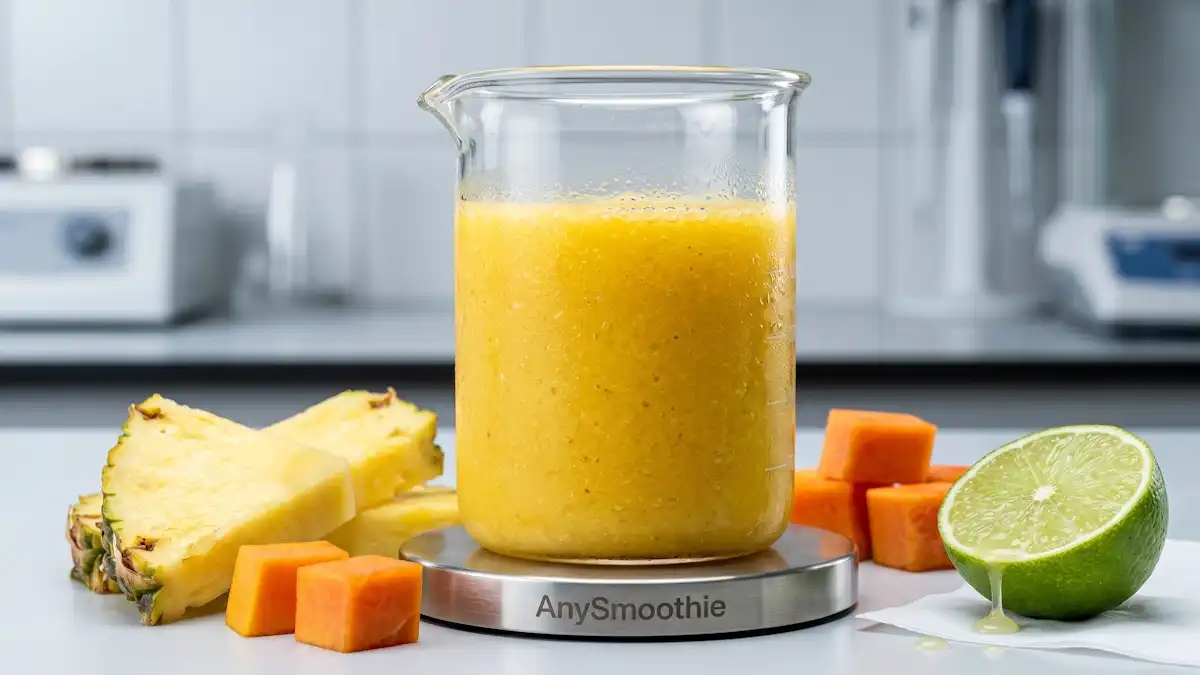
This tropical fruit formulation is strategically engineered to optimize cellular hydration and support the body’s natural enzymatic preservation pathways. By aligning the distinct bioactive profiles of frozen mango and pineapple with a dense coconut lipid matrix, this protocol delivers a precise influx of organic substrates and bromelain structures designed to support natural digestive and tissue recovery networks, serving as an efficient tool for systemic priming.
This technical guide gives a structured sequence for blending these enzyme-rich tropical fruits while helping protect their volatile compounds during homogenization. It also shows how layering affects blade contact, texture, and mix flow, so the blend stays smooth instead of turning thin or frothy. You can also adjust the macronutrient mix to support fluid and electrolyte balance without pushing blood sugar too hard.
| Tropical proteolytic enzyme | Source | Physiological mechanism | Optimal pH stability range | Thermal denaturation threshold | Best smoothie pairing |
|---|---|---|---|---|---|
| Bromelain | Pineapple stem and fruit | Cleaves internal peptide bonds in protein-rich matrices | 4.5 to 8.0 | About 50 to 60°C | Pineapple, citrus, coconut, protein-forward blends |
| Papain | Papaya | Hydrolyzes broad-spectrum peptide linkages | About 5.0 to 7.0 | About 60 to 70°C | Papaya, mango, banana, yogurt blends |
| Actinidin | Kiwifruit | Breaks down collagen and other hard structural proteins | About 3.5 to 6.5 | About 45 to 55°C | Kiwi, berries, apple, green fruit blends |
Bromelain is the most flexible in acid and mild alkaline conditions, with functional stability across an unusually wide pH range of 4.5 to 8.0. That makes it a strong fit for gastric transition, where pH can shift fast after intake.
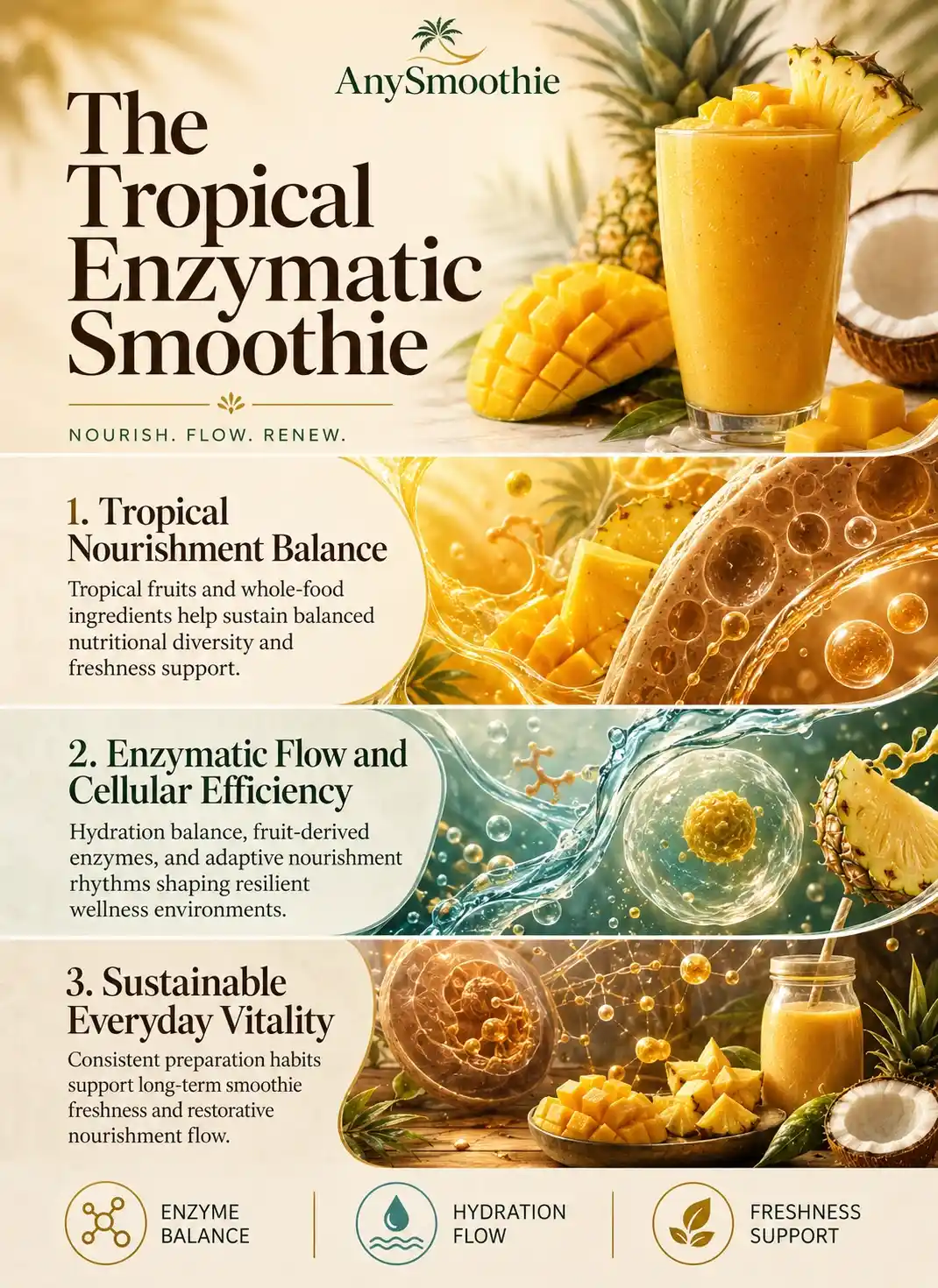
The best tropical smoothie recipe (creamy, fruity, not watery)
A good tropical smoothie should feel like a milkshake that took a trip to the beach, thick enough to sip slowly, smooth enough to drink without chewing ice. The biggest trick is simple: use frozen fruit and don’t drown it in liquid.
Ingredients you need and why they work
Here’s the base recipe for 1 large smoothie (or 2 smaller ones):
- 1 cup frozen mango chunks
- 1 cup frozen pineapple chunks
- 1 medium ripe banana (fresh or frozen)
- 3/4 cup coconut milk beverage (or milk of choice)
- 1/4 cup plain Greek yogurt (optional, for extra creaminess)
- 1 to 2 teaspoons fresh lime juice
- 1 teaspoon honey or maple syrup (optional)
- 1/2 teaspoon vanilla extract (optional)
- Pinch of salt (optional, but helpful)
Why these ingredients work:
Frozen mango + frozen pineapple: They bring bold flavor and natural thickness. Frozen fruit blends into a creamy texture without watering things down. If you only have fresh fruit, you can use it, but you’ll need ice, and ice can make a smoothie taste thin and “snowy.”
Banana: This is your texture insurance. Banana adds sweetness and gives the smoothie a soft, creamy body without needing much added sugar.
Coconut milk beverage or coconut milk: Coconut is what makes this taste tropical instead of “regular fruit smoothie.” A carton coconut milk beverage is light and easy for daily use. If you use canned coconut milk, start with 1/3 cup and add more as needed, since it’s much richer.
Yogurt (optional): It adds a thicker, almost milkshake-like texture and a gentle tang. If you prefer a pure fruit taste, skip it and add a splash more liquid.
Lime juice: One small squeeze wakes everything up. Think of it like turning on the lights in a room, the flavors pop.
Honey or vanilla (optional): Use these only if your fruit is bland or your banana isn’t very ripe. Many days, you won’t need them.
If you want another reference point for fruit ratios, this Mango Pineapple Smoothie shows how well those two fruits carry a simple blend.
Step-by-step blending method for the smoothest texture
- Add liquids first. Pour the coconut milk beverage into the blender. Add yogurt (if using) and lime juice next.
- Add soft items. Add the banana (especially if it’s fresh, not frozen).
- Top with frozen fruit. Add frozen mango and pineapple last. This helps the blades pull everything down into the liquid.
- Start low, then go high. Blend on low for 10 to 15 seconds to break up the fruit, then blend on high for 30 to 45 seconds until glossy and smooth.
- Stop and scrape once. If you see fruit stuck to the sides, stop, scrape, and blend 10 more seconds.
Quick fixes (no stress, no waste):
- Too thick to blend: Add 1 to 2 tablespoons of liquid at a time, then blend again.
- Too thin or watery: Add more frozen mango or pineapple (1/4 cup at a time).
- Tastes flat: Add a pinch of salt or another small squeeze of lime.
- Too tart: Add 1/2 banana or a small drizzle of honey.
For a similar “mango, pineapple, coconut” approach, you can also compare with this tropical smoothie recipe and notice how small changes in liquid and fruit affect thickness.
Make it your own: easy variations, boosts, and swaps
Once you have the base, changing the vibe is simple. Try one tweak at a time so you know what you like. The goal is to keep the tropical flavor front and center, even when you add nutrition boosts.
High protein tropical smoothie (no chalky taste)
Want it to hold you until lunch? Add protein in a way that stays creamy.
Greek yogurt: Use 1/2 cup Greek yogurt and reduce the coconut milk beverage to 1/2 cup. This keeps it thick, not soupy.
Cottage cheese: Start with 1/3 cup. It blends smoother than most people expect, and the fruit masks the flavor. Use a good blender and give it a full high-speed minute.
Protein powder: A scoop of unflavored or vanilla works well. If it thickens too much, add an extra splash of liquid. Flavor tip: add vanilla extract, a pinch of cinnamon, or a bit more pineapple to keep the “tropical” taste strong.
If you like to browse other creamy smoothie styles, this Best Tropical Smoothie Recipe is another useful point of comparison for texture and ingredient balance.
Dairy-free, lower sugar, and kid-friendly options
Dairy-free swaps: Use coconut yogurt, almond milk, oat milk, or a carton coconut milk beverage. If you want more coconut flavor without dairy, add 1 tablespoon unsweetened shredded coconut.
Lower sugar: Skip honey and let a ripe banana do the sweetening. For extra thickness without extra sweetness, blend in 1/4 to 1/2 cup frozen cauliflower rice. It sounds odd, but it disappears behind pineapple and mango.
Kid-friendly ideas: Serve it in a fun cup with a straw, or add a tiny splash of orange juice for a familiar flavor. You can also add a small handful of spinach. It’ll turn the smoothie green, so call it a “tropical green smoothie” and move on.
Prep, storage, and serving ideas that save time
Smoothies are easy, but they’re even easier when the work is already done. A little prep turns this into a real weekday habit.
Freezer smoothie packs and the best way to store leftovers
Freezer packs: In a quart freezer bag, portion 1 cup frozen mango, 1 cup frozen pineapple, and 1 sliced banana. Label it with the date and “add 3/4 cup coconut milk + lime.” Freeze flat so it stacks like a book.
When you’re ready, dump the pack into the blender and add your liquid (and yogurt, if using). Blend right away. If it’s too thick, add a small splash more liquid.
Leftovers: Store in a sealed jar in the fridge for up to 24 hours. It will separate, that’s normal. Shake hard, or re-blend with a few ice cubes or a handful of frozen fruit to bring back the thick texture.
Serving ideas: breakfast, post-workout, and party mocktail style
Breakfast: Pour into a bowl and top with granola and toasted coconut, or drink it alongside eggs or peanut butter toast.
Post-workout: Add Greek yogurt or protein powder, then finish with an extra squeeze of lime to keep it bright.
Brunch or mocktail style: Pour into small cups, add a pineapple wedge, and top with a mint leaf. For sparkle, stir in a splash of sparkling water at the end. If you want a “fancy” rim, use a very light lime-and-salt rim, keep it subtle so it doesn’t overpower the fruit.
Conclusion
This tropical smoothie recipe is built to be reliable: frozen mango and pineapple for thick texture, banana for creaminess, coconut for that beachy flavor, and lime to keep it lively. From there, the easiest upgrades are simple, go dairy-free with coconut yogurt or add protein with Greek yogurt or a scoop of powder.
Save the base recipe, then try one change at a time until it fits your routine. Make it once, and you’ll start eyeing your freezer like it’s your personal smoothie bar. What fruit combo are you going to try first?
🛡️ Safety Notes & Contraindications
Proteolytic Mucosal Irritation and Severe Bleeding Risks: CRITICAL: High-flux consumption of raw bromelain from concentrated pineapple matrices can interact with cell-surface receptors, exerting direct antiplatelet profiles and fibrinolytic activity. If you are under therapeutic prescription of anticoagulant agents (e.g., Warfarin, DOACs) or antiplatelet drugs (e.g., Aspirin), daily ingestion of this targeted enzyme-dense protocol requires strict clinical clearance to avoid systemic bleeding micro-risks.
Fructose Saturation and Enterocitary Osmotic Transit: Mango and pineapple concentrate high standalone structural ratios of free fructose. In individuals diagnosed with Fructose Malabsorption or active Irritable Bowel Syndrome (IBS), the GLUT5 transport capacity in the brush border can be rapidly overwhelmed. The unabsorbed fructose acts as an osmotic pump, drawing water into the bowel lumen and inducing acute distension, gurgling, or accelerated liquid transit.
Bromelain-Induced Protein Cleavage (The Burning Tongue): Consuming this smoothie too slowly or allowing the fresh un-denatured matrix to linger excessively in the oral cavity allows active bromelain to begin proteolysis of the protective salivary glycoproteins and surface epithelial proteins of the tongue. This presents as a transient, localized tingling or burning sensation. Rinse with water post-consumption.
Allergic Cross-Reactivity (The Latex-Fruit Syndrome): Due to strict structural homology between plant defense proteins, individuals with a diagnosed systemic type I hypersensitivity to natural rubber latex can present significant cross-reactivity to mango, pineapple, and banana proteins (Latex-Fruit Syndrome). Monitor for acute localized pruritus, urticaria, or upper respiratory layout tightness.
MCT-Induced Gastric Speed-Up from Canned Coconut Bases: Utilizing heavy, undiluted canned coconut milk instead of a beverage carton dramatically shifts the lipid density towards concentrated saturated fats and medium-chain fatty acids. This can cause immediate osmotic irritation in the gastric fundus of sensitive or gallbladder-compromised phenotypes, presenting as temporary reflux or acute nausea.
FAQ
How does “Bromelain Kinetic Stability” support proteolytic efficiency during gastric transition?
Unlike many dietary enzymes that denature rapidly when exposed to fluctuating digestive environments, bromelain maintains functional stability across an unusually broad pH spectrum ($\text{pH}\ 4.5\text{–}8.0$). Biochemically, this wide stability range allows the enzyme to remain active through both the upper gastric lumen and the early sections of the small intestine. Supporting this physiological system through raw pineapple infusions optimizes the natural pathways of “peptide cleavage,” assisting the body in breaking down complex proteins with minimal metabolic friction.
Why does a “Dense Coconut Lipid Matrix” optimize the absorption of lipophilic pigments in mango?
Mangoes are abundant in lipophilic carotenoids, including beta-carotene and xanthophylls, which possess low solubility in purely aqueous fluids. Biochemically, the medium-chain fatty acids (MCFAs) in coconut milk act as polar lipid vehicles that trigger the spontaneous self-assembly of micelles within the intestinal lumen. Supporting this physiological system wraps the hydrophobic fruit pigments in a lipid bilayer, optimizing the natural pathways of “carrier-mediated transport” across the brush border membrane.
What is the mechanical advantage of a “Thermodynamic Heat Sink” during high-velocity fruit homogenization?
High-speed blender blades transfer significant kinetic friction into a liquid matrix, generating localized heat that can accelerate the degradation of fragile botanical compounds. Biochemically, enzymes like bromelain and actinidin possess specific thermal denaturation thresholds ($45\text{–}60^\circ\text{C}$). Supporting this physiological system by utilizing flash-frozen fruit fractions acts as a native thermodynamic buffer, neutralizing frictional heat during mechanical shear and keeping blending temperatures low enough to preserve enzyme structures intact.
How does “Viscosity Stratification” from pectin and banana fibers attenuate postprandial glucose flux?
Pairing high-glycemic tropical fruits with the soluble fibers and uncoiled pectin found in a ripe banana creates a dense, viscoelastic hydrogel within the stomach. Biochemically, this gel matrix encapsulates simple fruit fructose, slowing down gastric emptying and increasing the physical diffusion distance required for sugars to reach transport channels. Supporting this physiological system through structured fruit layering facilitates the biochemical mechanics of “glycemic influx attenuation,” preventing sharp insulin surges.
Why is cellular “Osmotic Balance” enhanced by adding a trace sodium anchor to a potassium-rich fruit base?
Pineapple, mango, and banana deliver high concentrations of intracellular potassium ($K^+$), the primary cation required for cellular fluid volume. Biochemically, active cellular hydration and the transport of nutrients via sodium-glucose cotransporters (SGLT1) depend on a precise balance of extracellular sodium ($Na^+$). Supporting this physiological system with a small pinch of mineral salt alongside potassium-dense fruit optimizes the natural pathways of the sodium-potassium pump, driving rapid, efficient intracellular hydration without taxing renal clearance.

Medical Disclaimer: AnySmoothie content is for educational purposes only and is not a substitute for professional medical advice. Consult a healthcare provider for personalized guidance. See our full Disclaimer & Terms of Use. AI Transparency: AnySmoothie may use AI to support content development. All content undergoes human editorial review for accuracy, clarity, and editorial quality. See our full AI Transparency.