
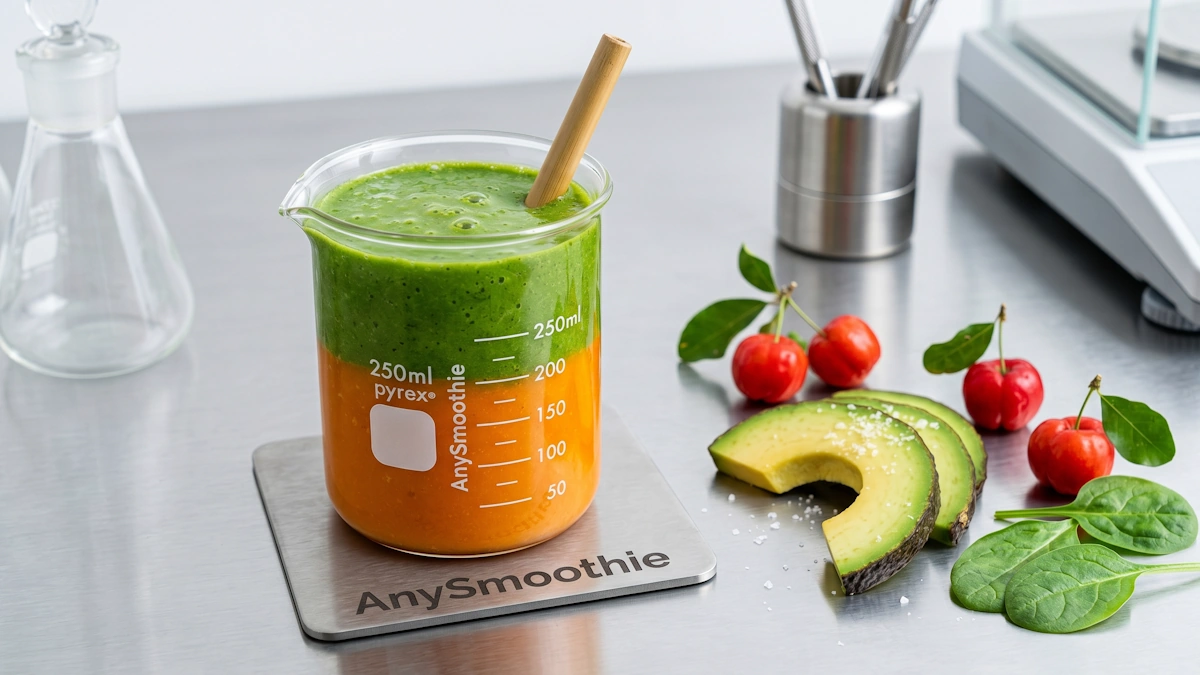
This protocol establishes a foundational framework for combining fruit and vegetable substrates into structured liquid matrices engineered to optimize micronutrient synergy and cellular bio-availability. By coordinating the diverse phytochemical profiles of raw botanical yields with precise fluid vehicles, these formulations support natural cellular defense systems and metabolic clearance pathways. High-velocity mechanical homogenization breaks down tough plant cell walls, allowing for the rapid delivery of dense vitamins, organic minerals, and enzymatic structures without inducing gastrointestinal or glycemic turbulence.
This technical manual provides a repeatable blueprint to balance complex carbohydrate structures with dense protein anchors and viscous fiber matrixes. You will discover the exact mechanics of ingredient layering required to maximize enzymatic preservation, prevent premature oxidation of volatile nutrients, and calibrate taste receptor masking to eliminate bitter organoleptic signaling while maintaining absolute nutritional density.
Why smoothies with fruits and vegetables are worth making
A good smoothie does more than taste nice. It can help you start the day with steady energy, especially when breakfast is usually coffee and a hope.
First, smoothies are fast. With a few freezer staples, you can go from zero to breakfast in under five minutes. That speed matters because consistency beats perfection, and the easier the habit, the more likely you’ll keep it.
Second, they make it easy to eat more produce. Fruit is simple for most people, but vegetables are harder to fit in. Blending spinach into a berry smoothie takes less effort than planning a side salad, and it still counts. It also helps when you want better nutrient pairing in one glass.
| Micronutrient Synergy | Physiological Mechanism | Absorption Transporter/Pathway | Best Smoothie Pairing | Target Physiological Outcome |
|---|---|---|---|---|
| Vitamin C + Non-Heme Iron (Spinach/Acerola) | Reduces Fe3+ to soluble Fe2+ for DMT-1 transport | DMT-1 in the small intestine | Spinach, acerola, or another vitamin C-rich fruit | Higher non-heme iron uptake, especially from plant foods |
| Vitamin E + Vitamin C (Avocado/Berries) | Regenerates tocopheryl radicals back to active tocopherol | Antioxidant recycling in lipid and aqueous phases | Avocado with berries | Better vitamin E retention and antioxidant support |
| Dietary Lipids + Carotenoids (Avocado/Carrots) | Enhances hydrophobic micelle formation for passive diffusion | Micelle formation and intestinal absorption | Avocado, carrots, mango | Improved carotenoid absorption and vitamin A support |
Vitamin C is a strict mechanical requirement if you want to maximize non-heme iron flux.
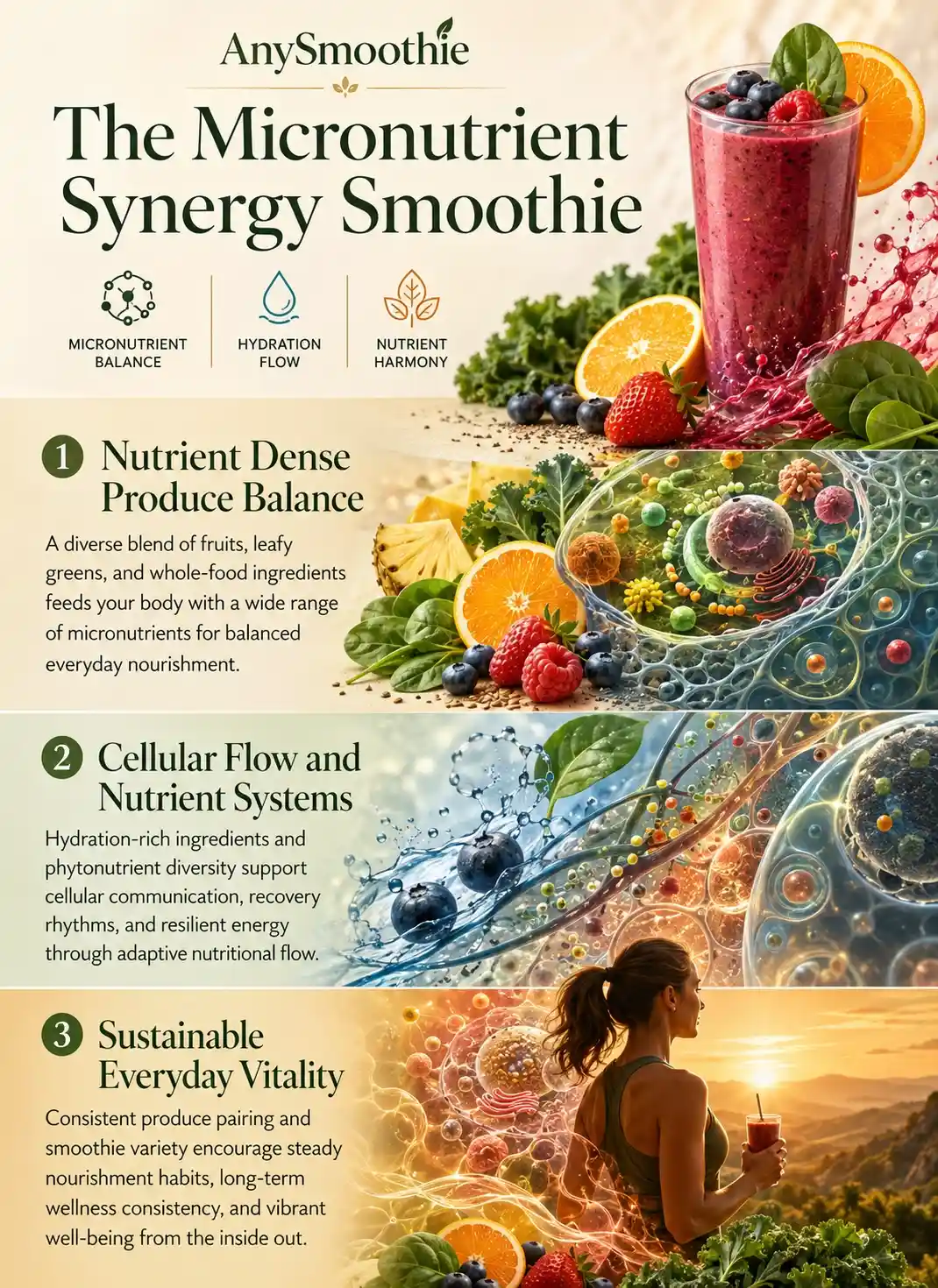
Third, smoothies can support hydration. They’re mostly water from fruit plus your liquid base. If you’re the type who forgets to drink water until lunchtime, a smoothie can quietly help.
Fourth, smoothies can be high in fiber when you use whole fruits and vegetables. Fiber helps you feel full and supports digestion. This is one reason blended produce can feel more satisfying than a glass of juice.
To make a smoothie stick with you, add a “booster.” Options like Greek yogurt, nut butter, chia, oats, or protein powder slow things down so you don’t get a quick spike and crash.
One caution: don’t build your smoothie around juice or added sugar. Juice makes it easy to drink a lot of sugar fast, and it’s not as filling as whole fruit.
What you get in one glass (fiber, vitamins, and steady energy)
Fruit brings natural sweetness and familiar flavors, plus vitamins and plant compounds. Vegetables bring extra fiber and micronutrients without adding much sugar, especially leafy greens and cauliflower.
The “steady energy” part comes from pairing produce with protein and healthy fats. A smoothie with only fruit and juice can feel like candy in a cup, tasty, but you might be hungry soon. Add Greek yogurt, chia seeds, or nut butter, and it becomes more like breakfast.
If you want a quick reference for ingredients that help (and ones to use less often), EatingWell’s breakdown of healthy smoothie ingredients and 10 to ditch is a solid reality check.
The easiest veggies to hide in sweet smoothies
If you’re new to veggie-forward smoothies, start with vegetables that don’t taste “vegetable-y” when blended with fruit:
- Spinach: mild flavor, blends smooth.
- Cauliflower (frozen florets or riced): neutral, makes smoothies creamy.
- Avocado: thick and rich, more “milkshake” than “salad.”
- Kale: stronger taste, start with a small handful.
- Carrots or pumpkin: naturally sweet, warm flavor (great with cinnamon).
Frozen produce is your friend. Frozen fruit makes smoothies thicker and colder without watering them down, and frozen veggies (like riced cauliflower or spinach) blend in easily.
How to build a great fruit and veggie smoothie every time
You don’t need a new recipe every day. You need a method. Think of smoothie-making like getting dressed: once you know the basic pieces, you can mix them in different ways and it still works.
A reliable smoothie has four parts: fruit, veggies, liquid, and a filling booster. The trick is choosing amounts that taste good and feel satisfying, then adjusting texture without adding a bunch of sugar.
A few grounding rules help most people:
Use frozen fruit for thickness. If you use all fresh fruit, you’ll end up adding lots of ice, which can make the flavor dull. Keep juice small or skip it, and use milk, soy milk, kefir, or unsweetened yogurt for creaminess. If dairy isn’t your thing, unsweetened almond milk or oat milk works, but it’s usually less filling than dairy or soy.
Also, keep an eye on “stealth calories.” Smoothies can get big fast with multiple nut butters, sweetened yogurt, or large portions. The goal is a smoothie that supports your day, not one that accidentally turns into dessert. If you want an example of a produce-packed blend, Vitamix’s Everything Smoothie recipe shows how brands structure a balanced mix of fruits and vegetables.
The simple formula: fruit, veggie, liquid, and a filling booster
For 1 to 2 servings, use this template:
- Fruit (1 to 2 cups): berries, mango, pineapple, banana, peaches (frozen is best).
- Veggies (1 to 2 cups): start with 1 cup spinach or cauliflower, then build up.
- Liquid (3/4 to 1 1/2 cups): milk, soy milk, kefir, coconut milk, or water.
- 1 filling booster (pick one):
- Greek yogurt (plain)
- Nut butter (1 to 2 tablespoons)
- Chia or ground flax (1 to 2 teaspoons)
- Oats (2 to 4 tablespoons)
- Protein powder (one serving)
Beginner tip: start with more fruit and a mild veggie (spinach or cauliflower). After a week, increase the veggie portion and reduce banana or other sweet fruit if you want less sugar.
Make it taste good: balance sweet, tart, and spice
A smoothie can be “healthy” and still taste flat. Flavor balance fixes that fast.
If it’s bland, add one of these: a squeeze of lemon or lime, a splash of vanilla, cinnamon, fresh ginger, or a pinch of salt (yes, salt, it makes fruit taste brighter).
If it’s bitter (often from too much kale), use pineapple or mango to soften the flavor, or switch to spinach until you get used to greens. Berries also pair well with spinach or cauliflower, they add tartness and color without fighting the veggies.
If it tastes “too green,” don’t keep adding honey. Add citrus, vanilla, or cocoa, and make sure you have enough fruit and a creamy booster. For more veggie ideas beyond the basics, this list of vegetables you can add to smoothies can spark new combos without making things weird.
Easy smoothie recipes with fruits and vegetables (mix and match)
Each recipe below makes 1 large or 2 small servings. Add more liquid to thin, add more frozen fruit to thicken. If you want them less sweet, cut the banana portion in half and add more berries or cauliflower.
If you like having more variations on hand, EatingWell’s roundup of green smoothie recipes for getting your veggies in is a useful library for swapping fruits, greens, and boosters.
Prep, storage, and common mistakes to avoid
Smoothies are easy, but small choices change the result. The biggest difference-makers are prep, frozen fruit, and not going heavy on juice.
If you want less sugar (or steadier blood sugar), use berries more often, cut back on banana, and add a booster with protein or fat (Greek yogurt, chia, nut butter). For kids or picky eaters, start with familiar flavors like strawberry-banana, then add mild veggies like spinach or cauliflower once the base tastes “normal.”
Freezer packs and grab-and-blend routines for busy days
Freezer packs make smoothies feel almost too easy. Add fruit and veggies to a freezer bag in single servings, then freeze flat so they stack.
In the morning: dump the pack in the blender, add liquid, add your booster, blend. Use frozen fruit instead of a lot of ice so you get thick texture without washing out the flavor.
Fix watery, foamy, too thick, or too bitter smoothies fast
A few quick fixes save almost any smoothie:
- Watery: add more frozen fruit, a few spoonfuls of yogurt, or a chunk of avocado.
- Too thick: add liquid, a little at a time, and blend again.
- Gritty greens: blend longer, and use spinach instead of kale until your blender catches up.
- Foamy: use less liquid at first, blend on a lower speed, then increase.
- Too bitter: add pineapple, mango, citrus, or a pinch of salt.
Keep juice and sweeteners as the last resort, not the default. If you’re adding honey every time, the recipe probably needs more fruit, more vanilla or spice, or a better sweet-tart balance.
Conclusion
Smoothies with fruits and vegetables don’t need to be complicated to be good. Stick to the simple formula (fruit, veggie, liquid, plus a filling booster) and you’ll get a smoothie that tastes great and actually holds you over. Start with one recipe from this list, make it twice, then change just one thing next week (a new veggie, a different fruit, or a new booster). Save the formula, stock your freezer, and treat your blender like a weekday tool, not a special occasion. Your next smoothie can be both easy and worth drinking.
🛡️ Safety Notes & Contraindications
Oxalate Nephropathy and Renal Filter Saturation: CRITICAL: Heavy daily loading of raw spinach and kale within standard fruit-vegetable matrices delivers a massive structural surge of soluble oxalates. In phenotypes with a clinical history of calcium-oxalate nephrolithiasis (kidney stones), this unmitigated flux can cause hyperoxaluria. Mandatory Protocol: Always anchor these variations with an ionized Calcium source ($Ca^{2+}$, like plain Greek yogurt or fortified bases) to complex oxalates directly in the bowel lumen, preventing renal filtration strain.
Insulin Volatility from Combined Fructose Pulsing: Stacking high-glycemic fruits (bananas, mangoes, pineapples) to camouflage greens generates an intense, rapid delivery of simple sugars. In individuals managing Type 2 Diabetes, Severe Insulin Resistance, or Metabolic Syndrome, this rapid absorption saturates the GLUT2/GLUT5 carriers, triggering sharp hyperinsulinemic spikes followed by reactive hypoglycemia.
Vitamin K1 Antagonism with Warfarin Therapy: Leafy greens (spinach, kale) concentrate substantial pools of Fillochinone (Vitamina K1), a critical co-factor for the hepatic synthesis of blood coagulation factors. If you are under active clinical treatment with vitamin K antagonists (such as Warfarin/Coumadin), sudden, volatile changes in your vegetable flooring can directly counteract the pharmacological stability of your medication.
Goitrogenic Influx from Raw Cruciferous Grids: Raw cauliflower and kale contain active mirosinasi enzymes that split glucosinolates into goitrin and thiocyanates, compounds that competitively inhibit iodine uptake at the thyroid follicular cells. Phenotypes managing hypothyroidism or Hashimoto’s autoimmune thyroiditis must utilize strictly blanched or frozen-steamed cruciferous inputs to denature the enzyme while preserving the texturizing matrix.
Enzymatic Tongue Erosion from Bromelain Overload: Utilizing raw, un-denatured pineapple cores as a primary bitter-masking tool exposes the oral mucosa to concentrated proteolytic cleavage. Allowing the fluid to linger excessively in the oral cavity can result in the superficial digestion of salivary mucins, causing a transient localized burning or tingling sensation on the tongue.
FAQ
How does “Vitamin C” mechanistically drive the bioavailability of non-heme plant iron?
Plant-derived iron exists as ferric iron ($Fe^{3+}$), an insoluble form that cannot be readily absorbed by the small intestine. Biochemically, when ascorbic acid (Vitamin C) co-exists with ferric iron in the gastric lumen, it functions as a potent electron donor, reducing the metal into its soluble ferrous state ($Fe^{2+}$). Supporting this physiological system through spinach and citrus pairings directly matches the substrate requirement for Divalent Metal Transporter 1 (DMT-1) on enterocyte membranes, optimizing the natural pathways of systemic iron uptake.
Why does the pairing of “Vitamin E and Vitamin C” enable antioxidant recycling?
Alpha-tocopherol (Vitamin E) is a lipid-soluble antioxidant that protects cellular bilayers by sacrificing itself to neutralize free radicals, converting it into a volatile tocopheryl radical. Biochemically, hydrophilic Vitamin C interacts with this lipid boundary, donating an electron to reduce the tocopheryl radical back into its active, protective form. Supporting this physiological system within an avocado-berry emulsion establishes a continuous, parallel antioxidant recycling cascade across both the watery and fat phases of the fluid matrix.
What molecular mechanisms allow “Dietary Lipids” to accelerate carotenoid absorption?
Carotenoids (such as beta-carotene in carrots and pumpkin) are highly hydrophobic molecules trapped within plant chromoplasts. Biochemically, the passive diffusion of these pigments across the intestinal brush border requires them to be incorporated into mixed lipid aggregates known as micelles. Supporting this physiological system by integrating healthy monounsaturated fats (like avocado or nut butter) provides the necessary lipid substrate to drive spontaneous micelle formation, dramatically increasing downstream vitamin A conversion kinetics.
How does a “Dense Protein Anchor” stabilize glucagon-insulin dynamics and prevent glycemic turbulence?
Homogenizing fruits breaks down their protective outer fiber matrix, which can cause a rapid release of free fructose and glucose into the portal vein. Biochemically, adding a dense protein-and-lipid vehicle (like plain Greek yogurt or soy protein) slows gastric emptying rates and alters downstream peptide signaling. Supporting this physiological system balances the release of insulin and glucagon, establishing a metered, steady energy curve that prevents the sudden cellular energy drops common with pure fruit juices.
Why does high-velocity mechanical shear maximize the retention of volatile enzymes?
Plant tissues contain active enzymes that degrade rapidly when exposed to heat and atmospheric air. Biochemically, prolonged blending at lower velocities generates substantial motor friction, raising the fluid’s kinetic energy and accelerating thermal denaturation. Supporting this physiological system through brief, high-velocity homogenization—ideally frozen to serve as a thermodynamic heat sink—disrupts cellulose structures instantly, liberating the dense nutrient pool while preserving volatile cofactors entirely intact.

Medical Disclaimer: AnySmoothie content is for educational purposes only and is not a substitute for professional medical advice. Consult a healthcare provider for personalized guidance. See our full Disclaimer & Terms of Use. AI Transparency: AnySmoothie may use AI to support content development. All content undergoes human editorial review for accuracy, clarity, and editorial quality. See our full AI Transparency.