
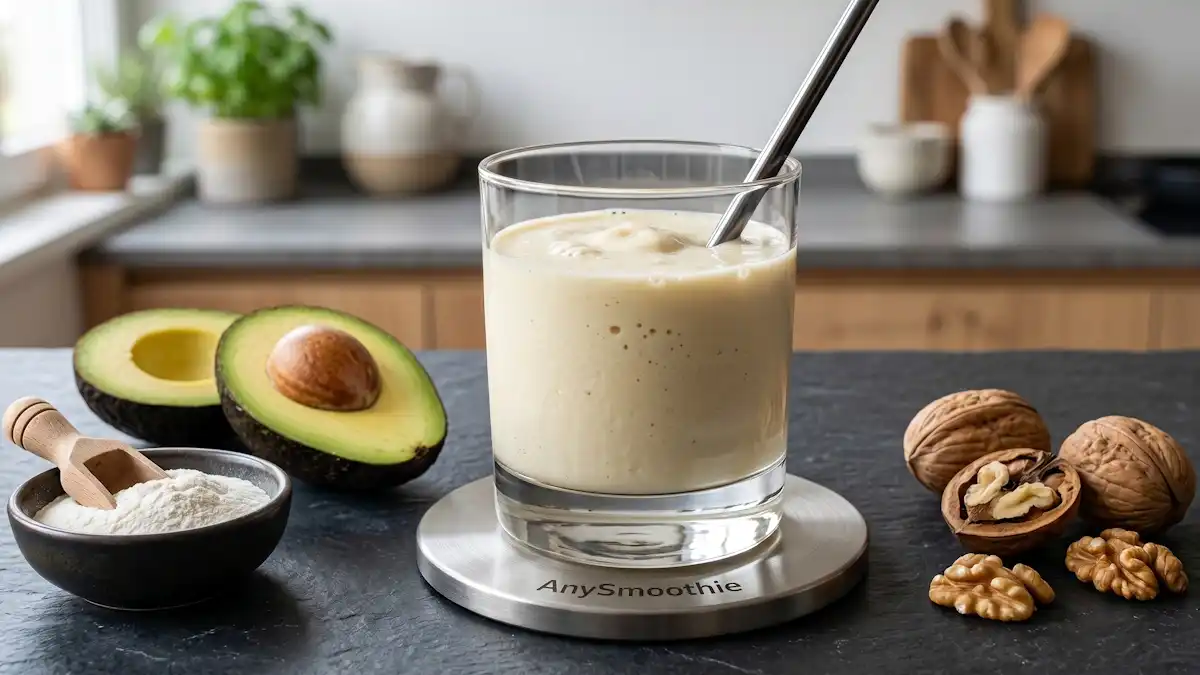
A smoothie can do more than give you calories. Built the right way, it can support hormone-mediated satiety with fiber, protein, and healthy fat in one glass. The goal isn’t a magic drink or a hunger cure. It’s a practical way to help GLP-1, PYY, and related fullness signals do their job, while also slowing gastric emptying enough to make the meal last. That matters on mornings when lunch used to arrive too soon.
How satiety hormones turn a smoothie into a real meal
Satiety starts in the gut, not the willpower center. When food reaches the small intestine, receptors read the mix of carbs, protein, fat, and fiber, then send signals that tell the brain to ease off eating. That response is part of the incretin effect, which is why the same calories can feel different in liquid or solid form.
The incretin effect matters because gut exposure, not just mouth feel, drives the downstream message. A thin fruit drink can move through fast and miss that window.
How L-cells respond when nutrients reach the intestine
L-cells line the lower small intestine and sense what arrives there. In response, they release GLP-1 and PYY, two signals that help slow intake and support appetite control. The stronger and longer the nutrient exposure, the more durable the signal can be.
That is why ingredient choice matters. A smoothie with protein, viscous fiber, and some fat usually creates a bigger satiety response than a low-fiber juice. Different ingredients change both the size and the length of the message.
Why a slower gastric exit can help you feel satisfied longer
Gastric residence time is the time food stays in the stomach before moving on. A thicker smoothie can increase that window, so the gut has more time to register fullness. As a result, the energy curve feels smoother.
Fast-drinking, low-fiber blends can create quick rebound hunger. Slower exit gives your satiety signals a longer runway and makes the meal feel more complete.
Build the smoothie around mechanical fullness and hormone signaling
The best satiety smoothie uses two levers at once. One creates mechanical fullness right away. The other supports slower, longer hunger control through nutrient signaling. That is the practical side of a smoothie for hormone-mediated satiety mechanisms, and it is easy to miss if you only count macros.
A thin drink can leave the stomach fast. A thicker blend keeps fullness signals in play longer.
A quick comparison helps.
Compare glucomannan, micellar casein, and oleic acid before you blend
| Ingredient | Physiological Mechanism | Hormone Targeted | Onset of Satiety | Best Smoothie Pairing |
|---|---|---|---|---|
| Glucomannan | Swells with water, raises viscosity, and increases gastric volume | GLP-1, PYY | Fast | Berries, protein, and enough liquid to gel |
| Micellar casein | Digests slowly and releases amino acids over time | GLP-1, PYY | Slower, longer lasting | Cocoa, banana, or nut butter |
| Oleic acid | Supports fat sensing and oleoylethanolamide-related signaling | CCK, PYY support | Moderate | Avocado, chia, or olive oil |
Glucomannan gives the immediate mechanical signal. Micellar casein keeps amino acids in the mix longer, so the fullness curve lasts. Oleic acid adds a fat cue that supports CCK-related signaling and fits well with fiber and protein.
Why texture matters as much as macros in a satiety smoothie
A smoothie’s thickness changes how your body reads it. Too thin, and it behaves like a drink. Viscous enough, and it behaves more like a meal. That is why ice, frozen fruit, chia, or glucomannan can matter as much as the protein powder.
The biohacker move is simple. Tune the feel of the drink so the biology follows.
3 satiety-prime hormone modulating smoothie recipes
These three builds are starting points, not rigid formulas. It is easier to repeat a simple pattern than to chase a perfect recipe. Each one balances fullness, digestion speed, and daily use.
How to fine-tune the smoothie for leptin and ghrelin support
Leptin and ghrelin are not fixed. Sleep loss, long gaps between meals, and chronic energy shortage can make hunger louder and satiety quieter. If you run on short sleep, that window gets narrower fast.
A smoothie helps most when it fits the rest of the day. Pair it with normal meal timing, enough total protein, and sleep that does not trash appetite cues. For a plain-language look at how GLP-1, PYY, and CCK work together, this satiety hormone explainer is useful context.
Support mitochondrial priming so hunger signals are easier to manage
Steady fuel flow makes satiety easier to notice. When cells have stable energy available, hunger signals tend to feel less erratic. That is the idea behind mitochondrial priming here, keep energy intake, protein, and carbs steady enough that your brain is not chasing a rebound.
You are supporting the signal, not forcing it.
Conclusion
The best smoothie for hormone-mediated satiety mechanisms does three things at once. It adds volume, slows gastric exit, and delivers protein and fat that extend the fullness signal. Fiber, especially viscous fiber, gives the gut something to work with.
Build one version, test it across a few mornings, then adjust thickness and protein until it holds you the way you want. That small experiment can pay off fast.
🛡️ Safety Notes & Contraindications
Choking Hazard (Glucomannan): CRITICAL: Glucomannan powder expands rapidly. Never add it to a smoothie without sufficient liquid (at least 250-300ml). Drink the smoothie immediately after blending to prevent it from turning into a solid gel that could pose a swallowing risk.
Gastrointestinal Distress: High doses of viscous fibers and sugar alcohols (if used) can cause significant bloating, flatulence, or osmotic diarrhea in sensitive individuals or those with SIBO. Start with minimal doses of glucomannan (0.5g to 1g).
Medication Absorption: High-viscosity smoothies can slow or reduce the absorption of oral medications. To ensure pharmacological efficacy, take any prescription drugs at least 1 hour before or 4 hours after consuming a high-fiber satiety smoothie.
Hypoglycemia Risk: By significantly slowing gastric emptying and glucose absorption, these smoothies may lead to lower post-prandial blood sugar. Individuals on insulin or sulfonylureas must monitor glucose levels closely to avoid hypoglycemia.
Biliary Gallbladder Contraction: The fat content required to trigger CCK may stimulate gallbladder contraction. Individuals with active gallstones should avoid high-fat additions like avocado or heavy nut butters.
FAQ
How does “Gastric Residence Time” influence the duration of satiety signals?
Gastric residence time refers to the duration food remains in the stomach before entering the small intestine. Biochemically, a high-viscosity smoothie (containing fibers like glucomannan or chia) slows this exit. Supporting this physiological system optimizes the natural pathways of “mechanical distension,” ensuring the biochemical mechanics of satiety are active for a longer runway, preventing rapid hunger rebounds.
Why are “L-Cells” critical for the release of GLP-1 and PYY?
L-cells are specialized enteroendocrine cells in the distal small intestine that respond to the arrival of nutrients. Biochemically, when peptides and fatty acids reach these cells, they trigger the release of Glucagon-Like Peptide-1 (GLP-1) and Peptide YY (PYY). Supporting this physiological system through fiber-anchored protein smoothies facilitates the biochemical mechanics of “prolonged nutrient exposure,” leading to a more durable fullness signal.
What is the role of “Oleic Acid” in stimulating CCK-related fullness?
Oleic acid, a monounsaturated fat found in avocado and olive oil, acts as a potent signaling molecule in the gut. Biochemically, it supports the production of oleoylethanolamide (OEA) and stimulates the release of Cholecystokinin (CCK). Supporting this physiological system through lipid-inclusive smoothies facilitates the biochemical mechanics of “fat sensing,” which signals the brain to reduce intake and slows gastric motility.
How does “Micellar Casein” differentiate from whey in the satiety response?
While whey provides a rapid amino acid spike, micellar casein is a slow-digesting protein that forms a stable gel in the stomach. Biochemically, this leads to “sustained aminoacidemia,” providing a steady stream of building blocks to the gut receptors. Supporting this physiological system facilitates the biochemical mechanics of “long-term protein signaling,” making it an ideal anchor for smoothies intended to bridge long gaps between meals.
Why is “Mitochondrial Priming” necessary for stable hunger management?
Hunger signals are often exacerbated by erratic cellular energy status. Biochemically, mitochondrial priming ensures that cells have a stable flux of ATP, which helps temper the “emergency” hunger signals sent to the brain. Supporting this physiological system through low-glycemic, nutrient-dense smoothies optimizes the natural pathways of “energy homeostasis,” making satiety signals easier for the nervous system to register and maintain.

Medical Disclaimer: AnySmoothie content is for educational purposes only and is not a substitute for professional medical advice. Consult a healthcare provider for personalized guidance. See our full Disclaimer & Terms of Use. AI Transparency: AnySmoothie may use AI to support content development. All content undergoes human editorial review for accuracy, clarity, and editorial quality. See our full AI Transparency.