
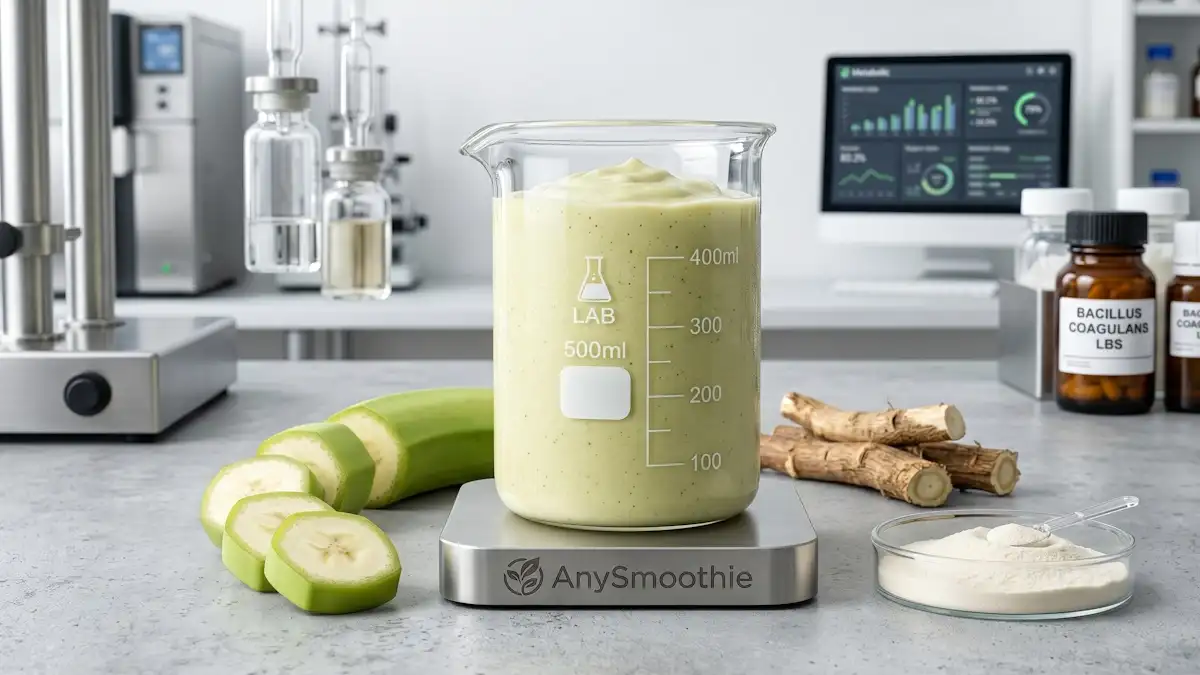
Postbiotics are the compounds your gut microbes leave behind after they eat fiber. That includes short-chain fatty acids, small metabolites, and other fermentation byproducts. A smoothie for postbiotic production works when it feeds those microbes the right carbs, not a flood of quick sugar.
The goal is steady fermentation in the colon. That means choosing ingredients that reach the large bowel in useful form. The best blends use resistant starch, inulin, and pectin, because they shape where fermentation happens and how fast it starts.
What makes a smoothie useful for postbiotic production?
A smoothie helps only when its carbs survive the small intestine. That means more prebiotic substrate and less fast-digesting sugar. Fiber type, particle size, and liquid balance all change what reaches the colon.
How gut microbes turn fiber into postbiotics
In the colon, microbes break down plant fibers and resistant starch. They make acetate, propionate, and butyrate, along with other metabolites that support normal gut function. One microbe’s output often feeds another, so the system works by cross-feeding, not by one strain doing all the work.
Why fiber structure matters more than sweetness
A sweet smoothie can taste clean and still do little for fermentation. Fast sugars are absorbed early. In contrast, resistant starch, inulin, and pectin move farther down the gut, where they keep microbes busy longer. That is where postbiotic output starts to matter.

The Colonic Fermenter: Mechanics of Postbiotic Synthesis
A good formula respects the colon’s job. It sends fuel where microbes can use it at a useful pace. Faster substrates tend to ferment higher up. Slower ones can keep activity going farther downstream.
Short-Chain Fatty Acids: Fueling the Epithelial Barrier
SCFAs are the main output most readers want from this process. Acetate, propionate, and butyrate each play a different role in colon metabolism. Butyrate matters most for butyratogenesis and local energy use in colon cells, so fiber kinetics matter more than most people think.
The best substrates don’t just ferment, they ferment in the right place.
Carbohydrate Complexity: Selecting Substrates for Butyrate Flux
The table below compares three useful prebiotic substrates for a smoothie focused on fermentation.
| Prebiotic substrate | Physiological mechanism | Primary SCFA produced | Best smoothie pairing | Target zone |
|---|---|---|---|---|
| Resistant starch type 2, green banana | Slow breakdown, strong cross-feeding drive for butyrate-producing microbes | Butyrate | Green banana, flax, cinnamon | Distal colon |
| Inulin, chicory root | Fast fermentation into acetate, then cross-feeding | Acetate | Chicory root, cocoa, almond milk | Proximal colon |
| Pectin, apple, berries | Steady gel-like fiber, moderate fermentation | Acetate, propionate | Apple, berries, chia | Mid to proximal colon |
Resistant starch type 2 is the strongest pick when you want butyratogenesis farther down the colon. Inulin fires faster, while pectin gives a smoother middle path.
Resistant Starch Type 2 and green banana as a distal-colon driver
Resistant starch type 2 breaks down slowly. That lets more of it reach the lower colon, where it can feed butyrate-producing microbes. Green banana is the easiest smoothie source, and it blends well with cinnamon or flax. For distal-colon support, this is the best place to start.
Inulin from chicory root and pectin from apples or berries
Inulin ferments fast and often supports acetate first, then cross-feeding. Chicory root powder is easy to dose in small amounts. Pectin from apples or berries gives a steadier pattern and often feels gentler. It fits well when you want fruit flavor and moderate fermentation. For a plain overview of inulin, see here.
How to build a postbiotic smoothie without upsetting digestion
Start small and keep the blend thin enough to drink easily. Too much fiber at once can turn a smart plan into bloating. Most people do better when they add one substrate at a time, then watch tolerance for a few days.
The best flavor and texture pairings for fermentation-friendly blends
Green banana pairs well with berries because tart fruit softens the starchy taste. Chicory root works with cinnamon and cocoa. Apple pectin blends nicely with chia or ground flax, which thickens the texture without blocking the prebiotic effect. A little fat or protein changes mouthfeel, but it doesn’t cancel fermentation.
When to use caution and scale up slowly
High-fiber blends can cause gas, especially with inulin or a big jump in resistant starch. Begin with half portions, then increase when digestion stays calm. Hydration matters too, along with the rest of the day’s fiber intake. More is not always better.
3 Postbio-Prime Fermentation-Targeted Smoothie Recipes
These are recipe concepts, not rigid formulas. Each one is built around a different fermentation pattern.
The Butyrate-Flux Green Banana, Chicory Root, and Apple Pectin Blend
Ingredients
- 1 small green banana
- ½ medium apple with skin, cored and chopped
- 1 teaspoon chicory root inulin
- 1 tablespoon ground flaxseed
- 1 cup unsweetened almond milk
- ½ teaspoon cinnamon
- ½ cup ice, optional
Pour the almond milk into the blender first. Add the green banana, apple, chicory root inulin, ground flaxseed, cinnamon, and ice if using. Blend until thick and completely smooth.
Less-ripe bananas generally contain more resistant starch than ripe bananas, while chicory root inulin is a fermentable prebiotic fiber. Apple contributes pectin, and flax adds fiber, lignans, and ALA omega-3 fatty acids. These fermentable carbohydrates can be metabolized by gut microbes into short-chain fatty acids, including butyrate, although the amount and location of fermentation vary between individuals. Increase inulin gradually if you are not accustomed to it, since it can cause gas or bloating.
Estimated Nutrition per Serving
- Calories: ~250 kcal
- Protein: ~6 g
- Carbohydrates: ~48 g
- Fat: ~7 g
- Fiber: ~13 g
- Sugars: ~20 g
If I were introducing this blend for the first time, I’d start with half the inulin and increase it gradually rather than changing the fruit. The texture stays essentially the same while making the fermentable-fiber load easier to adjust.
Green Banana Berry Blend
Ingredients
- 1 small green banana
- ½ cup frozen mixed berries
- 1 cup cold water
- ½ cup ice
Add the water to the blender first, followed by the green banana, frozen berries, and ice. Blend until completely smooth.
This simpler version removes the added inulin while retaining resistant starch from the less-ripe banana and fiber and polyphenols from the berries. These carbohydrates can provide substrates for microbial fermentation, although individual digestive tolerance varies.
Estimated Nutrition per Serving
- Calories: ~145 kcal
- Protein: ~2 g
- Carbohydrates: ~36 g
- Fat: ~1 g
- Fiber: ~6 g
- Sugars: ~17 g
Apple Cinnamon Pectin Blend
Ingredients
- 1 medium apple with skin, cored and chopped
- 1 tablespoon chia seeds
- ½ teaspoon cinnamon
- 1 cup cold water
- ½ cup ice
Add the water to the blender first. Add the apple, chia seeds, cinnamon, and ice. Blend until smooth, then let the smoothie stand for 2–3 minutes if you prefer a thicker texture.
Apple naturally provides pectin and other fibers, while chia contributes soluble and insoluble fiber along with ALA omega-3 fatty acids. This straightforward combination is easy to scale, although tolerance to larger fiber portions varies.
Estimated Nutrition per Serving
- Calories: ~160 kcal
- Protein: ~3 g
- Carbohydrates: ~32 g
- Fat: ~5 g
- Fiber: ~9 g
- Sugars: ~19 g
Managing the Microenvironment for Eubiosis
Fermentation changes luminal pH because microbes release acids as they eat fiber. A slightly lower pH can support a more stable microbial mix and keep the microenvironment steadier. The real goal is balance, not force.
Mitochondrial Priming: SCFA Beta-Oxidation in the Colonocyte
Butyrate is used by colon cells through beta-oxidation, which helps them handle energy with less strain. That is why steady SCFA output matters. When a smoothie supports slow, even fermentation, it gives the gut a cleaner fuel pattern and better metabolic efficiency.
Conclusion
The best smoothie for postbiotic production is built around fermentable fibers, not just ingredients that look healthy. Resistant starch type 2, inulin, and pectin each shape SCFA output in a different way, so the best choice depends on the colon zone you want to feed. Start with small amounts, watch digestion, and build slowly. That simple approach gives you more consistent fermentation and steadier postbiotic output over time.
🛡️ Safety Notes & Contraindications
SIBO and Severe FODMAP Dysbiosis: CRITICAL: High-kinetic prebiotic fibers like inulin (chicory root) and apple pectin are classified as highly fermentable oligosaccharides. If you present with active Small Intestinal Bacterial Overgrowth (SIBO) or severe IBS, this protocol will trigger premature fermentation in the small bowel, leading to painful meteorism, severe abdominal distension, and hyper-motility. Start strictly with the low-FODMAP modifications.
Hydrogen Sulfide ($H_2S$) Production Shifts: In a highly dysbiotica gut, shifting the luminal environment rapidly with massive doses of raw starches without adequate adaptation can alter the competition between sulfate-reducing bacteria and butyrate producers, potentially increasing methane or hydrogen gas accumulation. Titrate fibers upward in micro-fractions.
Renal Potassium Limitations: Green bananas and apples are naturally dense in Potassium. Individuals with advanced stages of Chronic Kidney Disease (CKD) or those on prescription potassium-sparing diuretics must monitor their total daily intake to prevent dangerous blood electrolyte shifts.
Choking and Viscosity Risks (Inulin/Flax): Ground flaxseeds combined with inulin create a highly viscous, hydrophilic sludge that continues to expand post-blending. Ensure the smoothie is built with at least 300ml of fluid to prevent throat irritation or esophageal layout blocks, and consume immediately.
Medication Adsorption in Pectin Gels: The structural grid of apple pectin and flax mucilage can non-specificly bind or trap oral medications within the bowel lumen, delaying or reducing their clinical efficacy. Consume this postbiotic protocol at least 1 hour before or 3 hours after any medical prescription therapeutics.
FAQ
How does “Carbohydrate Complexity” dictate the spatial layout of colonic fermentation?
The rate at which a prebiotic substrate is fermented is determined by its molecular structure. Biochemically, simple sugars are absorbed in the small intestine, whereas highly complex, insoluble fibers migrate further down the GI tract. Supporting this physiological system through structural variety ensures that faster-fermenting substrates (like inulin) fuel the proximal colon, while slower-fermenting substrates (like RS2) sustain butyratogenesis in the distal colon, optimizing the natural pathways of total luminal coverage.
Why is “Resistant Starch Type 2 (RS2)” from green bananas the optimal driver for butyrate flux?
RS2 resists enzymatic hydrolysis in the upper digestive tract due to its tightly packed crystalline structure. Biochemically, when RS2 reaches the large bowel, it serves as a primary fuel source for specialized cross-feeding networks, where primary fermenters produce acetate that secondary butyrate-producing bacteria convert into butyrate. Supporting this physiological system through green banana protocols facilitates the biochemical mechanics of “distal-colon driving,” providing the specific substrate required to optimize downstream butyrate availability.
What is the role of “SCFA Beta-Oxidation” in priming the colonic epithelial barrier?
The cells lining the colon (colonocytes) derive up to 70% of their total cellular energy directly from the beta-oxidation of butyrate. Biochemically, this localized energy production consumes oxygen, maintaining an anaerobic state at the mucosal surface that prevents the overgrowth of less desirable species. Supporting this physiological system through a steady stream of fermentable fibers facilitates the biochemical mechanics of “colonocyte priming,” ensuring the epithelial barrier has the ATP necessary to maintain tight junction integrity.
How does microbial fermentation alter “Luminal pH” to support eubiosis?
As commensal bacteria metabolize complex polysaccharides, they release hydrogen ions alongside organic acids (acetate, propionate, butyrate). Biochemically, this safe reduction in luminal pH creates a microenvironment that naturally suppresses acid-sensitive opportunistic organisms while encouraging the growth of beneficial, butyrate-producing obligate anaerobes. Supporting this physiological system through targeted smoothies optimizes the natural pathways of “pH self-regulation” across the colonic ecosystem.
Why is “Viscosity Modulation” necessary when introducing prebiotics to a smoothie base?
A sudden, high-volume surge of highly soluble prebiotics like isolated inulin can trigger rapid, unchecked gas production and osmotic imbalances in the lumen. Biochemically, pairing rapid-firing inulin with viscous, gel-forming fibers like apple pectin or ground flax slows down transit time and moderates fermentation kinetics. Supporting this physiological system through well-emulsified whole-food matrices facilitates the biochemical mechanics of “digestive glide,” ensuring smooth nutrient transit and preventing gastrointestinal distress.

Medical Disclaimer: AnySmoothie content is for educational purposes only and is not a substitute for professional medical advice. Consult a healthcare provider for personalized guidance. See our full Disclaimer & Terms of Use. AI Transparency: AnySmoothie may use AI to support content development. All content undergoes human editorial review for accuracy, clarity, and editorial quality. See our full AI Transparency.