

Ribose is the sugar backbone your cells use to build ATP, RNA, and DNA. That matters when energy demand is high and your system needs raw material, not hype.
A ribose smoothie gives you a simple way to pair that substrate with fluid, minerals, and other nutrients. For people who care about recovery, training load, and metabolic efficiency, it fits a practical biohacking routine.
This is about supporting energy pathways and cellular repair. It is not about making wild claims. The goal is a clean, usable drink that helps the body keep up.
The Pentose Pathway: Ribose as the Backbone of Life
Inside cells, the pentose phosphate pathway helps make ribose-5-phosphate, a key building block for nucleotide synthesis. For a plain-language view, the Nature review of the pentose phosphate pathway shows how this route feeds ribose, NADPH, and other cell-supporting intermediates.
That matters because ribose is part of the scaffold for ATP and the nucleotide pool. When cells need to rebuild after stress, they need that scaffold ready. D-ribose matters here because it can bypass slower glucose-to-ribose steps and move closer to precursor production.
Beyond Glucose: Why the Body Prioritizes Ribose for Repair
Glucose is the body’s main fuel, but ribose plays a different role. Glucose is burned for energy. Ribose is used to build the molecules that hold and move that energy.
During hard training, poor sleep, or other periods of demand, cells may need more nucleotide turnover. Ribose supports that rebuilding process. It does not replace glucose. It fills a separate job that glucose cannot do as well.
How a Smoothie Delivers Ribose in a Simple, Usable Format
A smoothie works because it is easy to mix, easy to drink, and easy to combine with other support nutrients. You can pair ribose with coconut water, a pinch of salt, protein, or a small amount of fruit.
That makes it useful before a busy morning, after exercise, or during a low-energy afternoon. The liquid format also fits a recovery routine when solid food feels heavy. In practice, that is often the point, simple intake with low friction.
Nucleotide Salvage: Recycling Adenine for ATP Priming
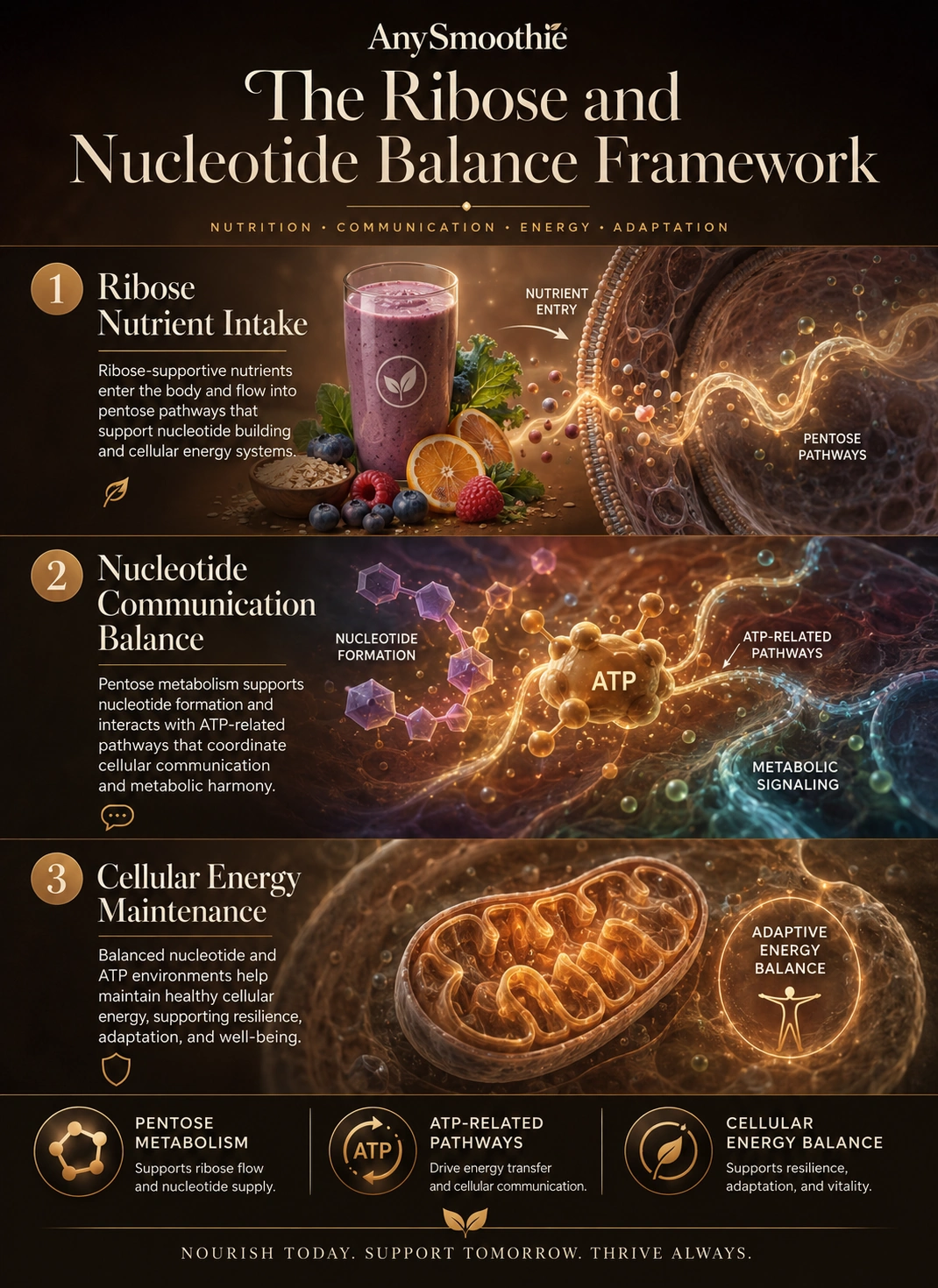
Cells do not build every nucleotide from scratch when demand rises. They recycle adenine and other parts through the salvage pathway. A review on D-ribose and mitochondrial function explains how ribose helps feed both salvage and de novo nucleotide production.
That is why ribose shows up in conversations about ATP rebuilding. It helps provide the sugar part of the molecule that cells need before they can reassemble the rest. In plain terms, it supports the material supply line.
RNA and DNA Integrity: Supporting the Building Blocks of Genetic Code
RNA and DNA both depend on ribose or ribose-derived structures. RNA uses ribose directly, while DNA uses a close cousin, deoxyribose. Either way, the sugar backbone matters.
When cells are under turnover or repair pressure, that backbone is part of the rebuild. Ribose does not create genetic material on its own, but it supports the structure cells use to make it. That is why ribose fits a broader recovery plan, especially when the goal is steady cellular support.
Choosing the Right Energy Substrate for a Ribose Smoothie
Not every sweet ingredient plays the same role. Ribose, glucose, and fructose all show up in smoothies, but they support different pathways.
| Energy Substrate | Physiological Role | Metabolic Pathway | Impact on Glycemic Index | Best Smoothie Pairing |
|---|---|---|---|---|
| D-Ribose | Nucleotide backbone, ATP support | Pentose phosphate pathway, PRPP formation | Low direct glycemic impact compared with common sugars | Coconut water, berries, light protein |
| Glucose | Primary fuel for glycolysis | Glycolytic pathway | Higher glycemic impact | Protein, fiber, post-training carbs |
| Fructose | Hepatic glycogen precursor | Fructolysis | Lower immediate glycemic rise than glucose, but still a sugar | Citrus, greens, tart berries |
The takeaway is simple. D-ribose is the one aimed at nucleotide backbone production. It gets closer to the ribose side of metabolism, so cells do not have to convert glucose through slower steps first.
D-ribose vs glucose vs fructose, what each one does in the body
D-ribose is the main ingredient when the goal is nucleotide support. It is not there to act like a standard sweetener. It is there to feed the structure behind ATP and nucleotides.
Glucose and fructose still have a place. Glucose is useful when you want straightforward fuel. Fructose works best in smaller amounts and usually pairs well with lower-sugar ingredients. A ribose smoothie is different because ribose is the focus, not the fruit sugar.
What makes a ribose-friendly smoothie different from a regular fruit blend
A regular fruit smoothie can turn into a sugar-heavy drink fast. A ribose-friendly version keeps the sugar load in check and adds support from minerals, protein, or fat.
That is where nutrient partitioning matters. Coconut water, chia, nut butter, or plain yogurt can slow the drink a bit and make it more balanced. The goal is metabolic efficiency, not a dessert in a cup.
3 “Nucleo-Recharge” Ribose Focus Smoothie Recipes
Bioenergetic Synergy: Combining Ribose with Carnitine and CoQ10
Ribose, carnitine, and CoQ10 support different parts of energy metabolism. The the “awesome foursome” nutrient model lays out that split clearly. Ribose supports the ATP building block, carnitine helps move fatty acids, and CoQ10 helps with electron transport in mitochondria.
Ribose supports the raw material side of ATP. Carnitine and CoQ10 support the recycling side.
Mitochondrial Flux: Accelerating Energy Recovery Cycles
Carnitine helps shuttle fatty acids into mitochondria. CoQ10 helps move electrons through the energy chain. Ribose supports nucleotide rebuilding, so the cell has enough ATP material to recycle.
That is why people often pair them. The setup is simple, each piece helps a different step. When those steps line up, energy recovery can feel more efficient.
When to use a combined stack, and when simple is better
A ribose-only smoothie makes sense when you want a light, focused drink. It is easy to digest and simple to repeat.
A combined stack fits heavier training blocks, long work days, or times when your recovery routine already includes carnitine and CoQ10. If your schedule is full and your stomach is sensitive, simple usually wins. If demand is high, a more complete stack can make sense.
Conclusion
Ribose in a smoothie is a clean way to support nucleotide synthesis, ATP rebuilding, and recovery support without turning the drink into a sugar bomb. The key is to keep the formula balanced, so ribose does its job while the rest of the ingredients support hydration, digestion, and steady fuel.
The best blends are the ones you can repeat. Start with a simple ribose smoothie after hard training or on low-energy mornings, then build from there if your routine needs more support.
🛡️ Safety Notes & Contraindications: Ribose smoothies
Hypoglycemic effect: D-ribose can cause a transient drop in blood glucose levels by stimulating insulin secretion; individuals with diabetes or reactive hypoglycemia should monitor their sugar levels and avoid consuming ribose on a completely empty stomach.
Hyperuricemia risk: high doses of ribose can lead to increased production of uric acid as a byproduct of nucleotide metabolism; individuals with a history of gout or kidney stones should use ribose with caution.
Gastrointestinal distress: excessive intake (usually above 10–15g per dose) can cause bloating, flatulence, or osmotic diarrhea; start with a small amount (1–3g) and ensure the smoothie contains fiber to stabilize digestion.
Insulin medication interaction: due to its potential to lower blood sugar, ribose may enhance the effects of insulin or oral hypoglycemic agents; consult a physician to adjust medication timing if necessary.
Surgery and recovery: while ribose supports energy, its effect on blood glucose means it should be discontinued at least 2 weeks before elective surgery to ensure stable intraoperative glycemic control.
FAQ
What is D-Ribose and how does it support “Nucleotide Synthesis”?
D-Ribose is a five-carbon sugar (pentose) that serves as the structural foundation for DNA, RNA, and ATP. Unlike glucose, which is primarily oxidized for fuel, ribose is used to build the scaffolding of energy molecules. Biochemically, providing D-Ribose supports the physiological systems involved in the de novo synthesis of nucleotides, bypassing the slow, rate-limiting metabolic steps usually required to synthesize ribose from glucose.
Why is Ribose considered a “bottleneck” in energy recovery?
Under normal conditions, the body produces ribose slowly through the pentose phosphate pathway. However, after intense physical or metabolic demand, the rate of ATP regeneration can exceed the body’s natural production capacity. Supporting the natural pathways of ribose availability ensures that the physiological systems have the “backbone” ready to incorporate adenine and phosphate, optimizing the natural pathways of energy recovery and mitochondrial priming.
Can D-Ribose support cardiac and muscle metabolic flux?
The heart and skeletal muscles are high-demand organs that can experience a transient depletion of the total adenine nucleotide pool during periods of peak exertion. D-Ribose supports the physiological systems involved in maintaining and replenishing these pools, facilitating the transition from energy depletion to energy surplus. This biochemical support ensures that the natural pathways of cellular respiration are not limited by a lack of structural components.
How does Ribose differ from standard sugars like Glucose?
While glucose provides the “fire” (energy), ribose provides the “wood” (structure). Ribose has a very low glycemic index and does not trigger a significant insulin response compared to glucose. This makes it an ideal tool for supporting the physiological systems of repair without disrupting glucose metabolic flow, optimizing the natural pathways of nutrient partitioning even in metabolically sensitive individuals.
What is the synergy between Ribose and Carnitine?
Ribose provides the structural components (the “parts”) for ATP, while Carnitine supports the transport of fatty acids into the mitochondria (the “shuttle”) to be oxidized for that ATP. Pairing them creates a powerful biochemical synergy: you are providing both the mechanism to move the fuel and the architecture to build the energy molecules. This combination optimizes the physiological systems of mitochondrial flux and systemic metabolic efficiency.

Medical Disclaimer: AnySmoothie content is for educational purposes only and is not a substitute for professional medical advice. Consult a healthcare provider for personalized guidance. See our full Disclaimer & Terms of Use. AI Transparency: AnySmoothie may use AI to support content development. All content undergoes human editorial review for accuracy, clarity, and editorial quality. See our full AI Transparency.