
Methylation helps your body move small chemical tags where they need to go. Those tags matter for energy use, cell repair, neurotransmitter balance, and detox work.
Homocysteine matters because it sits in the middle of that process. When the body clears it well, the cycle stays efficient. When it piles up, the system gets less smooth.
That is where methylation support smoothies for homocysteine balance fit in. A well-built smoothie can deliver key nutrients in one shot, with less prep and better daily consistency. The goal is simple, food-first support for methylation pathways, not a promise of treatment.
The methylation engine and why homocysteine balance matters
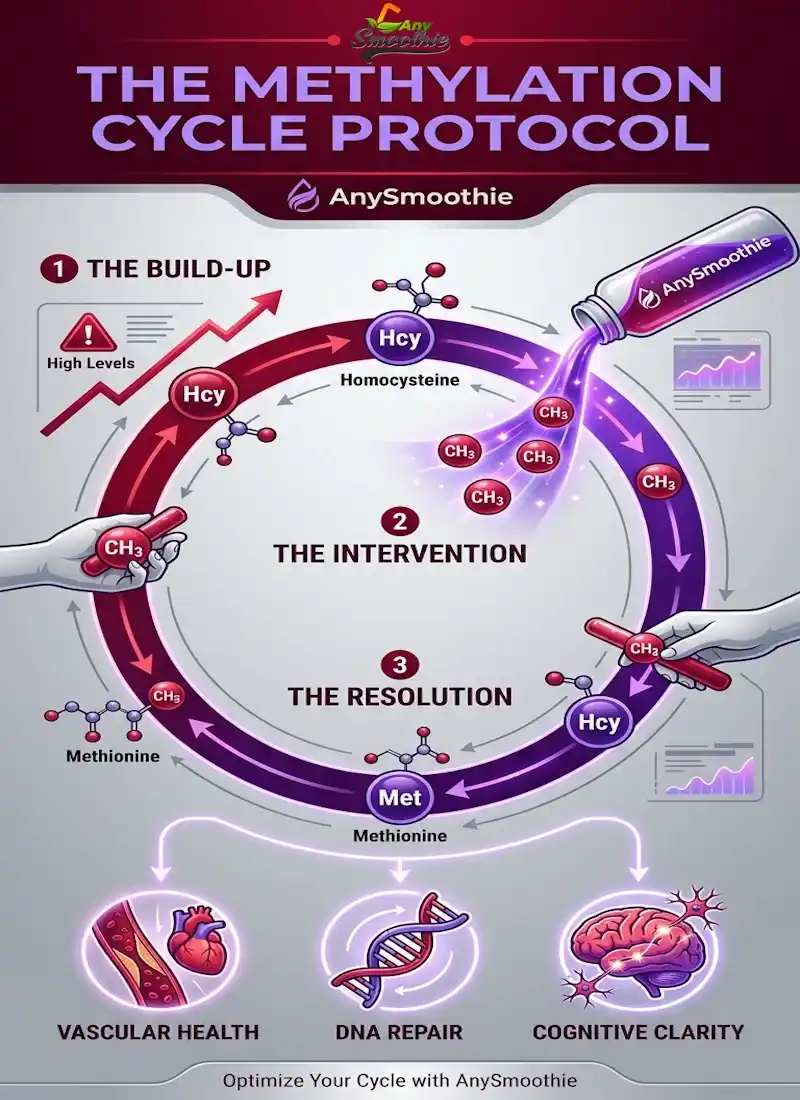
The methylation cycle runs like a recycling loop. Methionine enters the cycle, methyl groups get used, and homocysteine appears as a byproduct. The body then decides whether to recycle it back into methionine or send it down another route.
That decision matters because homocysteine is not meant to sit around. The body benefits when it converts it efficiently, since that helps keep one-carbon metabolism moving. In plain terms, the system works better when the byproducts keep flowing instead of backing up.
For a deeper biochemical map, the review on homocysteine metabolism and disease processes lays out the pathways clearly. The key point is simple: methylation depends on steady nutrient input.
How the methionine cycle turns byproducts into usable compounds
Methionine turns into S-adenosylmethionine, or SAMe, the body’s main methyl donor. After SAMe gives up a methyl group, homocysteine appears.
From there, the body has two main choices. It can remethylate homocysteine back to methionine, or move it into other sulfur pathways. That recycling supports DNA maintenance, neurotransmitter chemistry, and normal cleanup work.
This is why the cycle matters for metabolic efficiency. If the loop stays open, the body can keep using methyl groups without unnecessary drag.
Why smooth nutrient delivery can help support this pathway
Food matters because methylation runs on small, repeatable inputs. A smoothie can pack those inputs into a form that is easy to absorb and easy to keep up with.
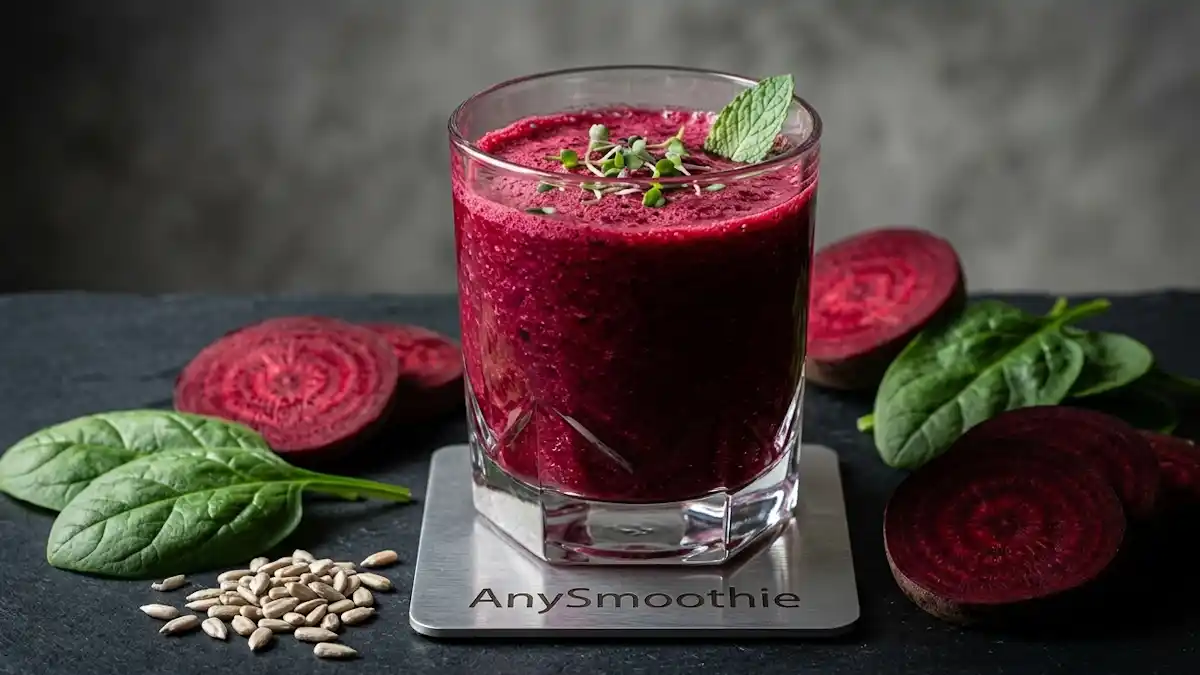
Blending greens, beets, citrus, and seeds can help with nutrient partitioning. You get folate from leaves, betaine from beets, and supportive fats or minerals from seeds. The blend also helps some nutrients travel with fats and fiber, which can make the whole routine easier to stick with.
That daily simplicity is the real advantage. The body likes steady input more than random bursts.
The key methyl donors that belong in a homocysteine support smoothie
Three nutrients matter most here: trimethylglycine, active folate, and methyl B12. They do different jobs, but they all help the same cycle keep moving.
Here is a quick comparison of the main players.
| Methylation co-factor | Physiological role | Primary food source | Impact on homocysteine levels | Best smoothie pairing |
|---|---|---|---|---|
| Trimethylglycine (betaine) | Direct methyl donor, supports a bypass route | Beets, beet powder, spinach | Can help lower homocysteine through BHMT pathways | Beet, greens, citrus, berries |
| 5-MTHF | Active folate, helps remethylation | Leafy greens, legumes, fortified foods | Supports conversion of homocysteine back to methionine | Spinach, avocado, lemon |
| Methylcobalamin | Active B12, cofactor for methionine synthase | Animal foods, fortified plant milks | Supports the folate-B12 remethylation cycle | Berry, cacao, fortified milk |
Betaine matters because it offers a bypass route when the folate pathway is less efficient. That is useful in day-to-day nutrition, especially when you want a food-based plan that covers more than one angle.
The best smoothie is the one you can repeat. Consistency feeds the cycle better than a perfect recipe used once.
Why MTHFR efficiency changes which ingredients matter most
MTHFR helps make 5-MTHF, the active folate form used in remethylation. If that step runs slowly, the body may rely more on betaine-rich foods and active folate from greens.
That does not mean anything is broken. It means the pathway may need more support from diet. A smart smoothie can cover that by combining folate, betaine, and B12-friendly ingredients in one glass.
For context on how folate, B12, choline, and riboflavin overlap, see the NCBI overview of B vitamins and choline.
3 methyl-prime smoothies for daily homocysteine support
These are practical templates, not rigid formulas. Use them as a base and adjust the flavor.
TMG-power beet, spinach, and sunflower seed blend
This one is built around betaine support.
Ingredients
- 1 small cooked beet or 1 tablespoon beet powder
- 1 cup spinach
- 1 tablespoon sunflower seeds
- 1/2 cup frozen berries
- 1/2 banana
- 1 cup unsweetened almond milk
- Squeeze of lemon
Beets bring trimethylglycine. Spinach adds folate, and sunflower seeds add a nutty texture plus extra support for the cycle. The berries and lemon keep the flavor bright.
Estimated Nutrition per Serving
- Calories: ~260 kcal
- Protein: ~8 g
- Carbohydrates: ~41 g
- Fat: ~9 g
- Fiber: ~9 g
- Sugars: ~21 g
Green recovery smoothie with avocado, greens, and citrus
This version focuses on folate, texture, and steady energy.
Ingredients
- 1 cup mixed greens
- 1/4 avocado
- 1 tablespoon chia seeds
- 1 orange, peeled
- 1/2 cucumber
- 1 cup water or coconut water
- Small piece of fresh ginger
Avocado helps with mouthfeel and fat balance. Chia gives the smoothie body, while citrus keeps the greens from tasting flat. This is a good option when you want something light but still nutrient-dense.
Estimated Nutrition per Serving
- Calories: ~250 kcal
- Protein: ~6 g
- Carbohydrates: ~35 g
- Fat: ~11 g
- Fiber: ~12 g
- Sugars: ~17 g
I’d start with a piece of ginger about the size of your thumbnail. The orange already gives this blend plenty of brightness, so a modest amount keeps the ginger from dominating the lighter cucumber and greens.
Berry-cocoa smoothie with chia and a methylation-friendly boost
This one works well for beginners.
Ingredients
- 1 cup mixed berries
- 1 tablespoon chia seeds
- 1 teaspoon cocoa powder
- 1/2 banana
- 1 cup fortified plant milk
- 1 teaspoon beet powder, optional
The flavor stays familiar, which helps with consistency. If you use fortified plant milk, you may also add a little B12 support. The beet powder keeps the methylation angle in the mix without pushing the taste too far toward earthier notes.
Estimated Nutrition per Serving
- Calories: ~260 kcal
- Protein: ~8 g
- Carbohydrates: ~46 g
- Fat: ~7 g
- Fiber: ~12 g
- Sugars: ~23 g
Synergistic cofactors that help the cycle run more smoothly
Methyl donors get the attention, but cofactors keep the process clean. Choline and riboflavin are two of the most useful helpers.
Think of them as spark plugs for the pathway. They do not do the whole job, but they help the main parts work with less friction.
How choline supports methylation backup pathways
Choline can convert into betaine, which then supports homocysteine remethylation. That makes it a useful backup nutrient when methyl demand runs higher.
You do not need to force choline into every smoothie. If you use eggs elsewhere in the day, or pair smoothies with foods like soy, quinoa, or salmon, you still help the overall pattern. The point is coverage, not overload.
Research on one-carbon metabolism shows how choline, betaine, folate, and B vitamins cross paths in the same system, including effects on gene expression and methyl use. A good review on methyl donors and DNA methylation explains that overlap well.
Why riboflavin helps keep methylation chemistry efficient
Riboflavin, or vitamin B2, helps enzymes do their job. It also supports energy metabolism, which matters because methylation sits close to the body’s fuel systems.
When riboflavin is present, the pathway can run with more clarity. That matters alongside folate, B12, and betaine because the cycle works best when the helpers are in place too.
A smoothie routine is useful here because it creates repetition. You can rotate ingredients, keep the base simple, and still give the pathway steady support.
Conclusion
Homocysteine balance depends on a working methylation cycle, and that cycle needs the right nutrients to keep moving. Betaine, active folate, B12, choline, and riboflavin all play different parts.
The strongest move is not chasing a perfect formula. It is building a repeatable routine that delivers these nutrients in food form.
That is why methylation support smoothies can be such a practical tool. They fit daily life, they support metabolic efficiency, and they keep the pathway fed without making breakfast complicated.
⚠️ SAFETY NOTES & CONTRAINDICATIONS: Homocysteine Balance
METHYLATION OVERLOAD: Introducing high-potency methyl donors (like TMG or concentrated folate) can occasionally cause anxiety, irritability, or insomnia in sensitive individuals. If you feel “wired” or restless after your smoothie, consider reducing the betaine (beet) or folate (greens) content.
B12 DEFICIENCY MASKING: High intake of folate can mask a Vitamin B12 deficiency by correcting anemia symptoms while neurological issues may persist. If you follow a plant-based diet, ensure your routine includes a reliable source of Methyl-B12.
OXALATE SENSITIVITY: Beets and spinach are high in oxalates. Individuals with a history of calcium-oxalate kidney stones should use these ingredients in moderation and maintain high hydration levels.
HOMOCYSTEINE MONITORING: If you have clinically high homocysteine levels, food-based support should complement, not replace, professional medical oversight. The “methylation trap” can occur if B12 levels are insufficient regardless of folate intake.
NITRATE CONTENT: Beets are naturally rich in nitrates, which can lower blood pressure. If you are already taking antihypertensive medications, monitor your levels to avoid hypotension.
FAQ
How does TMG (Betaine) facilitate a “bypass route” for homocysteine remethylation?
Trimethylglycine (TMG) acts as a methyl donor for the enzyme betaine-homocysteine methyltransferase (BHMT), which facilitates the conversion of homocysteine back into methionine. Biochemically, this pathway is independent of the folate and B12-dependent cycle. Supporting this physiological system through betaine-rich smoothie inputs like beets provides a critical backup mechanism for homocysteine clearance, ensuring that the natural pathways of the methionine cycle remain fluid even when folate-dependent enzymes are less efficient.
Why is the SAM:SAH ratio a critical indicator of cellular methylation potential?
The ratio between S-adenosylmethionine (SAMe) and S-adenosylhomocysteine (SAH) determines the body’s methylation capacity. Biochemically, SAMe is the primary methyl donor, while SAH is a potent inhibitor of methylation enzymes. Supporting the physiological systems of homocysteine removal—either via remethylation or transsulfuration—optimizes this ratio. Maintaining a favorable SAM:SAH balance ensures that the “biochemical mechanics” of gene expression, neurotransmitter synthesis, and DNA repair are effectively supported.
How do Riboflavin (B2) and Choline act as spark plugs for methylation chemistry?
Riboflavin serves as a critical cofactor for the MTHFR enzyme, while choline is a precursor to betaine. Biochemically, these nutrients support the physiological systems of the one-carbon metabolism by ensuring that the necessary enzymatic cofactors and secondary methyl donors are present. Optimizing these natural pathways through smoothie ingredients like leafy greens (B2) and sunflower lecithin (choline) reduces metabolic friction, facilitating the efficient recycling of metabolites within the remethylation loop.
What is the significance of the “Methyl-Trap” in B12 and Folate synergy?
The “methyl-trap” occurs when a deficiency in Vitamin B12 prevents 5-methyltetrahydrofolate (5-MTHF) from donating its methyl group to homocysteine. Biochemically, this causes folate to become functionally “trapped,” disrupting the entire cycle. Supporting the physiological systems of both B12 and folate intake simultaneously optimizes the natural pathways of remethylation, ensuring that the biochemical mechanics of nucleotide synthesis and homocysteine balance are not compromised by a single-nutrient bottleneck.
How does the Transsulfuration pathway convert homocysteine into Antioxidant Defense?
When remethylation pathways are saturated or adequately fueled, excess homocysteine is directed toward the transsulfuration pathway, where it is converted into cysteine. Biochemically, this process requires Vitamin B6 as a cofactor and serves as a precursor to glutathione synthesis. Supporting this physiological system through B6-rich smoothie inputs optimizes the body’s natural pathways of redox defense, transforming a potential metabolic byproduct into a key component of the intracellular antioxidant pool.

Medical Disclaimer: AnySmoothie content is for educational purposes only and is not a substitute for professional medical advice. Consult a healthcare provider for personalized guidance. See our full Disclaimer & Terms of Use. AI Transparency: AnySmoothie may use AI to support content development. All content undergoes human editorial review for accuracy, clarity, and editorial quality. See our full AI Transparency.