
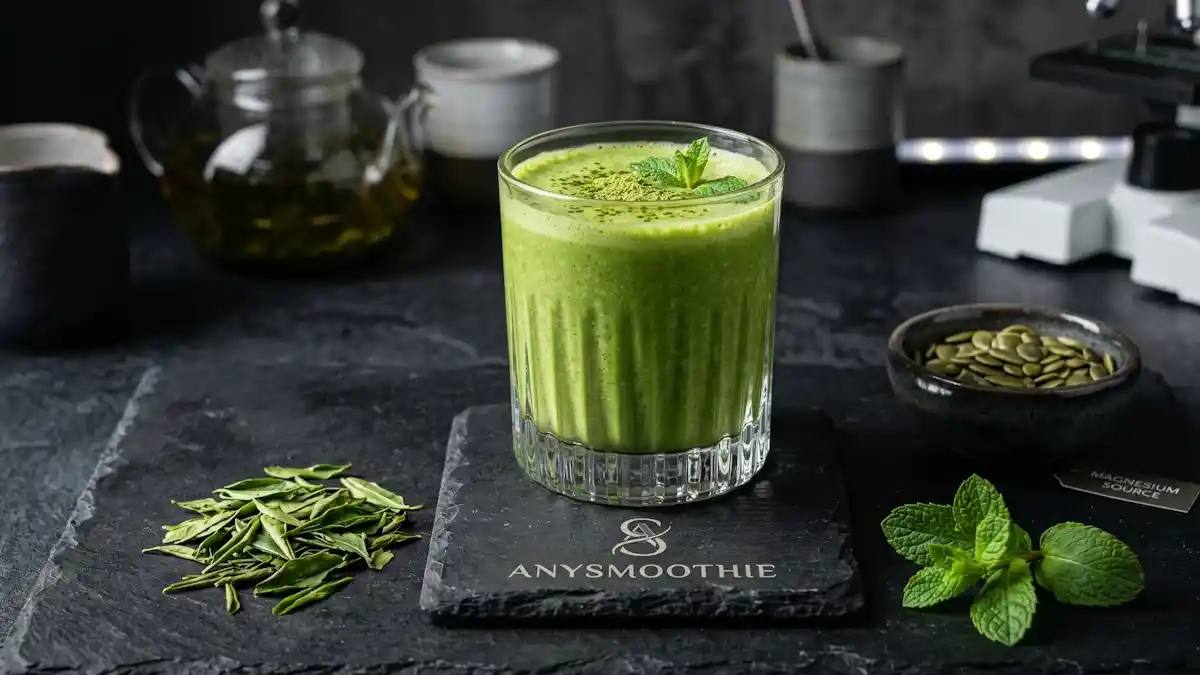
Feel that afternoon slump hit hard? Or notice mood swings tie to hormone shifts? Many people face these because of how their body clears dopamine and estrogen. The COMT enzyme acts as your cleanup crew for these chemicals. It breaks them down to keep energy steady and pathways clear.
EGCG, a key polyphenol from green tea, steps in to support that process. It protects enzymes and boosts efficiency through antioxidants. Blend it into smoothies, and you get better absorption thanks to fats that aid liposomal transport. These EGCG smoothies for COMT gene support make biohacking simple and practical.
Let’s start with the basics of COMT and why it matters.
The COMT Enzyme: Understanding Your Body’s Neuro-Clearance System
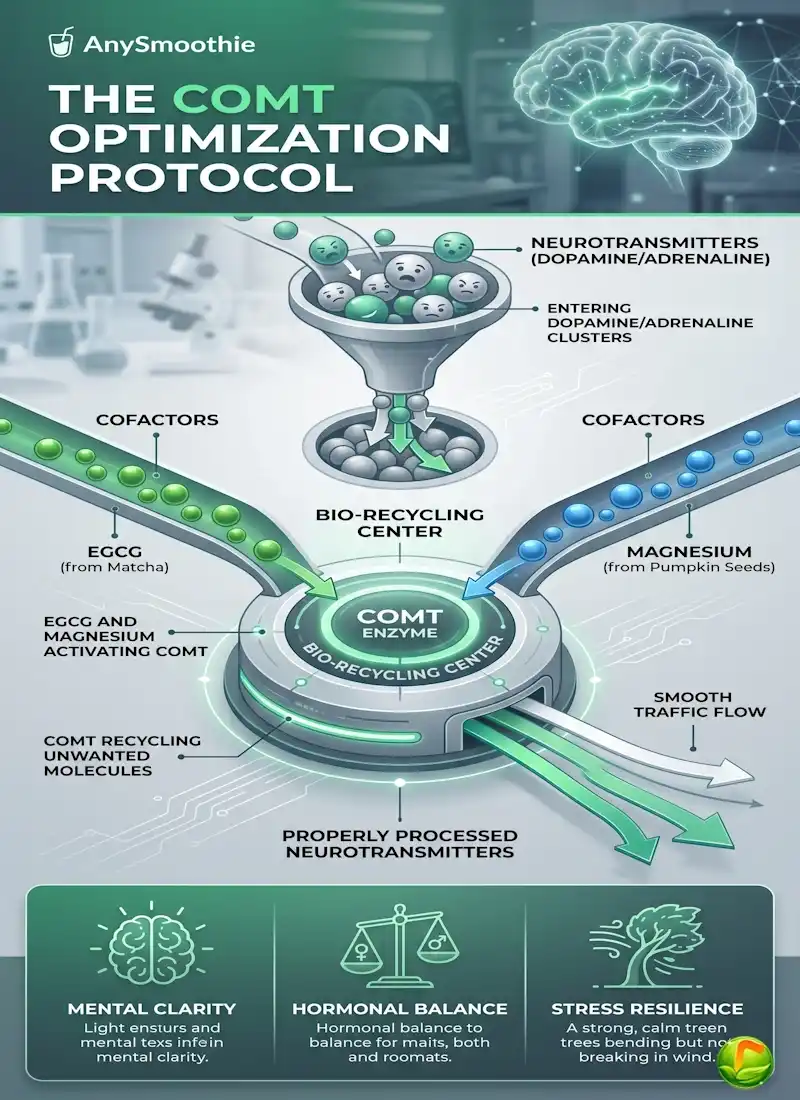
COMT clears catecholamines like dopamine and norepinephrine. It also handles estrogen. Think of it as a highway crew that keeps traffic moving smooth.
Fast COMT variants clear these quickly. Slow ones let buildup happen. This affects daily energy and mood balance. You stay steady when clearance works right.
Research shows COMT’s role in estrogen breakdown varies by gene type. It impacts how hormones linger in your system.
Dopamine and Estrogen: Clearing the Metabolic Traffic Jam from COMT Variants
Slow COMT can mean excess dopamine sticks around. Estrogen builds up too. Picture a clogged drain. Backups slow the whole system.
These jams disrupt metabolic efficiency. Your body needs help to clear them.
Three nutrients stand out for support. Here’s a quick comparison:
| Nutrient | Biochemical Role | Target Metabolite | Best Smoothie Pairing | Timing Strategy |
|---|---|---|---|---|
| EGCG (Green Tea) | Enzyme modulation | Catecholamines, estrogens | Fats like lecithin or avocado | Morning for mitochondrial priming |
| Magnesium Bisglycinate | Indispensable co-factor | All COMT substrates | Spinach or almond butter bases | Anytime as baseline support |
| Trimethylglycine (TMG) | Methyl donor | Homocysteine | Citrus or beet blends | After meals for partitioning |
Magnesium powers COMT as the core co-factor. Every smoothie benefits from it. Stack these for full pathway support.
EGCG and Catechol Modulation: Fine-Tuning Your Clearance Pathways
EGCG fits the COMT active site well. It protects against oxidative stress. This keeps enzymes running efficient.
It modulates catechol handling without overload. Cells get steady support. Mitochondria prime better for energy.
One study found high-dose EGCG does not impair COMT in vivo. It even boosted activity by 24%. Pathways stay optimized.
Polyphenol Synergy: How Green Tea Catechins Boost Enzymatic Performance
EGCG teams with COMT cofactors. It shields substrates during breakdown. This harmony aids metabolic flow.
Green tea catechins enhance bioavailability in blends. Fats turn them into liposomal forms. Your body absorbs more.
General research backs polyphenols for enzyme protection. Smoothies deliver this daily.
3 EGCG-Packed Smoothie Recipes Built for COMT Balance
Recipes make support easy. Each packs EGCG from matcha or tea. Add magnesium sources and fats for uptake. Prep takes minutes. They taste great too.
Strategic Stacking: Pair Magnesium and B-Vitamins with Your EGCG Smoothies
Magnesium fuels COMT as co-factor. B-vitamins drive the methylation cycle. Stack them for peak efficiency.
Add spinach or seeds for magnesium. Fruits like banana bring B6. Time smoothies to match needs.
The SAMe Cycle: Fueling COMT’s Methylation Engine
SAMe donates methyl groups to COMT. B-vitamins and magnesium build it.
The cycle runs like this: Folate and B12 make methyl groups. Magnesium stabilizes. COMT uses them to clear substrates.
Add B-rich items to smoothies. Berries or seeds work. Post-meal timing aids partitioning.
Conclusion
COMT clears dopamine, norepinephrine, and estrogen. EGCG from green tea supports that efficiency. Recipes blend it with magnesium for co-factor power.
Stack smart for metabolic gains. Start one smoothie today. Your pathways thank you.
Test your variants if curious. Share tweaks in comments. Feel the steady flow.
⚠️ Safety Notes for EGCG and COMT Support Smoothies
Liver Health and Concentrated EGCG: While whole green tea is safe, extremely high doses of EGCG extracts (above 800mg daily) have been linked to liver stress in some individuals. Always prefer matcha or brewed tea in your smoothies and avoid stacking with high-dose green tea supplements.
Slow COMT and Stimulants: If you have a confirmed “Slow COMT” variant, your body already clears caffeine and dopamine slowly. Combining a green tea smoothie with other stimulants (like coffee or pre-workouts) may cause excessive jitteriness, palpitations, or anxiety.
Interaction with Iron: EGCG is a potent iron chelator. If you are anemic or iron-deficient, consume your green tea smoothie at least 2 hours away from your iron-rich meals or supplements to prevent interference with iron absorption.
Magnesium and Blood Pressure: Magnesium has a mild vasodilatory effect. If you naturally have very low blood pressure or are taking antihypertensive medications, monitor your levels as magnesium can enhance the blood pressure-lowering effect.
TMG and Cholesterol: In some individuals, high doses of Trimethylglycine (TMG/Betaina) may slightly raise LDL cholesterol levels. If you have pre-existing cardiovascular concerns, use food sources like beets rather than concentrated TMG powders.
FAQ
How does EGCG act as a mild modulator of the COMT enzyme?
Epigallocatechin gallate (EGCG) possesses a catechol structure that allows it to interact with the active site of the Catechol-O-Methyltransferase (COMT) enzyme. Biochemically, it acts as a mild modulator by protecting the enzyme from oxidative degradation and optimizing its natural pathways of catecholamine turnover. This interaction supports the physiological systems involved in maintaining a balanced dopamine baseline, ensuring that cognitive focus is maintained without systemic overload.
Why is Magnesium considered an “obligatory co-factor” for COMT function?
Magnesium is a divalent cation required for the COMT enzyme to physically bind its substrates. Biochemically, magnesium coordinates with the oxygen atoms of the catechol group, facilitating the transfer of a methyl group from S-adenosylmethionine (SAMe). Providing magnesium-rich inputs in a smoothie supports the physiological systems of hormonal degradation, ensuring that the natural pathways of estrogen and dopamine clearance remain efficient at a cellular level.
How does Sunflower Lecithin optimize the “liposomal transport” of EGCG?
Phospholipids in sunflower lecithin, such as phosphatidylcholine, can encapsulate EGCG molecules to create a liposomal-like delivery system within the digestive tract. This biochemical strategy supports the physiological systems of nutrient absorption by protecting the polyphenols from premature degradation. Optimizing this transport ensures that a higher concentration of EGCG reaches the systemic circulation, facilitating more effective enzymatic support for COMT-dependent pathways.
In what way do methyl donors like TMG synergize with COMT activity?
Trimethylglycine (TMG) supports the physiological systems of the methylation cycle by donating methyl groups for the regeneration of methionine from homocysteine. This process ensures a steady supply of SAMe, which is the primary methyl source for the COMT enzyme. Biochemically, providing TMG alongside EGCG optimizes the natural pathways of neurotransmitter deactivation, ensuring that the biochemical mechanics of the “metabolic cleanup crew” have sufficient raw materials to function.
How does the COMT pathway impact the structural integrity of estrogen-sensitive tissues?
The COMT enzyme is responsible for the methylation of catechol estrogens (2-OHE and 4-OHE) into their safer, methylated forms. Supporting this enzyme through EGCG and magnesium supports the physiological systems involved in hormonal metabolism and tissue protection. This optimization ensures that estrogen clearance follows natural pathways that maintain the structural integrity of hormonal-sensitive tissues, preventing the accumulation of reactive intermediates that could disrupt cellular homeostasis.

Medical Disclaimer: AnySmoothie content is for educational purposes only and is not a substitute for professional medical advice. Consult a healthcare provider for personalized guidance. See our full Disclaimer & Terms of Use. AI Transparency: AnySmoothie may use AI to support content development. All content undergoes human editorial review for accuracy, clarity, and editorial quality. See our full AI Transparency.