

High uric acid can set off a painful gout flare when crystals collect in a joint. That happens fast enough to ruin sleep, walking, or even a normal workday.
Smoothies for high uric acid can help, but only as support. They can improve hydration, add potassium, and bring in antioxidant compounds that support the body’s urate-handling systems. If you’re in the middle of a flare, or you have kidney disease, get medical guidance before changing your diet in a big way.
The good news is simple. A well-built smoothie can be more like a clean-up crew than a sugar bomb.
How smoothies fit into uric acid control
Uric acid starts with purines. Your body breaks purines down, xanthine oxidase helps finish the job, and uric acid is the result. If the body makes too much, or clears too little, urate can build up and form crystals.
That is where a smart smoothie can help. Fluids support kidney clearance, citrus can add citrate, and certain plant compounds may support a calmer inflammatory response. The best blends keep added sugar low and rely on water-rich produce instead of juice.
The CDC’s gout guidance points to the same big picture, less sugar, better food choices, and steady habits that support uric acid control.
How uric acid builds up after purine breakdown
Purines come from food and from normal cell turnover. When they break down, xanthine oxidase helps convert the leftovers into uric acid. If your body makes more uric acid than it can clear, blood levels rise.
Once urate stays high for long enough, crystals can settle into joints. That is why ingredient choice matters. A smoothie should support clearance, not add more fuel to the problem.
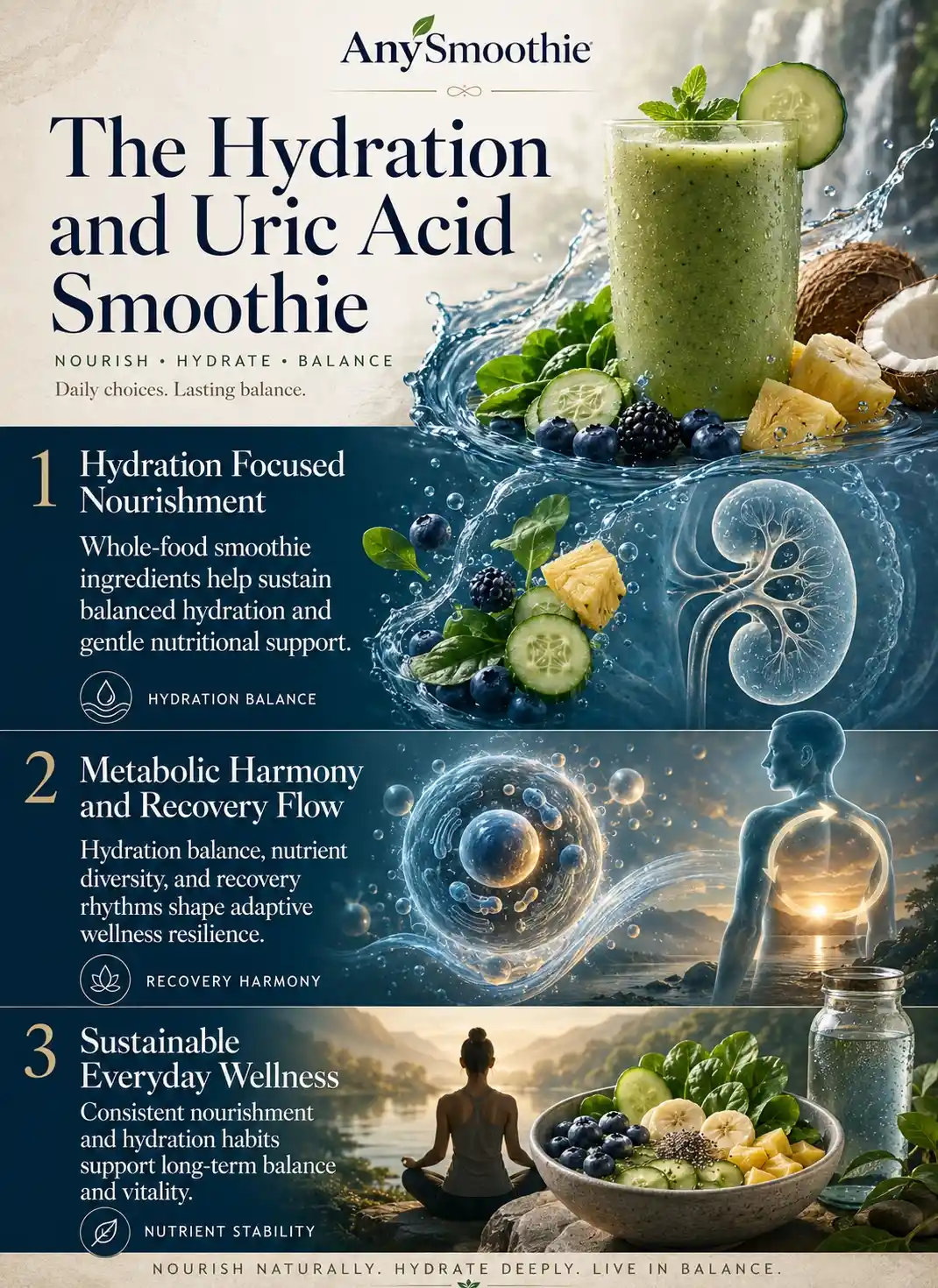
The smoothie goals that matter most for gout support
A useful smoothie has four jobs. It should hydrate, keep sugar low, offer potassium-rich produce, and include plant compounds that support urate handling.
That means fruit juice, honey, and sweetened yogurt are poor fits. It also means a low-purine eating pattern still matters overall. The Cleveland Clinic’s low purine diet guide is a clear reference for food choices outside the blender.
The best smoothie for uric acid is quiet, low sugar, fluid-heavy, and built for support, not sweetness.
The best smoothie ingredients for high uric acid
Here’s a quick way to compare the most useful targets.
| Targeted substrate | Physiological mechanism | Kinetic target | Best smoothie pairing | Target physiological outcome |
|---|---|---|---|---|
| Tart cherry anthocyanins | Downregulate xanthine oxidase and support calmer inflammatory signaling | Raw uric acid production rate | Cucumber, celery, lemon | Key systemic regulator that helps suppress uric acid production |
| Potassium citrate from citrus fruits | Supports urinary alkalinity and better ionic urate solubility | Urine chemistry and urate excretion | Orange, lemon, berries, water | More favorable urinary environment for urate clearance |
| Apigenin from celery or parsley | Supports antioxidant signaling and inflammatory balance | Joint inflammation and renal handling | Parsley, cucumber, pear | Fresh mineral support and a calmer joint environment |
Tart cherry is one of the most popular ingredients in gout-friendly smoothies. Citrus helps the kidneys work in a friendlier urinary environment. Celery and parsley add a clean mineral profile and a lighter plant mix that fits well in a daily blend.
Tart cherry, citrus, celery, and parsley do different jobs
Tart cherry is the anchor. Its anthocyanins are the most interesting ingredient here because they support the body at the production level. That makes them useful when you want a smoothie that works upstream, not just one that tastes good.
Citrus does a different job. Lemon and orange bring acid and citrate, which can support urinary thermodynamics and urate solubility. In plain terms, they help create a better setting for clearance.
Celery and parsley round things out. They add freshness, small amounts of potassium, and plant compounds that fit a gout-aware pattern without pushing sugar too high.
Why added sugar and fruit juice can work against your goal
A smoothie can go sideways fast. Sweetened yogurt, honey, agave, fruit juice, and large amounts of high-sugar fruit can raise the sugar load and add extra calories.
That matters because a gout-friendly smoothie should help the body handle urate, not overload it. If the drink tastes like dessert, it has probably drifted off course.
3 Smoothies for High Uric Acid
These are simple, low-sugar blends that fit the same pattern: hydrate well, keep fruit modest, and let vegetables do part of the work.
Crystalline-Flux Tart Cherry, Cucumber, and Celery Smoothie
Ingredients
- ½ cup (120 ml) unsweetened tart cherry juice
- 1 cup (240 ml) cold water
- ½ medium cucumber, chopped (about 100 g)
- 1 medium celery stalk, chopped (about 40–50 g)
- 1 cup ice
- 1 teaspoon fresh lemon juice, optional
Keep the cherry portion modest so the drink stays tart, not sweet. This is the cleanest option for days when you want the strongest cherry presence. Cucumber keeps it light, while celery adds a fresh, mineral-like flavor that complements this hydrating blend.
Estimated Nutrition per Serving
- Calories: ~90 kcal
- Protein: ~2 g
- Carbohydrates: ~21 g
- Fat: ~0.5 g
- Fiber: ~2 g
- Sugars: ~16 g
Citrus-Berry Recovery Smoothie with Chia and Spinach
Ingredients
- ½ small orange, peeled
- ½ cup (75 g) mixed berries, fresh or frozen
- 1 cup fresh spinach
- 1 tablespoon chia seeds
- 1 cup (240 ml) unsweetened almond milk
- ½ cup ice, optional
This blend provides citrate from citrus, along with fiber and a better texture than a juice-heavy drink. The berries bring color and polyphenols, while chia adds fiber and makes the smoothie more filling.
Estimated Nutrition per Serving
- Calories: ~160 kcal
- Protein: ~6 g
- Carbohydrates: ~23 g
- Fat: ~7 g
- Fiber: ~10 g
- Sugars: ~10 g
Green Parsley-Pear Smoothie for a Lighter Daily Option
Ingredients
- 1 cup fresh parsley, lightly packed
- ½ medium cucumber, chopped (about 100 g)
- ½ small pear, cored and chopped (about 60–70 g)
- 1 cup (240 ml) water
- ½ cup ice, optional
Keep the pear modest so the drink stays balanced. This is a good daily option when you want something mild. It is less tart than a cherry blend, and the herbs give it a fresh finish without piling on sugar.
Estimated Nutrition per Serving
- Calories: ~80 kcal
- Protein: ~3 g
- Carbohydrates: ~18 g
- Fat: ~1 g
- Fiber: ~5 g
- Sugars: ~9 g
I’d blend the parsley, cucumber, and water first until the herbs are completely broken down, then add the pear and ice. This keeps the parsley from leaving coarse leafy pieces in an otherwise light smoothie.
How to build a gout-friendly smoothie without making it too sweet
Use water, ice, or unsweetened milk alternatives as the base
Start with water, ice, or an unsweetened milk alternative like almond milk. That keeps the drink hydrating and avoids the sugar hit that comes with juice.
If you want more flavor, use lemon, lime, ginger, or herbs instead of sweeteners. The goal is a clean base that supports fluid intake.
Keep fruit portions moderate and use vegetables for volume
Use berries, citrus, cucumber, and leafy greens to build volume. These ingredients add taste and texture without turning the drink into a sugar load.
If you want more staying power, chia seeds are a solid add-in. They bring fiber and help the smoothie feel like part of a meal, not a sugar snack.
When smoothies help most, and when to be careful
Smoothies work best as part of a steady routine. They fit well on days when you need hydration, a lighter meal, or a simple way to keep produce intake up. They also work better when the rest of your diet is balanced.
Still, caution matters. If you have diabetes, kidney disease, or frequent gout flares, your fluid and potassium needs may be different. Don’t treat a smoothie plan as a substitute for personalized care.
Conclusion
The best smoothies for high uric acid are built on hydration, low sugar, and the right plant compounds. Tart cherry, citrus, cucumber, celery, parsley, and modest berries can support the body’s natural urate pathways without flooding it with sweetness.
Consistency matters more than chasing one perfect ingredient. Start with one simple recipe this week, keep it low in sugar, and let the routine do the work.
🛡️ Safety Notes & Contraindications
🛡️ Watch the Fructose Sugar Rush: High-fructose fruits (like pears or mangoes) and juices can instantly crash your liver’s energy (ATP) levels. This rapid energy depletion forces your body to produce an immediate surge of uric acid within 30 minutes, which is dangerous if you are prone to gout. Stick strictly to low-sugar berries.
🛡️ Monitor Potassium and Kidney Filters: Stacking heavy potassium sources like celery, cucumber, and orange can overload your system if your kidneys aren’t filtering at 100 percent, or if you take blood pressure medications (like ACE-inhibitors). Too much potassium at once can stress your heart rhythm.
🛡️ Never Skip the Calcium Shield: Blending greens like spinach daily without a calcium source allows free oxalates to easily flood your bloodstream and saturate your kidneys, creating a high risk for painful kidney stones. Always add Greek yogurt, kefir, or calcium-fortified plant milks to trap them in the gut.
🛡️ Avoid Sudden Joint Shock: Dropping your uric acid levels too fast by aggressively chugging clearance herbs can actually backfire. A sudden drop in your blood metrics can destabilize old crystal deposits in your joints, triggering a painful, paradoxical gout flare. Titrate and introduce your clean-up smoothies gradually.
FAQ
Why does drinking too much fruit juice or sweet syrup spike uric acid levels?
When you drink a smoothie packed with high-fructose fruits, store-bought juices, or syrups, the sugar hits your system all at once because there is no whole-food fiber matrix to slow it down. Your liver absorbs this sudden wave of fructose rapidly, forcing an enzyme called fructokinase to process it completely unchecked. This rapid processing burns up a massive amount of cellular energy (ATP) in your liver very quickly. As your liver’s energy stores drop, it creates a byproduct called AMP, which triggers a biological chain reaction that directly shoots up your body’s raw production of uric acid.
How do tart cherries help lower the amount of uric acid your body makes?
Before uric acid can form in your body, the final steps of the process rely entirely on a specific enzyme called xanthine oxidase. This is where tart cherries come in as a great natural tool. They contain unique antioxidant compounds called anthocyanins that are shaped perfectly to sit right inside the active center of that enzyme. By occupying that space, they act as a natural roadblock, slowing down the enzyme’s ability to produce uric acid in the first place and lowering the overall concentration of urate that enters your kidneys for filtering.
How does adding lemon or lime juice to a smoothie help flush out uric acid?
Uric acid dissolves very poorly in an acidic environment, which makes it much easier for it to bind together and form sharp, painful crystals in your joints or kidneys. When you consume natural citrates from fresh lemons, limes, or oranges, these organic compounds help raise the pH of your urine within the kidneys. Making the environment more alkaline causes the uric acid molecule to lose a proton, turning it into a highly soluble ionic form. This chemical shift allows your body to hold much more dissolved uric acid in fluid suspension so you can flush it out safely.
Can celery and parsley actually help your kidneys get rid of uric acid?
Yes, and the reason comes down to how your kidneys manage waste. Your kidneys have a specialized gateway protein called URAT1, which acts like a sponge, pulling filtered uric acid out of the urine and reclaiming it back into your bloodstream. Celery and parsley contain active natural plant compounds, like apigenin, that temporarily slow down this URAT1 gateway. By keeping the gateway busy, these compounds allow more filtered uric acid to slide right past the reabsorption trap and leave the body naturally through your urine.
Why do your kidneys need steady energy and hydration to clear waste efficiently?
Flushing uric acid out of your blood and pushing it through your kidney walls is a heavy, active job. The transport pumps in your renal tubules (like the ABCG2 pump) operate like manual water levers—they require a continuous supply of cellular energy (ATP) generated by your mitochondria to push waste out against tight gradients. Giving your body clean hydration, minerals, and light amino acids from low-fat dairy gives your kidney cells the exact fuel and structural support they need to maintain healthy cellular respiration, keeping your body’s filtration gates working at full capacity.

Medical Disclaimer: AnySmoothie content is for educational purposes only and is not a substitute for professional medical advice. Consult a healthcare provider for personalized guidance. See our full Disclaimer & Terms of Use. AI Transparency: AnySmoothie may use AI to support content development. All content undergoes human editorial review for accuracy, clarity, and editorial quality. See our full AI Transparency.