
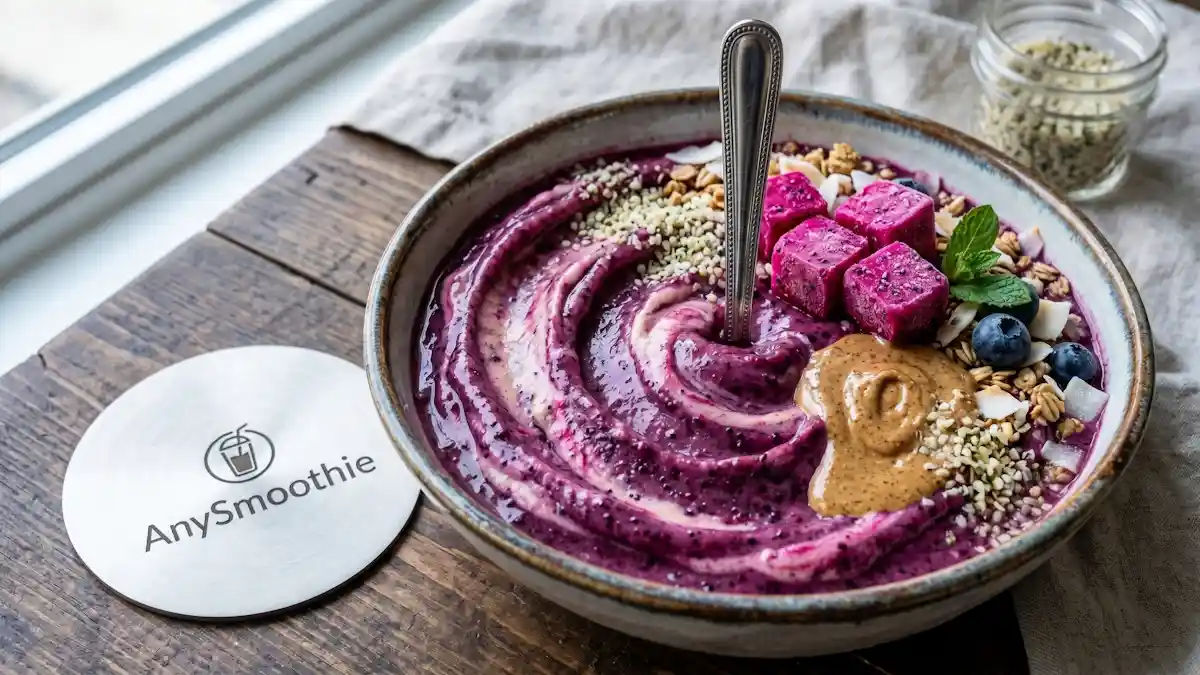
A smoothie bowl can taste great and still fail the moment it hits the spoon. Texture matters because the bowl should hold its shape, feel rich in the mouth, and stay thick long enough to eat without rushing. That is where a guide to engineering smoothie bowl texture starts, with the right frozen base, the right thickener, and the right blend method.
When those pieces line up, the bowl feels dense instead of watery. It eats more like soft serve than a drink, and that changes the whole experience.
What makes a smoothie bowl thick instead of runny?
Thick bowls are built on control. The main variable is water, because water loosens structure fast. A splash helps the blades move, but too much liquid turns frozen fruit into soup. High-water fruit, extra juice, and long blend times all push the bowl in that direction.
Why water is the main reason bowls turn thin
Fresh fruit often carries more water than people expect. Pineapple, melon, and juicy berries can make a bowl taste bright, but they also thin the mix. Overblending does the same thing, because the blades warm the ingredients and break down the frozen solids that give the bowl its body.
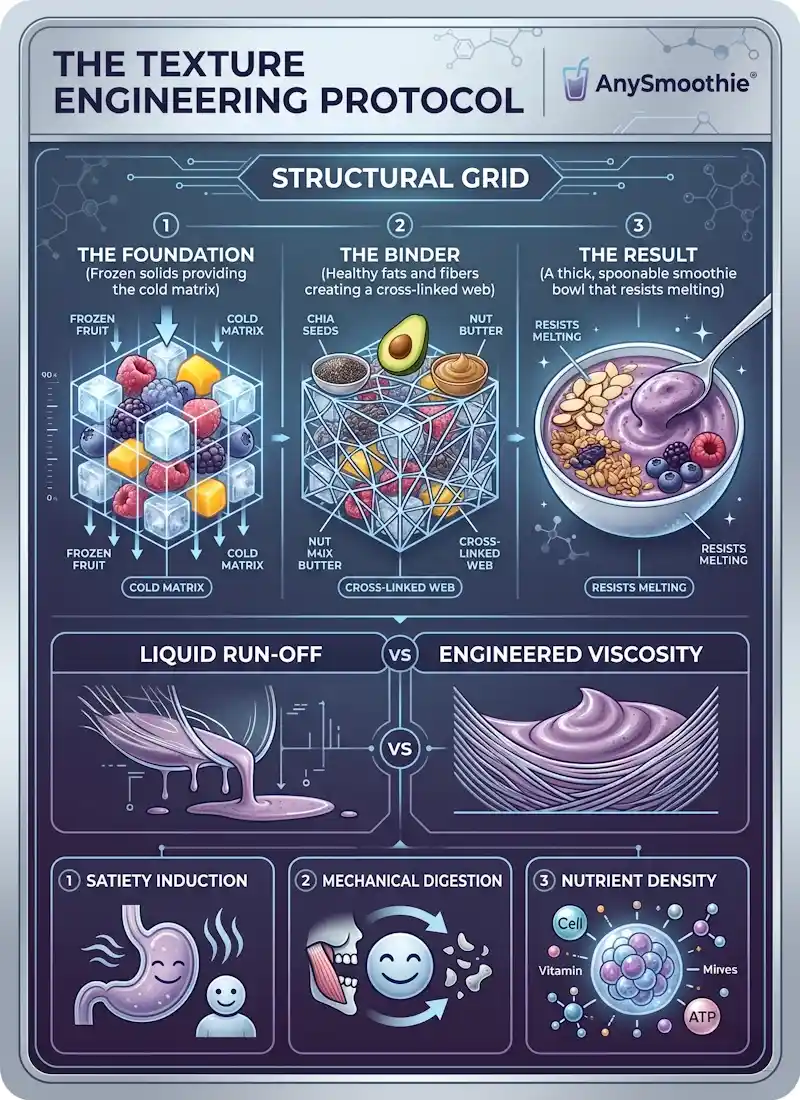
How fiber, fat, and frozen solids create body
Fiber acts like scaffolding. It helps the mix hold shape and slows the melt. Fat adds creaminess and makes the mouthfeel feel rounder. Frozen solids keep the base cold and dense, which is what gives you that spoonable finish.
The best bowls balance all three instead of leaning on one ingredient to do all the work. That balance is the real trick behind a thick smoothie bowl.
The best ingredients for a thick, creamy base
These ingredients work as structural emulsifiers, using polysaccharides and lipids for stability.
| Texture Engineer | Physiological Impact | Impact on Flavor Profile | Best Smoothie Pairing | Target Consistency |
|---|---|---|---|---|
| Frozen Steamed Cauliflower | Adds structural volume with a low sugar load, and helps the bowl stay cold and thick | Mild and easy to hide under fruit, cacao, or vanilla | Berries, cocoa, avocado, plant protein | Dense, scoopable, soft-serve thick |
| Avocado | Adds monounsaturated fat, boosts creaminess, and slows melt | Rich, buttery, and slightly green | Banana, cacao, coffee, berries | Silk-like, heavy, spoonable |
| Chia Seeds | Thickens with mucilaginous fiber and supports a gel-like texture | Neutral with a light seed speck | Berry bowls, yogurt bowls, citrus fruit | Pudding-like, holds peaks |
Frozen cauliflower is the quiet workhorse here. It gives structure without the high glycemic load of a banana-heavy base. Avocado fills in the gaps with fat, while chia seeds help the bowl stay put after blending.
Other ingredients that help build a stable bowl
Frozen banana still has a place. It adds sweetness and body, but it can pull the texture softer, so use it as a support instead of the main base. Greek yogurt or plant yogurt adds thickness plus a tangy edge. Oats bring a smooth, porridge-like body, nut butter adds density, and cocoa deepens flavor without adding water.
How to blend for a spoon-thick finish every time
The method matters as much as the ingredients. Start with frozen items first, then add powders, seeds, and the smallest useful amount of liquid. A thick mix needs patience, not more juice.
The thickest bowl usually starts with less liquid than feels safe.
Use less liquid and add it slowly
Begin with a small pour, not a full splash. If the blender stalls, pause and use the tamper instead of flooding the jar. Thick mixtures often need short pauses, scraping, or a blender stick so the base stays dense.
Blend in short bursts, then check the texture
Short pulses protect thickness better than a long, nonstop blend. Stop, look, and test the spoonful before you add anything else. If the bowl looks smooth but still holds a mound, you’re there. If it starts moving like a shake, it’s already too loose.
The Role of Texture in Hedonic Hunger Control
The Rheology of Satiety is simple. Thicker bowls take longer to eat, so they support normal satiety signaling and slow the pace of the meal. That extra oral processing matters because mouthfeel changes how fast the bowl disappears.
Oral Processing Time: The Link Between Viscosity and Leptin Release
Viscosity shapes eating speed. A dense bowl asks for more chewing and more tongue work, which can help fullness cues register more clearly. Thin smoothies slide down fast, but a thick bowl makes you stay with each spoonful longer.
Mitochondrial Priming: Slow-Release Carbs for Sustained Energy
When fruit is paired with fiber, fat, and protein, the meal feels more even afterward. That kind of structure supports nutrient partitioning and a simple form of mitochondrial priming, because the body gets a steadier fuel pattern instead of a quick sugar hit.
3 ultra-thick smoothie bowl formulas to try
Velvet Cauliflower and Avocado Smoothie Bowl
Ingredients
- 1½ cups frozen cauliflower florets
- ½ avocado
- ¼ cup unsweetened soy milk
- ½ teaspoon vanilla extract
- ½ cup frozen blueberries
Pour the soy milk into the blender first. Add the avocado, frozen cauliflower, blueberries, and vanilla. Blend on low, stopping to scrape down the sides as needed, until very thick and completely smooth. Add only a small splash of extra milk if the blades need help moving.
Frozen cauliflower creates bulk with relatively little natural sugar, while avocado contributes fiber and unsaturated fats that give the bowl a dense, creamy consistency. Blueberries provide sweetness, color, fiber, and anthocyanins without requiring a large amount of additional liquid.
Estimated Nutrition per Serving
- Calories: ~280 kcal
- Protein: ~10 g
- Carbohydrates: ~30 g
- Fat: ~17 g
- Fiber: ~13 g
- Sugars: ~12 g
Bright Berry, Chia, and Yogurt Smoothie Bowl
Ingredients
- 1½ cups frozen mixed berries
- ¾ cup plain Greek yogurt
- 1 tablespoon chia seeds
- 2 tablespoons unsweetened almond milk
- ½ teaspoon vanilla extract
Add the Greek yogurt and almond milk to the blender first, followed by the frozen berries, chia seeds, and vanilla. Blend until thick and spoonable, scraping down the sides as necessary. Let the bowl rest for two or three minutes if you want the chia to thicken it further.
Berries contribute fiber, vitamin C, and polyphenols, while Greek yogurt provides high-quality protein and calcium. Chia absorbs liquid and forms a gel-like mucilage as it hydrates, naturally increasing the thickness of the bowl.
Estimated Nutrition per Serving
- Calories: ~365 kcal
- Protein: ~22 g
- Carbohydrates: ~50 g
- Fat: ~10 g
- Fiber: ~15 g
- Sugars: ~28 g
Higher-Fiber Oat and Nut Butter Smoothie Bowl
Ingredients
- 1 medium frozen banana
- ⅓ cup rolled oats
- 1 tablespoon natural almond butter
- 1 tablespoon ground flaxseed
- ½ cup unsweetened soy milk
- ½ teaspoon ground cinnamon
Pour the soy milk into the blender first. Add the frozen banana, oats, almond butter, ground flaxseed, and cinnamon. Blend until dense and spoonable, using the tamper or stopping to scrape down the sides rather than adding unnecessary liquid.
Oats, banana, almond butter, and flax provide a combination of fiber, carbohydrates, protein, and unsaturated fats. The relatively low liquid volume helps maintain a thick bowl consistency, while oats and flax continue absorbing moisture after blending.
Estimated Nutrition per Serving
- Calories: ~430 kcal
- Protein: ~14 g
- Carbohydrates: ~64 g
- Fat: ~16 g
- Fiber: ~11 g
- Sugars: ~21 g
If I were serving this as a bowl, I’d have the toppings ready before blending. The texture is at its best immediately, before the frozen banana begins to soften and the oats continue absorbing the available liquid.
Conclusion
Smoothie bowl texture comes down to a few simple choices, water, fiber, fat, and frozen solids. When those pieces are balanced, the bowl holds its shape, eats slowly, and stays rich from the first bite to the last.
Start with one change, maybe less liquid, maybe frozen cauliflower, maybe shorter blend bursts. That small adjustment is often enough to turn a thin blend into a bowl that actually holds up.
🛡️ Safety Notes & Contraindications: Smoothie bowl texture
Blender Stress: preparing ultra-thick bowls can put significant mechanical strain on blender motors; always use a tamper or a high-powered unit (min. 1200W) to avoid overheating and potential electrical failure or plastic off-gassing.
Choking Hazard (Frozen Chunks): if not blended thoroughly, large frozen pieces of cauliflower or fruit can remain; ensure the texture is a uniform “soft-serve” consistency, especially when serving to children or elderly individuals.
Gastric Distension: the high air-incorporation (overrun) and fiber density of engineered bowls can cause rapid gastric distension; eat slowly to avoid discomfort, bloating, or “cold-induced” stomach cramps.
Oxalate Awareness: if using raw spinach as a colorant/thickener in your base, be mindful of oxalate accumulation; rotating with steamed/frozen greens is safer for long-term kidney health.
Caloric Density Misjudgment: because these bowls are aerated and voluminous, it is easy to underestimate their caloric and fat content; monitor portions of added fats (avocado, nut butters) to maintain your specific nutrient partitioning goals.
FAQ
How does “Viscosity” influence the physiological signaling of satiety?
Viscosity refers to the thickness and resistance to flow of a liquid or semi-solid. Biochemically, high-viscosity meals slow down gastric emptying and increase oral processing time. Supporting this physiological system through thick smoothie bowls optimizes the natural pathways of leptin and ghrelin regulation, ensuring the biochemical mechanics of “fullness cues” have sufficient time to register in the brain compared to thin, rapidly consumed drinks.
Why is “Frozen Steamed Cauliflower” considered a structural workhorse for bowls?
Frozen cauliflower provides a high volume of dietary fiber (cellulose and hemicellulose) without the high fructose load of fruit. Biochemically, these fibers act as a “scaffolding” that holds the cold structure together even as it begins to melt. Supporting this physiological system through vegetable-based bases facilitates the biochemical mechanics of a low-glycemic meal, providing a dense, scoopable texture that mimics soft-serve without the insulin spike.
How do “Mucilaginous Fibers” in chia seeds stabilize bowl texture?
Chia seeds contain a high concentration of soluble fiber that, when hydrated, forms a mucilaginous gel. Biochemically, this gel acts as a natural emulsifier and thickener, binding water molecules and preventing the bowl from turning runny. Supporting this physiological system through the addition of seeds optimizes the natural pathways of “bolus stabilization,” ensuring the biochemical mechanics of the texture remain intact from the first to the last spoonful.
What is the role of “Lipid Emulsification” in mouthfeel and nutrient delivery?
Healthy fats from ingredients like avocado or nut butters create a creamy emulsion when blended. Biochemically, these lipids coat the tongue, providing a rich mouthfeel (hedonic response) and slowing the absorption of fruit sugars. Supporting this physiological system through fat-inclusive recipes facilitates the biochemical mechanics of “nutrient partitioning,” ensuring that energy is released steadily rather than in a sharp peak.
Why does “Over-blending” degrade the structural integrity of a smoothie bowl?
The friction from high-speed blender blades generates thermal energy, which begins to melt the frozen solids (ice crystals) that provide the bowl’s body. Biochemically, excessive blending also breaks down the long-chain polysaccharides in fiber that contribute to thickness. Supporting the physiological system through short, high-powered bursts and the use of a tamper optimizes the natural pathways of “thermal stability,” ensuring the biochemical mechanics of the frozen matrix are preserved for a spoon-thick finish.

Medical Disclaimer: AnySmoothie content is for educational purposes only and is not a substitute for professional medical advice. Consult a healthcare provider for personalized guidance. See our full Disclaimer & Terms of Use. AI Transparency: AnySmoothie may use AI to support content development. All content undergoes human editorial review for accuracy, clarity, and editorial quality. See our full AI Transparency.