
No smoothie has been shown to improve peroxisomal alpha-oxidation, so recipes connected to this pathway are everyday food ideas, not treatments. If you’re searching because of Refsum disease, your personal dietary plan takes priority.
The three recipes below offer different flavors and textures, alongside guidance for readers managing a related condition. First, it helps to understand what this fatty-acid pathway does and why ingredient claims need care.
What Peroxisomal Alpha-Oxidation Does, and Why Food Claims Need Care
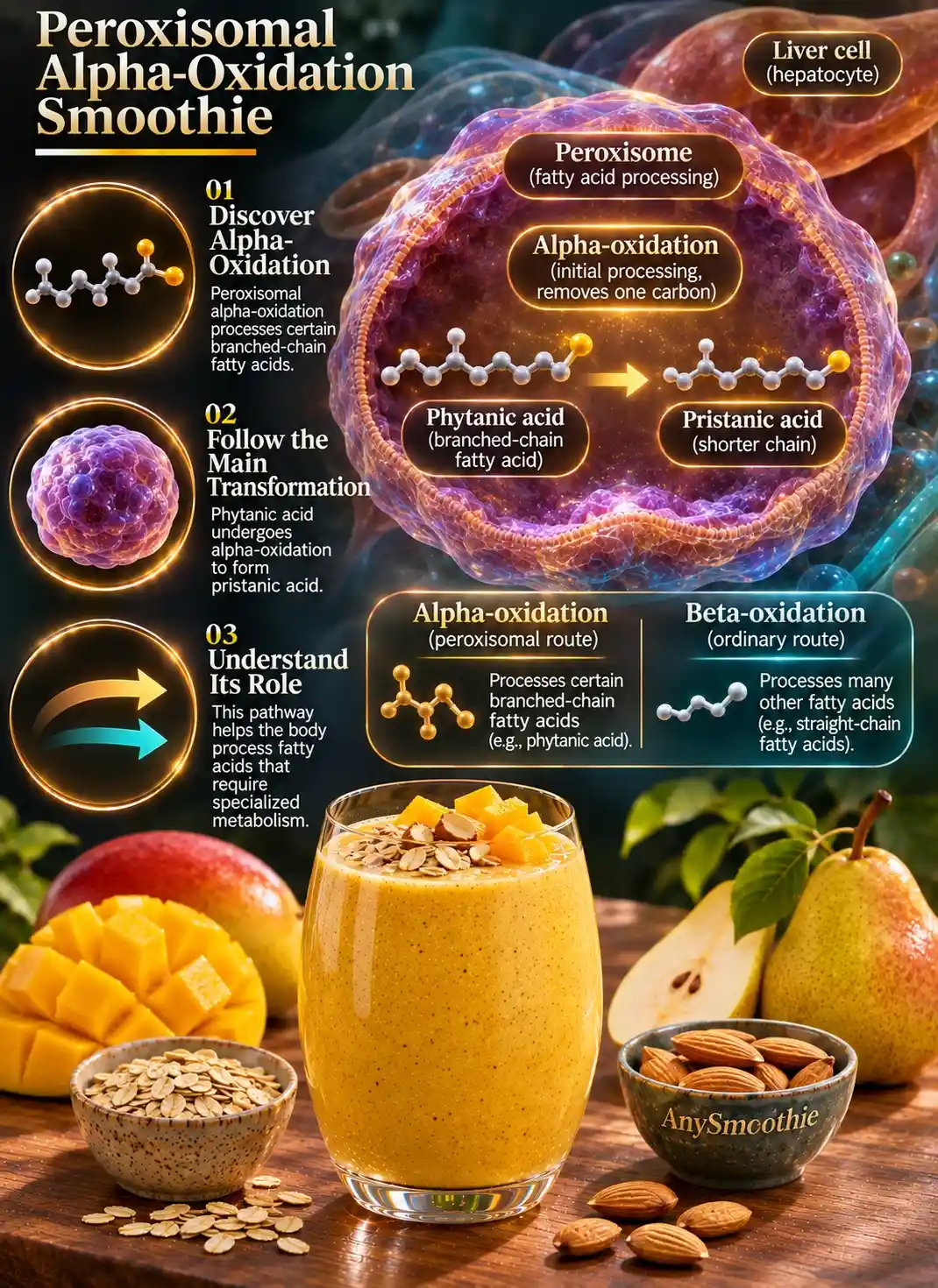
Peroxisomes are small compartments inside cells that contain enzymes for several chemical processes. One process, alpha-oxidation, helps break down certain branched-chain fatty acids, including phytanic acid.
For a distinct example of cellular organelle maintenance involving mitochondria, see urolithin a smoothies for mitophagy optimization.
Most fatty acids undergo beta-oxidation, which removes two-carbon units during breakdown. However, phytanic acid has a methyl branch that prevents this usual starting sequence. Alpha-oxidation removes one carbon, allowing the resulting compound to undergo further processing. That processing produces pristanic acid, which can enter beta-oxidation.
A separate fatty-acid process involving enzyme-mediated changes to dietary fats is discussed in smoothies for essential fatty acid desaturation.
The distinction matters because this is a specific enzyme-dependent process. Ordinary dietary advice about fat intake doesn’t tell you how efficiently an individual processes phytanic acid.
NCBI’s clinical review of Refsum disease describes how problems with phytanic acid metabolism lead to its accumulation. Adding fruit, oats, or seeds to a blender doesn’t establish that those ingredients change the relevant enzyme activity.
For a broader discussion of cellular maintenance processes, see smoothies to support cellular cleanup.
A smoothie’s calorie, protein, or fiber content cannot tell you whether it affects phytanic acid metabolism.
These recipes provide ordinary nutrients in drinkable form. Their ingredients offer flavor, texture, and nutritional variety, but no evidence establishes them as formulas for optimizing this pathway. Likewise, a recipe’s plant-based ingredients don’t establish its suitability for someone with a metabolic disorder.
A related discussion of another metabolic intermediate involved in cellular energy processing appears in alpha-ketoglutarate smoothies for healthy longevity.
3 Smoothies for Peroxisomal Alpha-Oxidation
Each recipe makes one serving. Nutrition estimates vary with brands and fruit size; they don’t measure phytanic acid.
Blueberry Oat Smoothie
Ingredients
- 3/4 cup blueberries
- 1/2 cup unsweetened soy milk
- 1/4 cup rolled oats
- 1 teaspoon chia seeds
Instructions
Blend until the oats are finely broken down. Let the smoothie stand for two minutes, then stir before drinking.
Estimated Nutrition (per serving)
- Calories: ~200 kcal
- Protein: ~8 g
- Carbohydrates: ~33 g
- Fat: ~5 g
- Fiber: ~7 g
- Sugars: ~12 g
Mango Banana Smoothie
Ingredients
- 1/2 cup mango chunks
- 1/2 medium banana
- 3/4 cup unsweetened soy milk
- 1 tablespoon unsweetened shredded coconut
Instructions
Blend everything until creamy, pausing to scrape down any coconut caught on the sides. Use frozen mango for a thicker, colder texture.
Estimated Nutrition (per serving)
- Calories: ~200 kcal
- Protein: ~7 g
- Carbohydrates: ~30 g
- Fat: ~7 g
- Fiber: ~5 g
- Sugars: ~20 g
Strawberry Pear Smoothie
Ingredients
- 1 cup halved strawberries
- 1/2 medium ripe pear, cored
- 1/2 cup cold water
- 1 tablespoon unsweetened almond butter
Instructions
Cut the pear into small pieces, leaving the skin on. Blend with the remaining ingredients until the pear skin is finely dispersed.
Estimated Nutrition (per serving)
- Calories: ~200 kcal
- Protein: ~5 g
- Carbohydrates: ~29 g
- Fat: ~10 g
- Fiber: ~7 g
- Sugars: ~17 g
How the Three Smoothies Compare for Flavor and Everyday Use
The main differences are taste, consistency, and estimated nutrient content.
| Smoothie | Flavor | Texture | Nutrition profile | Everyday use |
|---|---|---|---|---|
| Blueberry oat | Tart, mildly sweet | Thick, slightly textured | Most protein; least sugar | Breakfast accompaniment |
| Mango banana | Sweet, tropical | Smooth, creamy | Most total sugar | Creamy afternoon snack |
| Strawberry pear | Fresh, lightly sweet | Lighter, slightly grainy | More fat; less protein | Lighter-textured snack |
Choose according to your preferences and dietary needs. Total sugar includes naturally occurring fruit sugars; it doesn’t mean added sugar. Also, similar calorie totals don’t make the recipes nutritionally interchangeable. These comparisons describe food characteristics, not differences in alpha-oxidation activity.
When a Smoothie Needs Personal Medical Guidance
People with Refsum disease or another diagnosed metabolic condition may need specific dietary restrictions. GeneReviews’ guidance on adult Refsum disease describes dietary management as part of specialist care. A general recipe cannot replace that individualized plan.
Food restrictions can involve details that broad labels miss. “Fruit-based,” “plant-based,” and “vegan” don’t establish that a drink is low in phytanic acid or appropriate for a particular diagnosis. Likewise, the absence of dairy doesn’t certify a recipe for a metabolic diet.
The nutrition estimates above cover common macronutrients, fiber, and sugars. They don’t report phytanic acid concentrations, so they cannot establish whether a serving fits a prescribed restriction.
Ask your metabolic specialist or dietitian to review the exact ingredients, product brands, and serving amounts before incorporating these recipes. Bring the complete recipe rather than only its title or calorie estimate.
Substitutions also deserve review. Replacing water with milk, adding yogurt, or including a protein powder changes the recipe’s composition. Even when a change seems minor, your care team’s approved food guidance should determine whether it fits.
For anyone managing a diagnosed condition, that review is a safety step rather than a judgment about whether smoothies are generally healthy.
Conclusion: Keep the Recipes Separate From Pathway Claims
These smoothies offer convenient variety, with different flavors, textures, and nutrient profiles. None has been shown to improve peroxisomal alpha-oxidation.
The useful distinction is between ordinary food choices and condition-specific dietary care. If you have Refsum disease or another metabolic diagnosis, use your medical team’s personalized guidance to decide whether any recipe belongs in your eating plan.
🛡️ Safety Notes & Dietary Interactions
- Refsum Disease: These recipes are not designed to control phytanic acid. Anyone with Refsum disease or another metabolic disorder should follow their specialist’s dietary plan rather than assuming a fruit-based smoothie is appropriate.
- Ingredient Verification: Nutrition labels do not report phytanic acid content. Exact brands, serving sizes, and substitutions can matter for medically prescribed diets, so review complete recipes with a metabolic dietitian.
- Allergen Awareness: The recipes contain soy, chia, coconut, and almond butter. Check labels carefully for allergies and cross-contact, particularly when replacing ingredients or using packaged plant-based products.
- Fiber and Texture: Oats, chia, berries, pear, and coconut contribute fiber and can thicken smoothies. Introduce higher-fiber combinations gradually and add water as needed for comfortable consistency.
FAQs
Can these smoothies improve peroxisomal alpha-oxidation?
No. The article does not establish that any of these recipes improves alpha-oxidation. The pathway depends on specific cellular enzymes involved in phytanic acid metabolism, and ordinary calorie, protein, or fiber content cannot predict an individual’s enzyme activity.
Are these smoothies suitable for someone with Refsum disease?
Not automatically. A recipe being fruit-based, plant-based, or dairy-free does not establish that it meets a person’s phytanic acid restriction. Anyone with Refsum disease should have the exact ingredients, brands, and serving sizes reviewed against their individualized dietary plan.
Which smoothie has the most protein?
The Blueberry Oat Smoothie provides the most estimated protein, at approximately 8 grams per serving. The Mango Banana Smoothie provides about 7 grams, while the Strawberry Pear Smoothie provides approximately 5 grams. These nutritional differences do not indicate differences in alpha-oxidation or phytanic acid metabolism.
Why doesn’t the article list phytanic acid amounts?
The recipes were compared using calories, macronutrients, fiber, and sugars, but those estimates do not measure phytanic acid. Therefore, the nutrition table cannot establish whether a particular serving meets a medically prescribed restriction.
Can I substitute ingredients in these smoothies?
You can make culinary substitutions, but substitutions may matter when following a condition-specific dietary plan. Adding milk, yogurt, protein powder, or changing plant ingredients alters the recipe’s composition. For Refsum disease or another metabolic diagnosis, have proposed substitutions reviewed by your metabolic specialist or dietitian.

Medical Disclaimer: AnySmoothie content is for educational purposes only and is not a substitute for professional medical advice. Consult a healthcare provider for personalized guidance. See our full Disclaimer & Terms of Use. AI Transparency: AnySmoothie may use AI to support content development. All content undergoes human editorial review for accuracy, clarity, and editorial quality. See our full AI Transparency.