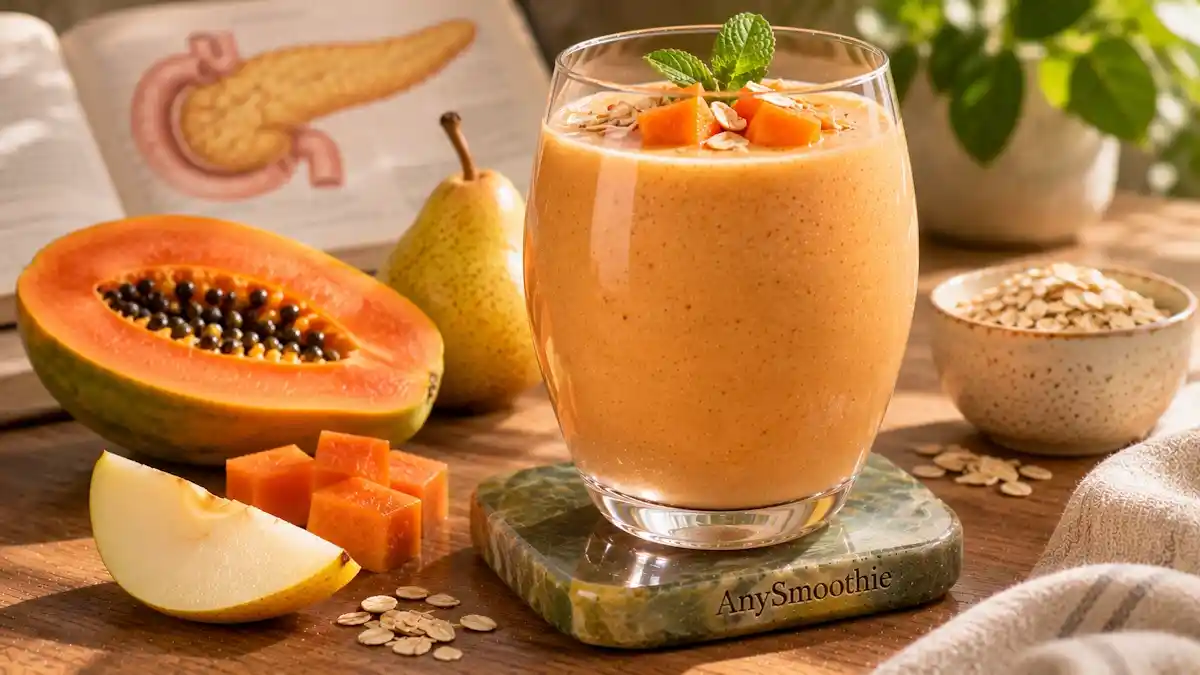
Exocrine pancreatic insufficiency (EPI) can make it harder to digest food and absorb nutrients. Smoothies for pancreatic exocrine function support can provide food and fluids, but they don’t restore pancreatic enzyme function or replace prescribed treatment.
A drinkable snack may feel more manageable when appetite or food tolerance varies. For another food-focused discussion of nutritional intake during recovery, see smoothies for recovery after illness. However, blending changes texture without removing the need for digestion.
Start with these three simple options, then tailor portions and ingredients with your clinician or registered dietitian.
How to Fit Smoothies Into an EPI Eating Plan
Tolerance varies with EPI, so use these recipes as starting points rather than fixed rules. A clinician or registered dietitian can help adapt them to your needs. For a separate discussion of smoothie portions and digestive comfort around exercise, see acid reflux and exercise: when to drink smoothies.
Adjust Portions and Ingredients to Your Tolerance
Start with a small serving and track the amount, ingredients, and any symptoms afterward. That record can help your care team identify useful adjustments.
Discuss portion size, fat, fiber, lactose, and other ingredients instead of assuming everyone needs the same restrictions. For example, low-fat cottage cheese isn’t necessarily lactose-free. NIDDK’s EPI nutrition guidance recommends working with a health professional on your eating plan. Tell your clinician about persistent symptoms or unintended weight loss.
Keep Prescribed Enzymes and Nutrition Guidance in the Plan
A smoothie still contains nutrients that require digestion. If you’ve been prescribed pancreatic enzyme replacement therapy (PERT), take it as directed with food, including smoothies.
NIDDK’s EPI treatment guidance explains that PERT supplies digestive enzymes. Ask your care team how to take your prescribed enzymes with blended meals, including timing and dose. Don’t skip or change treatment because food is blended.
Gut microbes also process dietary components through pathways distinct from pancreatic enzyme digestion. For a separate overview, see smoothies for gut-derived indole metabolites and smoothies for estrobolome and gut ecology.
Also ask whether a dietitian can help you meet your nutrient needs. Smoothies are food, not a substitute for PERT or individualized care.
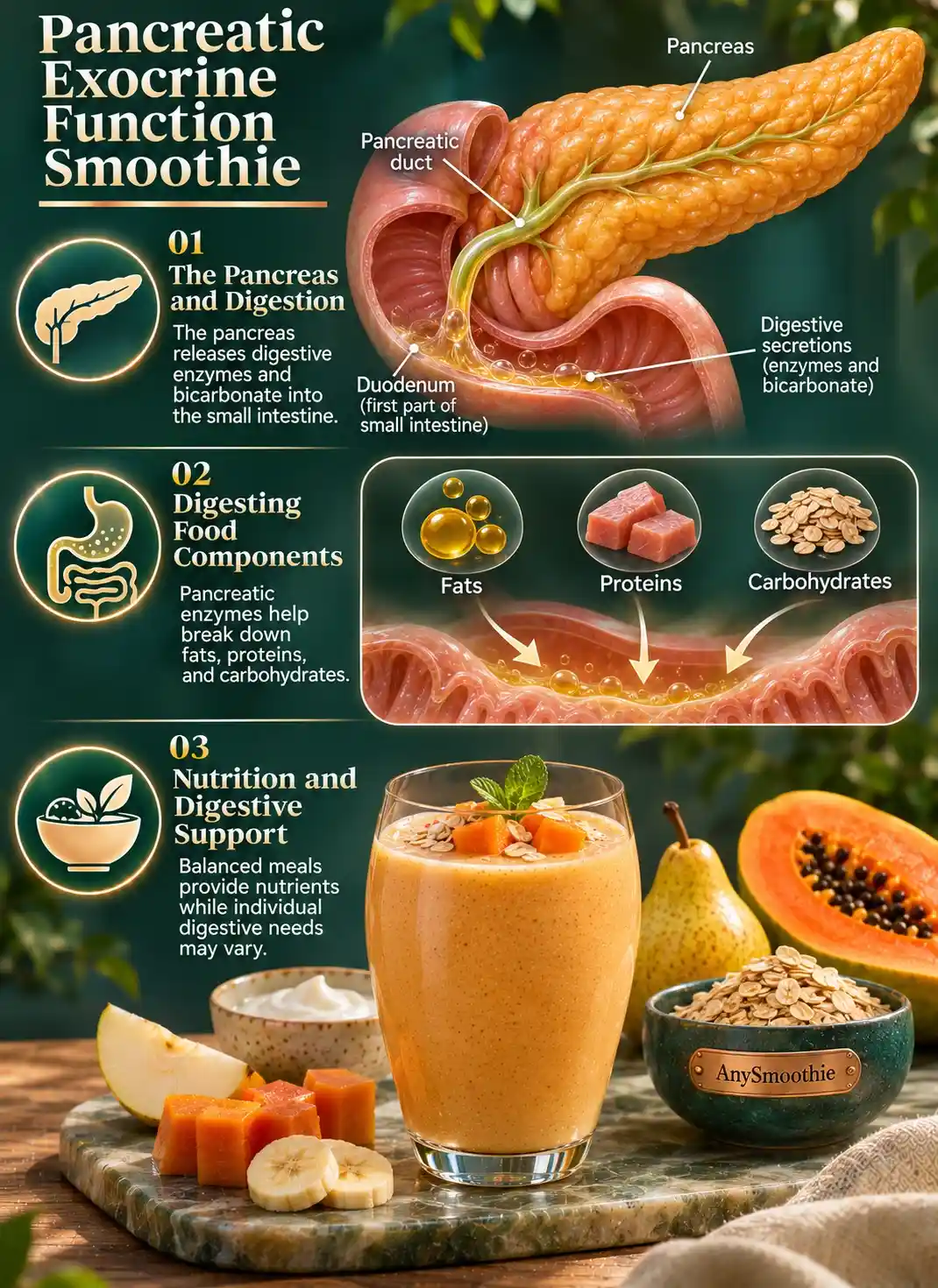
3 Smoothies for Pancreatic Exocrine Function Support
Each recipe makes one serving. Nutrition estimates are approximate; brands, portions, and extra liquid can change them.
Banana Oat Yogurt Smoothie
Ingredients
- 1 medium banana
- 1/2 cup plain nonfat lactose-free Greek yogurt
- 1/2 cup unsweetened oat milk
- 2 tablespoons rolled oats
Instructions
Pour the oat milk into a blender, then add the banana, yogurt, and oats. Blend until smooth, adding a little more oat milk if needed for a thinner texture.
Estimated Nutrition (per serving)
- Calories: ~255 kcal
- Protein: ~14 g
- Carbohydrates: ~48 g
- Fat: ~3 g
- Fiber: ~5 g
- Sugars: ~22 g
Berry Soy Tofu Smoothie
Ingredients
- 1 cup unsweetened fortified soy beverage
- 3/4 cup strawberries
- 1/4 cup blueberries
- 2 ounces silken tofu
Instructions
Add the soy beverage, strawberries, blueberries, and silken tofu to a blender. Blend until creamy, then add a little water and blend again if you prefer a thinner texture.
Estimated Nutrition (per serving)
- Calories: ~195 kcal
- Protein: ~13 g
- Carbohydrates: ~26 g
- Fat: ~6 g
- Fiber: ~5 g
- Sugars: ~17 g
Peach Cottage Cheese Smoothie
Ingredients
- 1 cup sliced peaches packed in juice and drained
- 1/2 cup low-fat cottage cheese
- 1/2 cup lactose-free milk
- 1 tablespoon rolled oats
Instructions
Put the drained peaches, cottage cheese, milk, and oats in a blender. Blend until smooth, then thin with a splash of water if desired and blend briefly again.
Estimated Nutrition (per serving)
- Calories: ~230 kcal
- Protein: ~18 g
- Carbohydrates: ~31 g
- Fat: ~4 g
- Fiber: ~3 g
- Sugars: ~25 g
Compare the Smoothies by Texture, Flavor, and Nutrition
Use this comparison to match the recipes to your preferences, rather than to rank their medical benefits.
| Smoothie | Texture | Flavor profile | Nutrition profile | Best suited for |
|---|---|---|---|---|
| Banana Oat Yogurt | Thick and hearty | Mild, banana-forward | Highest carbohydrates and calories | A thicker snack |
| Berry Soy Tofu | Creamy, lighter-bodied | Bright and tart | Lowest calories; moderate protein | A dairy-free choice |
| Peach Cottage Cheese | Smooth and creamy | Mellow and sweet | Highest protein; lowest fiber | A higher-protein snack |
The peach recipe provides the most protein, while the banana version has the most substantial texture. Meanwhile, the berry option offers a brighter flavor. Peach may appeal more if tart fruit isn’t your preference.
The berry recipe is the only fully dairy-free option as written. Lactose-free yogurt in the banana recipe still contains milk proteins, so it isn’t suitable for someone with a milk allergy. Likewise, lactose-free milk doesn’t make the peach recipe dairy-free.
Total sugars include naturally occurring sugars in fruit and milk. That figure doesn’t mean the recipe contains an equal amount of added sugar. For the peach smoothie, using fruit packed in juice and draining it keeps the recipe consistent with the estimate.
Also, compare the whole nutrition profile rather than choosing solely by calories or sugar. The berry smoothie has the fewest calories, but that doesn’t automatically make it the right choice when you need more energy.
Estimated nutrition describes what’s in the glass; it doesn’t measure how much your body absorbs.
Conclusion: Choose a Smoothie That Fits Your Care Plan
Banana, berry, and peach smoothies offer different flavors, textures, and nutrition profiles. The suitable choice depends on individual tolerance and the guidance you receive for managing EPI.
Use an option you enjoy as part of your eating plan. Keep prescribed treatment in place, and work with your care team on adjustments rather than treating a smoothie as therapy for EPI.
🛡️ Safety Notes & Dietary Interactions
- PERT Timing: Blending changes texture, not digestion. If pancreatic enzyme replacement therapy is prescribed, take it as directed with smoothies or other foods and never alter the dose independently.
- Fat and Tolerance: EPI does not mean everyone needs the same fat restriction. Discuss fat portions and symptoms with your clinician rather than assuming lower-fat recipes are universally appropriate.
- Lactose and Dairy: Lactose-free yogurt and milk still contain milk proteins, while cottage cheese is not necessarily lactose-free. Milk allergy and lactose intolerance require different ingredient choices.
- Nutrient Absorption: Smoothies cannot guarantee normal nutrient absorption in EPI. Persistent digestive symptoms, unintended weight loss, or difficulty meeting nutritional needs should prompt review with your care team or dietitian.
FAQs
Which smoothie has the most protein?
The Peach Cottage Cheese Smoothie provides the most estimated protein, at about 18 grams per serving. The Banana Oat Yogurt version supplies approximately 14 grams, while Berry Soy Tofu provides about 13 grams. These figures describe the nutrients in the drink, not how much protein someone with EPI will ultimately absorb.
Does blending make food easier to digest with EPI?
Blending primarily changes texture and particle size; it does not replace pancreatic digestive enzymes. A smoothie may feel easier to consume for someone whose appetite or food tolerance varies, but the nutrients still require digestion. If PERT is prescribed, follow your care team’s instructions for taking it with blended foods.
Is the Berry Soy Tofu smoothie the best choice for EPI?
There is no universally best smoothie for EPI. The berry version is the only dairy-free recipe as written and has the lowest estimated calories and moderate fat. Someone needing more energy, tolerating dairy, or following different nutritional goals may find another recipe more suitable. Individual tolerance should guide the choice.
Can I use lactose-free ingredients if dairy bothers me?
Lactose-free milk or yogurt can be useful when lactose is the issue, but they still contain milk proteins. They are therefore not appropriate for a milk allergy. The Berry Soy Tofu Smoothie is dairy-free as written, although soy tolerance and individual dietary requirements still need consideration.
Should I change my pancreatic enzyme dose for a smoothie?
Do not change a prescribed PERT dose simply because a food is blended. Enzyme requirements depend on the food and the individual’s treatment plan, while blending does not eliminate the need for digestion. Ask your clinician or dietitian how your prescribed enzymes should be taken with these particular smoothies and portions.

Medical Disclaimer: AnySmoothie content is for educational purposes only and is not a substitute for professional medical advice. Consult a healthcare provider for personalized guidance. See our full Disclaimer & Terms of Use. AI Transparency: AnySmoothie may use AI to support content development. All content undergoes human editorial review for accuracy, clarity, and editorial quality. See our full AI Transparency.