
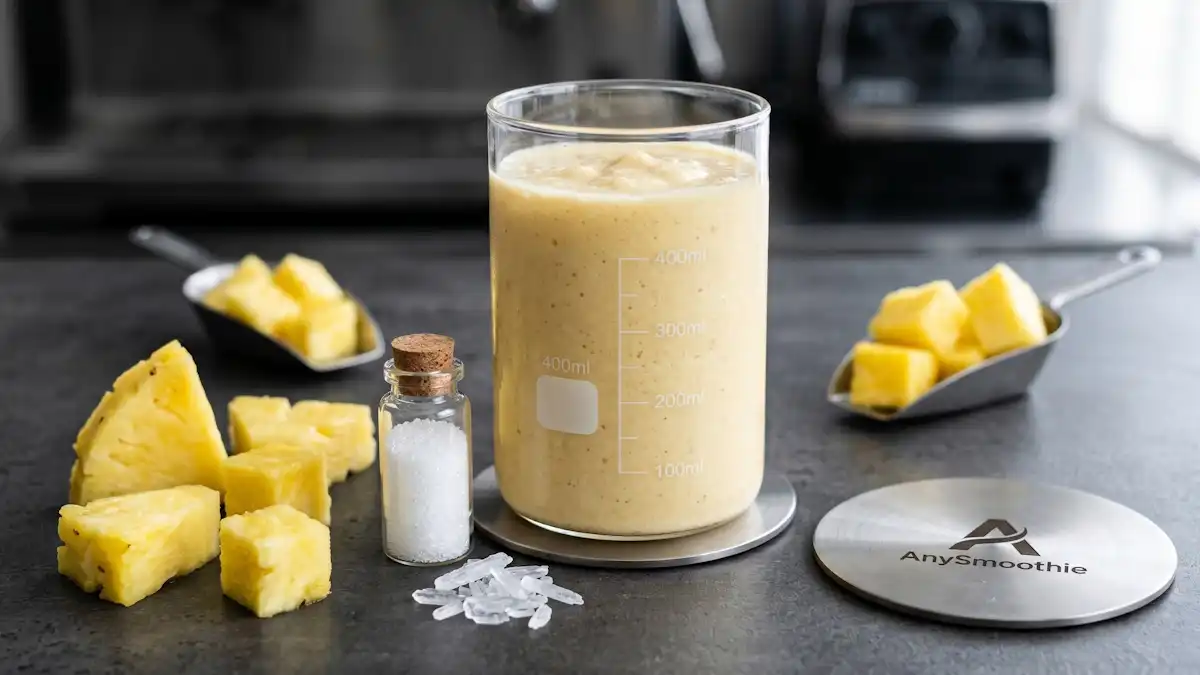
Joint lubrication is the difference between a hinge that glides and one that grinds. Inside healthy joints, synovial fluid cushions movement, cartilage stays nourished, and the joint surfaces handle load with less friction. A smoothie for joint lubrication can support that system because it brings hydration, healthy fats, protein, and key micronutrients into one easy habit.
It is not a cure, and it should not be treated like one. The point is to support synovial fluid, cartilage health, and the body’s normal repair work with ingredients you can use every day. Start with how the fluid actually works.
The Synovial Fluid Membrane: Mechanics of Tribological Transport
Synovial joints, like knees, hips, shoulders, and ankles, use a sealed fluid pocket. That fluid reduces friction, spreads load, and helps nutrients reach cartilage. For a plain-language refresher, Cleveland Clinic’s synovial fluid guide explains how the membrane and fluid work together.
When the fluid has the right viscosity, movement feels smoother. When hydration drops or tissue quality slips, the system gets less efficient. Healthy motion helps too, because joint movement circulates fluid across the cartilage surface.
Hyaluronan Synthesis: The Rate-Limiting Step in Viscosupplementation
Hyaluronan is the main thickener in synovial fluid. It binds water, so the fluid stays slippery without getting too thin. That balance matters because joints need both cushion and glide.
The NCBI Bookshelf overview of synovial fluid describes synovial fluid as both a lubricant and a nutrient source. That is why hydration and movement belong in the same conversation. In practical terms, the body makes the best use of what you feed it.
Extracellular Matrix Anchors: Type II Collagen and Chondroitin Flux
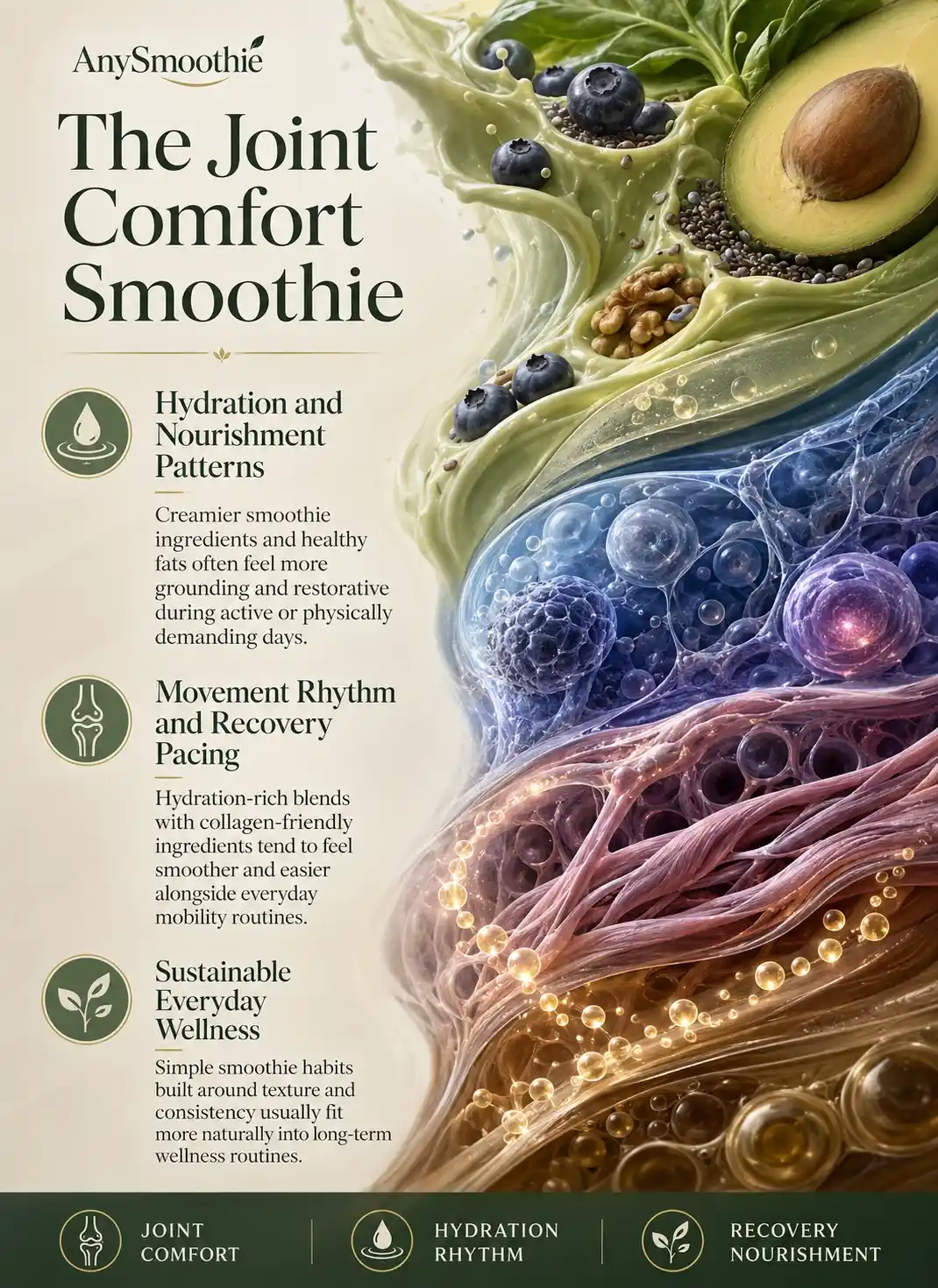
The best smoothie ingredients for joint support and fluid balance do not work alone. A systems-biology paper on synovial joint lubrication shows how lubricant molecules, cartilage tissue, and the synovial lining all depend on one another.
That is why the smartest formulas mix water, protein, antioxidants, and fats instead of chasing one star ingredient. Here is a simple comparison of three common joint-lube substrates.
| Substrate | Physiological Mechanism | Tissue Absorption Velocity | Best Smoothie Pairing | Target Joint Component |
|---|---|---|---|---|
| High molecular weight hyaluronic acid | Binds water and supports synovial fluid viscoelasticity | Low direct absorption, indirect support | Citrus, berries, kefir | Fluid |
| Collagen type II peptides | Supplies amino acids and signaling peptides for matrix maintenance | Moderate after digestion | Pineapple, yogurt, berries | Cartilage matrix |
| MSM (methylsulfonylmethane) | Donates structural sulfur for glycosaminoglycan and proteoglycan support | Moderate and well absorbed | Ginger, turmeric, avocado | Cartilage matrix |
Hyaluronic acid is the joint’s main mechanical lubricant inside the articular capsule.
High molecular weight hyaluronic acid is the fluid-side anchor. Collagen peptides and MSM do different work, but they support the matrix that holds that fluid-friendly structure together.
Sulfur Donors: How MSM Drives Proteoglycan Cross-Linking
MSM brings structural sulfur, which the body can use when it builds glycosaminoglycans and proteoglycans. Those matrix molecules help cartilage hold water and keep its shape under load.
In a smoothie, MSM pairs well with citrus, ginger, or yogurt because taste matters if you want the habit to stick. Keep the formula simple. Consistency does more than a long ingredient list.
3 ‘Synovia-Prime’ Viscosity Support Smoothie Recipes
Once the structure is clear, the recipes get easy. Use a liquid base, a protein source, fruit, and one fat or seed. That gives you hydration and makes the smoothie feel like a meal, not dessert.
Viscoelastic Load Management
Timing matters less than consistency, but a smoothie works well after a walk, a lift, or breakfast. Movement helps joint fluid circulate, and the smoothie helps refill the tank.
Mitochondrial Priming: Energy Flux for Synoviocyte Cellular Secretion
When you build a routine around the same base ingredients, your body gets a steadier supply of water, amino acids, and minerals. That supports normal secretion work in synoviocytes and keeps the formula easy to repeat.
If a recipe tastes good, you will use it. That matters more than chasing a perfect mix.
Simple add-ins that improve texture, nutrition, and satiety
- Oats for thicker texture and slower energy
- Greek yogurt for protein and creaminess
- Nut butter for fullness
- Chia or flax for fiber and viscosity
- Frozen fruit for a colder blend
Mistakes that can work against your joint support goals
- Too much fruit juice
- Too little protein
- No water-rich liquid base
- Too much sweetness and not enough balance
A good joint-support smoothie should never be fruit juice in disguise. Balance keeps it useful.
Conclusion
A smoothie for joint lubrication works best when it supports hydration, connective tissue, and healthy movement patterns. That means fluid, protein, and micronutrients come before fancy add-ins.
The strongest takeaway is simple: consistency matters more than one perfect ingredient. Build one version you can make often, then keep it balanced enough to drink without effort. When the recipe is easy, the habit lasts, and your joints get steadier day-to-day support.
🛡️ Safety Notes & Contraindications
Anticoagulant and Antiplatelet Synergy (Turmeric/Ginger): CRITICAL: High doses of raw turmeric and ginger within daily smoothie protocols exert mild antiplatelet profiles, inhibiting specific thromboxane pathways. If you are taking prescription blood thinners (e.g., Warfarin, DOACs) or antiplatelet therapies (e.g., Aspirin), consult your hematologist to evaluate cumulative bleeding metrics.
MSM and Mild Gastrointestinal Transit Shifts: MSM is highly bioavailable, but initial exposure to high therapeutic doses can induce transient osmotic shifts in the colon lumen, presenting as mild bloating, nausea, or softer stools. Introduce MSM into your formulation matrix in micro-fractions (starting with $1\text{g}$) and titrate upward gradually.
Bromelain-Induced Proteolysis and Medication Interactions: Pineapple is rich in bromelina, a potent proteolytic enzyme group that degrades protein structures and enhances intestinal permeability. Bromelain can non-specifically increase the absorption and plasma concentration of specific oral antibiotics (e.g., Tetracyclines) and blood thinners. Space drug intake by at least 2 hours.
Oxalate Loading via Spinach in Joint Profiles: Utilizing raw spinach daily as a green anchor introduces a substantial oxalic acid load. In individuals with underlying metabolic vulnerabilities, oxalates can form calcium-oxalate crystals that deposit in kidney tissues or exacerbate systemic joint stiffness. Substitute spinach with low-oxalate alternatives like cucumber or zucchini.
Chondroitin Sourcing and Shellfish Allergies: If your collagen or chondroitin substrates are extracted from marine matrices, individuals with severe Type 1 IgE-mediated shellfish or seafood allergies must cross-verify raw material certificates to avoid acute systemic hypersensitivity episodes. Prioritize avian (chicken) or bovine sources.
FAQ
How does “Tribological Transport” dictate the mechanical friction within a synovial joint?
Synovial joints function as sealed bio-mechanical systems that rely on boundary and fluid-film lubrication to distribute load. Biochemically, the synovial membrane filters plasma to secrete a specialized fluid rich in lubricants. Supporting this physiological system through nutrient-dense, hydrating smoothies optimizes the natural pathways of “fluid-film maintenance,” ensuring that under heavy mechanical loads, joint surfaces glide smoothly past one another rather than generating abrasive friction.
Why is “Hyaluronan Synthesis” considered the rate-limiting step for synovial viscosity?
Hyaluronic acid (HA) is a high-molecular-weight glycosaminoglycan that dictates the unique viscoelasticity of synovial fluid, allowing it to act as a shock absorber under pressure and a lubricant during rapid movement. Biochemically, its production by type B synoviocytes requires a steady supply of glucose and amino-sugar precursors. Supporting this physiological system with vitamin C-dense fruit bases (such as pineapple or citrus) serves as an enzymatic catalyst that supports natural hyaluronan synthesis, keeping the internal environment slippery and resilient.
What is the role of “Type II Collagen Peptides” in anchoring the extracellular matrix?
Articular cartilage owes its tensile strength to a dense scaffolding of Type II collagen. Biochemically, ingested hydrolyzed Type II peptides provide specific hydroxyproline and glycine matrices that serve as signaling fragments to stimulate chondrocytes (cartilage cells). Supporting this physiological system through targeted protein inclusion facilitates the biochemical mechanics of “extracellular matrix turnover,” providing the raw structural substrates needed to maintain cartilage density.
How do “Sulfur Donors” like MSM drive proteoglycan cross-linking in cartilage?
Cartilage resiliency depends on proteoglycans—large molecules that act like biological sponges to hold water within the joint matrix. Biochemically, Methylsulfonylmethane (MSM) acts as an organic sulfur donor necessary for establishing the disulfide bonds that cross-link these proteoglycan chains. Supporting this physiological system through sulfur-rich additions optimizes the natural pathways of “cartilage hydrodynamics,” ensuring the tissue can squeeze out water under load and reabsorb it during rest.
Why is “Mitochondrial Priming” necessary for synoviocyte cellular secretion?
The continuous synthesis and exocytosis of high-molecular-weight lubricants by synoviocytes is an intensive metabolic process that requires substantial cellular energy. Biochemically, these specialized lining cells demand a constant flux of ATP to manufacture and pump out synovial components. Supporting this physiological system with a low-glycemic, electrolyte-rich smoothie base (using coconut water or kefir) facilitates the biochemical mechanics of “synoviocyte priming,” providing the cellular fuel needed to maintain steady fluid turnover.

Medical Disclaimer: AnySmoothie content is for educational purposes only and is not a substitute for professional medical advice. Consult a healthcare provider for personalized guidance. See our full Disclaimer & Terms of Use. AI Transparency: AnySmoothie may use AI to support content development. All content undergoes human editorial review for accuracy, clarity, and editorial quality. See our full AI Transparency.