

The first drink of the day can shape energy, appetite, and blood sugar for hours. If breakfast lands too hard, you may feel foggy before lunch. If it lands well, the morning feels steadier and easier to manage.
That is the idea behind metabolic priming in plain language, helping the body move from overnight fasting into a more efficient fed state. A breakfast smoothie can do that well, but only when the ingredients match the goal. The sections below cover what to blend, what to avoid, when to drink it, and how to match the formula to your day.
Metabolic Priming: Shifting from Post-Absorptive to Postprandial
After sleep, the body is in a post-absorptive state. It is still running on stored fuel, and it is ready to respond to food. Once you eat, the body enters a postprandial state, where insulin, glucose use, and nutrient transport all start to shift.
A useful overview of the concept appears in this metabolic priming guide, which treats breakfast as a strong signal, not a casual habit. A smoothie can support that signal when it gives the body clear fuel without a fast sugar hit.
First-Phase Insulin Response: Preventing the Morning Glucose Spike
The first-phase insulin response is the quick early release that helps move glucose out of the blood. If breakfast is mostly fruit juice, honey, or sweet add-ins, that response has to work harder.
Protein, fiber, and fat slow the pace. As a result, glucose enters the bloodstream more evenly, and the morning feels less jumpy. That matters because a smooth start often means fewer cravings an hour later.
Why the Morning Meal Can Shape Energy, Focus, and Cravings
Breakfast is often the first chance to set fuel flow for the day. A smoothie with protein, fiber, and low-glycemic carbs can support steadier energy and cleaner focus.
When the mix is balanced, you usually get less of the sharp rise and crash pattern. You also give the body a better chance to use incoming fuel for work instead of storing it too quickly.
How a Smoothie Can Support Nutrient Partitioning
Nutrient partitioning is how the body decides where nutrients go. Some gets burned right away. Some gets stored. Some goes to repair and recovery.
A well-built smoothie can support that process by slowing the sugar surge and adding useful substrates. That can help mitochondrial output stay more stable, because cells get a cleaner fuel mix.
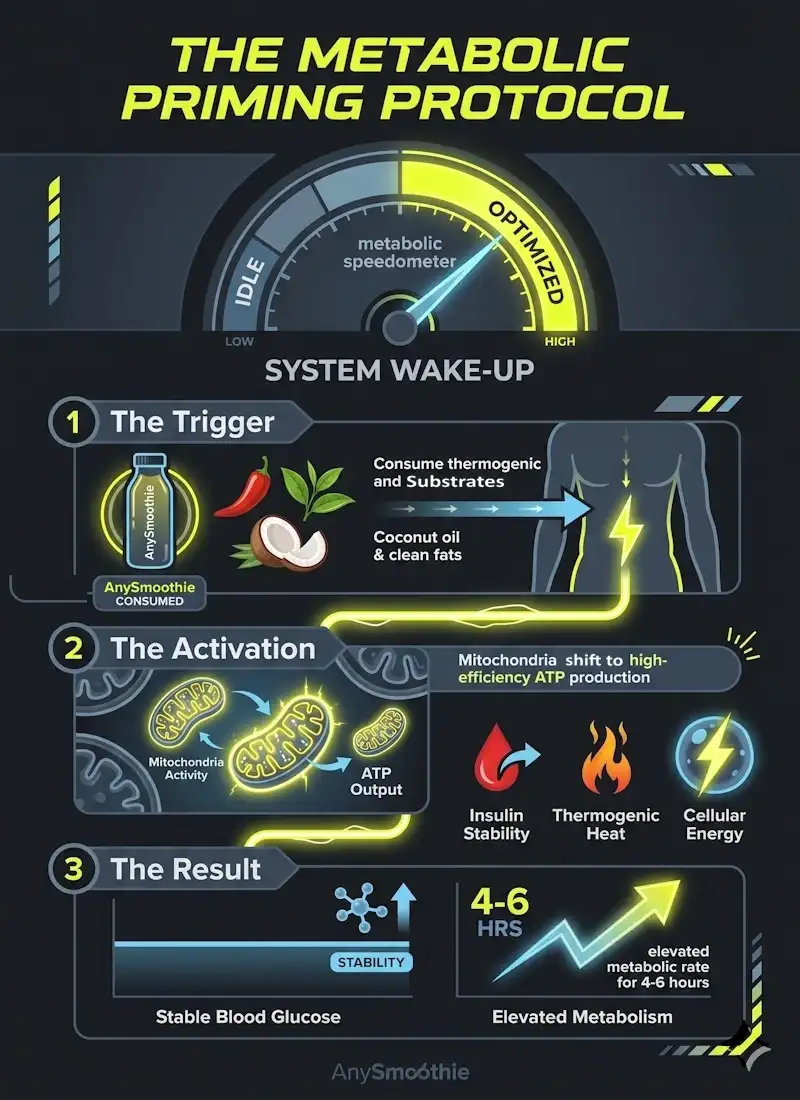
Thermogenic Substrates: Activating Brown Adipose Tissue (BAT)
Brown adipose tissue uses fuel to make heat, so it matters in morning energy use. A breakfast that stays light on sugar and includes thermogenic compounds can help keep the body in a more alert mode.
EGCG and Caffeine: Synergistic Lipolysis and Catecholamine Signaling
Matcha is useful here because it brings caffeine and EGCG together. Caffeine supports alertness and catecholamine signaling, while EGCG may support fat oxidation and thermogenesis.
Build a Smoothie That Primes Metabolism Instead of Spiking It
The best breakfast smoothie protocols for metabolic priming all follow the same pattern, one protein anchor, one fat or thermogenic support, one fiber source, and carbs only when the day calls for them. C8 MCT fits well here because it gives an immediate non-carbohydrate energy source and can prime the mitochondria without raising insulin much.
| Primer | Physiological Mechanism | Metabolic Focus | Best Smoothie Pairing | Ideal Timing |
|---|---|---|---|---|
| MCT Oil (C8) | Rapid ketone production, beta-oxidation, fast non-carb fuel | Energy substrate | Whey, matcha, cinnamon, unsweetened milk | On waking, before focused work or light training |
| Matcha Green Tea (EGCG) | Supports thermogenesis and fat oxidation | Rate-limiting catalyst | Berry, protein, chia, low-sugar base | Early morning, when alertness matters |
| L-Tyrosine | Precursor for catecholamine synthesis | Cognitive and neuro-metabolic support | Protein-heavy blends, small fruit load, electrolytes | Before mentally demanding mornings |
The pattern is simple, choose the primer that fits the job. A high-output morning wants a different blend than a calm, low-stimulus day.
Protein, Fat, Fiber, and Low-Sugar Carbs, How to Balance Them
Protein brings amino acids and helps with satiety. Fat slows digestion and gives a longer energy curve. Fiber smooths the glucose response. Low-sugar carbs fit best when you need exercise fuel or a faster refill after training.
A practical rule is easy to follow. Build around protein first, then add fiber and a modest fat source. Use carbs with intent, not by default.
If you want a cleaner version of that same logic, a smoothie for insulin priming follows a similar structure, keep the blend simple and the sugar load modest.
When to Use MCT Oil, Matcha, or L-Tyrosine
Choose MCT oil when you want fast fuel with minimal sugar. Pick matcha when you want thermogenesis plus alertness. Use L-tyrosine when the morning demands fast thinking, especially before a long work block.
These choices work best when they sit inside a balanced smoothie. One ingredient should not carry the whole drink.
3 “Prime-Start” Metabolic Activation Smoothie Recipes
Each of these recipes matches a different morning demand. None of them need a long ingredient list.
Circadian Nutrient Partitioning: Timing for Mitochondrial Flux
Timing changes everything. A smoothie at 6:30 a.m. does not have the same effect as the same smoothie at 11 a.m. Circadian nutrient partitioning matters because the body often handles fuel better earlier in the day, when activity and light exposure are already nudging metabolism on.
What to Do if You Train Early, Work Early, or Skip Breakfast
- If you train early, use a lighter smoothie before exercise, or drink it after.
- If you work early, keep the blend protein-first and low in sugar.
- If you skip breakfast on purpose, do not force food. Use a delayed smoothie when appetite shows up, then keep the protein high.
Matching intake to output supports mitochondrial flux and keeps the morning from feeling scattered. A good breakfast protocol should fit your schedule, not fight it.
Cortisol Management: Supporting the HPA Axis through Micronutrients
Morning stress can stack up fast. Food helps, but micronutrients matter too. Magnesium supports relaxation pathways, B vitamins help with energy handling, and electrolytes replace what you lose overnight.
That mix can support the HPA axis and make the first meal feel smoother. When the body starts calmer, it often handles breakfast with less friction.
Conclusion
Breakfast smoothies can be more than a convenience. Built with purpose, they can support metabolic priming, steadier appetite, and cleaner morning energy.
The formula is simple. Anchor the drink with protein, choose fat or thermogenic support based on the goal, and time it around your body clock. When the smoothie matches the day, the whole morning tends to run better.
Pick one protocol and use it for a week. Then pay attention to your energy, hunger, and focus.
🛡️ Safety Notes & Contraindications: Metabolic Priming Smoothies
MCT Oil Digestive Tolerance: C8 MCT oil is rapidly absorbed but can cause significant GI distress (cramping, urgency, or diarrhea) if introduced too quickly; start with a minimal dose (5ml or 1 tsp) and increase gradually.
Caffeine Sensitivity: Matcha contains significant levels of caffeine and L-theanine; if you are sensitive to stimulants or have a history of heart palpitations or severe anxiety, monitor your intake and avoid consuming these blends late in the morning.
L-Tyrosine and Medications: Supplemental L-Tyrosine can interact with thyroid medications (levothyroxine) and MAO inhibitors (antidepressants); do not use tyrosine-fortified smoothies if you are on these medications without medical clearance.
Early Morning Fasting Glucose: If you are monitoring blood glucose for clinical reasons, be aware that even low-carb/high-fat smoothies will trigger a metabolic shift from fasting to fed states.
Adrenal Health (HPA Axis): While these smoothies support energy, relying on caffeine-based “priming” to mask chronic exhaustion can exacerbate HPA axis dysfunction; prioritize adequate sleep as the primary metabolic primer.
FAQ
How does “Metabolic Priming” transition the body from a fasted state?
Upon waking, the body is in a post-absorptive state, relying on endogenous fuel stores. Biochemically, “priming” involves providing specific substrates—like whey protein and C8 MCT oil—that signal the transition to a postprandial state without overwhelming the system with glucose. Supporting this physiological system optimizes the natural pathways of energy utilization, ensuring the biochemical mechanics of the morning favor metabolic flexibility and steady fuel flow.
Why is the “First-Phase Insulin Response” critical for morning energy stability?
The first-phase insulin response is the rapid release of pre-stored insulin in response to a meal. Biochemically, if a breakfast smoothie is overloaded with simple sugars, this response may be followed by a sharp glucose drop, leading to mid-morning fatigue. Supporting this physiological system through fiber-rich and protein-anchored blends facilitates the biochemical mechanics of “glucose smoothing,” ensuring a more predictable and sustained energy curve.
What is the role of “Thermogenic Substrates” like Matcha and MCT in metabolic activation?
Thermogenesis is the process of heat production in organisms. Biochemically, compounds like EGCG in matcha and medium-chain triglycerides (MCTs) can influence catecholamine signaling and beta-oxidation. Supporting this physiological system optimizes the natural pathways of “brown adipose tissue (BAT) activation,” facilitating the biochemical mechanics of fat oxidation and metabolic alertness during the first few hours of the day.
How does “Nutrient Partitioning” determine where breakfast fuel is stored?
Nutrient partitioning is the biological process of directing calories toward either oxidation (burning), tissue repair, or storage. Biochemically, the presence of specific amino acids and the modulation of the insulin-to-glucagon ratio dictate this flow. Supporting this physiological system through balanced protein-to-carb ratios optimizes the natural pathways of “substrate allocation,” ensuring the biochemical mechanics of the smoothie support muscle maintenance and immediate energy needs.
How does “Circadian Nutrient Partitioning” influence morning fuel handling?
The body’s sensitivity to insulin and its enzymatic efficiency follow a circadian rhythm, typically peaking in the earlier hours of the day. Biochemically, matching nutrient intake to these peak windows supports the mitochondrial electron transport chain and overall fuel handling. Supporting this physiological system by timing a nutrient-dense smoothie around light exposure and early activity facilitates the biochemical mechanics of “metabolic synchronization,” reducing systemic friction.

Medical Disclaimer: AnySmoothie content is for educational purposes only and is not a substitute for professional medical advice. Consult a healthcare provider for personalized guidance. See our full Disclaimer & Terms of Use. AI Transparency: AnySmoothie may use AI to support content development. All content undergoes human editorial review for accuracy, clarity, and editorial quality. See our full AI Transparency.