
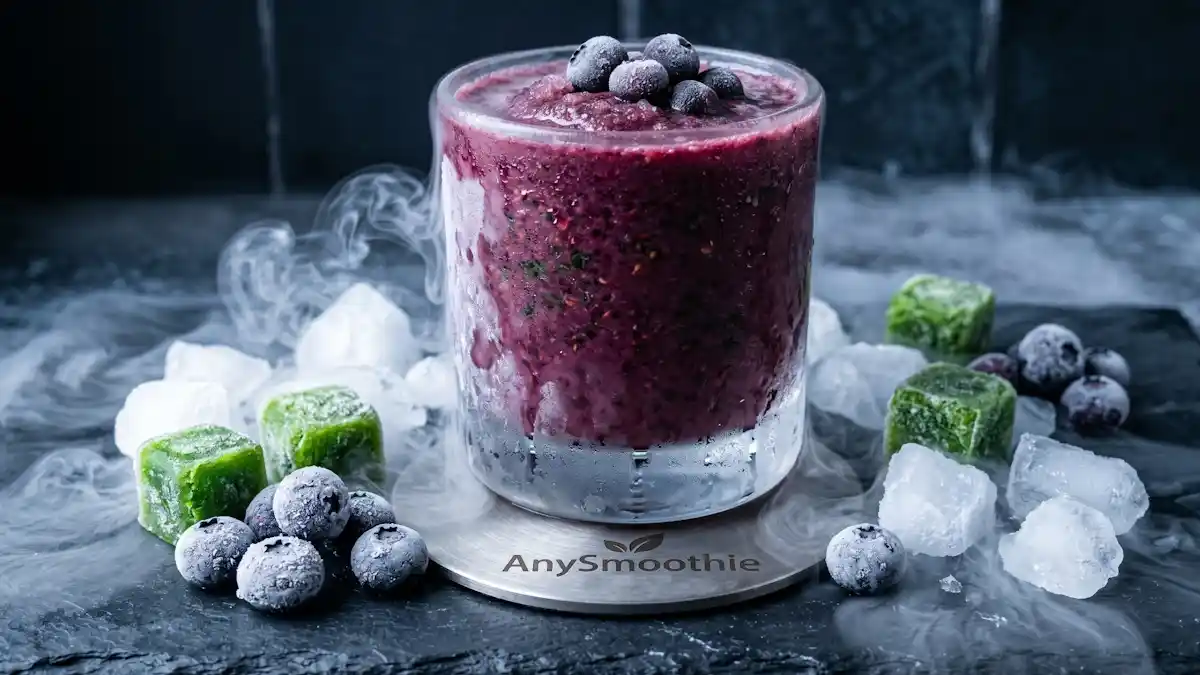
Frozen produce can hold onto more of its original profile than fruits and greens left in the fridge for days. After harvest, enzymes keep working, oxygen keeps touching cut surfaces, and delicate compounds start to drift.
A smoothie for cryopreserved nutrient density uses that reality in a practical way. You get ingredients frozen at peak ripeness, faster prep, a colder blend, and less wasted produce. It is not a miracle drink. It is a smarter build that keeps the plant closer to its starting point.
Cryopreservation Thermodynamics: Halting Cellular Decay
Freezing at the right time slows respiration, enzyme activity, and oxidation. When the drop in temperature is fast enough, the food matrix shifts into a stable state before much damage can spread. That matters because a berry or leafy green can lose quality in hours, not just days.
Blast-Freezing vs. Leaving Produce in the Fridge
Fresh produce in the fridge still breathes. Spinach, berries, and herbs keep changing after harvest, even when they look fine.
Blast-freezing changes that path early. It helps pause the oxidation cascade before it runs far, so compounds like vitamin C and color pigments have less time to break down. In practice, that means the freezer often protects more of the original flavor and structure than long cold storage does. The USDA FoodKeeper app also has basic storage guidance for produce, if you want a quick reference.
What Happens to Vitamin C, Folate, and Polyphenols After Harvest
Vitamin C oxidizes easily. Folate is also sensitive to storage time and heat. Polyphenols are more stable, but they still shift when tissue is cut, warmed, or exposed to oxygen.
Fast freezing helps hold those compounds in place. By contrast, fresh-stored produce can lose quality little by little, and pasteurized juice loses more of the original plant structure that shields those nutrients.
A Quick Comparison of Frozen, Fresh-Stored, and Pasteurized Ingredients
The difference shows up clearly when you compare the three formats side by side.
| Nutrient State | Physiological Mechanism | Vitamin C Retention Rate | Polyphenol Bioavailability | Best Smoothie Application |
|---|---|---|---|---|
| Flash-Frozen (Cryopreserved) | Immediate metabolic arrest at harvest, the oxidation cascade stops early | Best preserved when frozen soon after harvest | Matrix stays intact, so compounds stay well protected | Thick, cold, nutrient-forward smoothies |
| Fresh-Stored (5 Days Post-Harvest) | Respiration and enzymatic oxidation continue in storage | Lower than peak-harvest produce, especially in leafy greens | Some oxidation and drip loss reduce stability | Works, but quality depends on age |
| Thermal-Pasteurized (Juices) | Heat denatures enzymes and alters delicate compounds | Often reduced by heat and storage | Profile shifts because the matrix is broken down | Fine for juice, less ideal for dense smoothies |
The biggest win happens in the first hours after harvest. Freeze early, and the plant keeps more of its original shape and chemistry.
Why Frozen Textures Can Support a Better Smoothie Build
Frozen ingredients do more than protect nutrients. They also change the drink itself.
A frozen base keeps the smoothie thick without extra ice, so you avoid dilution. That matters because water thins flavor and pushes you toward sweeteners you do not need. It also keeps the final cup colder, which helps the texture stay stable longer.
How Ice Crystal Formation Can Reduce Cellular Damage and Nutrient Leakage
Fast freezing creates smaller ice crystals. Slow freezing makes bigger ones that tear cell walls and cause drip loss after thawing.
Less leakage means more of the pigment, acid, and mineral load stays inside the food matrix. When you blend later, you still get the full body of the ingredient, not a watered-down shell of it.
Why Frozen Ingredients Can Help Keep Blending Temps Lower
Blending warms food. A frozen base keeps the motor from raising the temperature too much, especially if you pulse instead of running the blender too long.
Shorter blend times help preserve texture and keep delicate compounds from taking a heat hit. The result is a thick, cold smoothie with less foam and less separation.
How Enzyme Inactivation Helps Lock in the Plant Profile
Freezing slows or pauses many enzyme-driven changes. That means flavor, color, and aroma stay closer to the harvest state.
You do not get permanent perfection, but you do keep more of the original plant profile intact. For a smoothie, that usually means brighter taste and a cleaner finish.
3 “Cryo-Dense” Smoothie Recipes to Try
SubZero-Flux Wild Blueberry, Kale, and Wheatgrass Blend
Ingredients
- 1 cup flash-frozen wild blueberries
- 1 cup frozen kale
- 1 cup unsweetened almond milk
- 1 teaspoon wheatgrass powder
- 1 tablespoon chia seeds
Pour the almond milk into the blender first. Add the frozen kale and blend briefly until smooth. Add the wild blueberries, wheatgrass powder, and chia seeds, then blend until thick and completely smooth.
Wild blueberries provide fiber and anthocyanins, while kale contributes carotenoids, vitamin K, and other micronutrients. Chia adds fiber and ALA omega-3 fatty acids. Wheatgrass powder contributes additional plant compounds and micronutrients, although its composition varies by product. The frozen berries also give the blend a naturally thick, cold texture without added sugar.
Estimated Nutrition per Serving
- Calories: ~210 kcal
- Protein: ~7 g
- Carbohydrates: ~34 g
- Fat: ~8 g
- Fiber: ~13 g
- Sugars: ~15 g
Citrus-Ginger Spinach Smoothie for Brightness and Balance
Ingredients
- 1 cup frozen pineapple
- 1 packed cup spinach
- 1 tablespoon fresh lemon juice
- 1 teaspoon freshly grated ginger
- 1 cup unsweetened coconut water
Pour the coconut water into the blender first. Add the spinach and ginger and blend briefly until the greens are finely incorporated. Add the frozen pineapple and lemon juice, then blend until completely smooth.
Pineapple provides vitamin C and natural sweetness, while spinach contributes folate and carotenoids. Ginger adds a sharp aromatic note and has been studied in digestive contexts, while lemon balances the sweetness with acidity.
Estimated Nutrition per Serving
- Calories: ~150 kcal
- Protein: ~4 g
- Carbohydrates: ~35 g
- Fat: ~1 g
- Fiber: ~4 g
- Sugars: ~25 g
Avocado, Cacao, and Frozen Berry Recovery Blend
Ingredients
- 1 cup frozen mixed berries
- ½ avocado
- 1 tablespoon unsweetened cacao powder
- 1 cup low-fat milk
- Pinch of salt
Pour the milk into the blender first. Add the avocado, cacao, frozen berries, and salt. Blend until thick and completely smooth.
Berries provide carbohydrates, fiber, and polyphenols, while avocado contributes fiber and unsaturated fats. Cacao adds flavanols and depth of flavor, and milk provides high-quality protein and calcium. This makes a substantial nutrient-rich smoothie, although a higher-protein meal or additional protein may be appropriate when post-exercise recovery is the primary goal.
Estimated Nutrition per Serving
- Calories: ~400 kcal
- Protein: ~14 g
- Carbohydrates: ~45 g
- Fat: ~21 g
- Fiber: ~16 g
- Sugars: ~25 g
If I were making this after training, I’d blend the avocado with the milk and cacao first, then add the frozen berries. That order makes the base exceptionally smooth before the frozen fruit thickens everything.
This blend is less sweet and more filling. It works well after a workout or as a late morning meal replacement.
How to Build a Better Frozen Smoothie Without Losing Quality
Good frozen smoothies start with good ingredients. Look for single-ingredient bags, like blueberries, spinach, mango, or cauliflower rice. Skip added sugar, syrups, and juice concentrates when you can.
A few quick label habits help:
- Choose pieces that look separate, not clumped into a hard block.
- Check that frozen greens or fruit have no syrup coating.
- Pick bags that list one ingredient, or only a short mix you recognize.
Blend in the Right Order to Limit Heat and Protect Texture
Put liquid in first, then powders or soft items, then frozen produce. That order reduces motor strain and helps the blades pull everything down.
Pulse a few times before blending fully. Then stop as soon as the texture turns smooth. Longer blending makes heat, and heat works against the cold, dense finish you want.
Use the Right Liquid Base So the Smoothie Stays Dense, Not Watered Down
Water makes the fastest blend, but it can thin a nutrient-dense cup. Milk, kefir, or unsweetened plant milk adds body.
If you want the thickest result, start with less liquid than you think you need. Add more only if the blender stalls. That keeps the smoothie rich without turning it into soup.
Conclusion
Frozen produce is a storage method, not a shortcut. When it is frozen well and frozen early, it helps preserve nutrient density, supports better texture, and makes smoothie prep easier.
Start with one frozen fruit and one frozen green, then build from there. That small shift is enough to make a smoothie for cryopreserved nutrient density part of a real routine.
🛡️ Safety Notes & Contraindications
Bacterial Dormancy vs. Sterilization: CRITICAL: Flash-freezing induces metabolic arrest in microorganisms but does not sterilize the produce. Pathogens like Listeria monocytogenes can survive indefinitely in a dormant state at $-18^\circ\text{C}$. Once thawed or blended, the clock restarts. Frozen smoothies must be consumed within 15-20 minutes of preparation to prevent rapid bacterial proliferation in the newly emulsified liquid matrix.
The “Thaw and Refreeze” Hazard: If a bag of frozen produce shows signs of large ice clumps or aggregations, it indicates that the cold chain was broken and the product has partially thawed and refrozen. This slow, domestic refreezing process generates large macro-crystals that destroy cellular integrity, causing severe nutrient leakage and increasing the risk of enterotoxin accumulation. Discard clumped bags.
Oxalate Density in Frozen Greens: Frozen spinach and kale are often blanched or tightly packed, significantly increasing their nutrient density per cup compared to fresh, loose leaves. Individuals with a clinical history of hyperoxaluria or calcium-oxalate kidney stones must carefully measure portions by weight (grams) rather than volume (cups) to avoid accidental oxalate overload.
Gastric Vasoconstriction from Extreme Cold: Consuming a sub-zero, highly concentrated cryo-smoothie too rapidly can induce acute vasoconstriction of the gastric mucosa, leading to transient thermal cramping, digestive stasis, or vagal nerve stimulation (“brain freeze”). Sip the dense matrix slowly over 10-15 minutes to allow thermal equilibration in the oral cavity.
Sulfite and Preservative Additives: Some commercial frozen fruits (especially light-colored ones like mango or peaches) may be treated with sulfur dioxide or sulfites to prevent non-enzymatic browning before freezing. Individuals with diagnosed sulfite sensitivities or asthma must rigorously check labels for clean, single-ingredient certifications.
FAQ
How do cryopreservation thermodynamics halt post-harvest cellular decay?
Plants do not immediately cease metabolic activity upon being harvested; cellular respiration and enzymatic oxidation continue to consume stored nutrients. Biochemically, flash-freezing induces an immediate thermodynamic deceleration, shifting the plant matrix into a stable state of “metabolic arrest.” Supporting this physiological system through cryopreserved ingredients freezes delicate compounds—such as ascorbic acid—in place, pausing the degradation pathways that typically deplete fresh produce stored over several days.
Why does “Flash-Freezing” limit intracellular nutrient leakage compared to slow freezing?
The velocity of temperature reduction dictates the physical morphology of water crystallization within plant tissues. Biochemically, rapid blast-freezing forms micro-crystalline ice structures that leave fragile cell walls intact. Supporting this physiological system minimizes structural tearing and the subsequent “drip loss” of water-soluble pigments, minerals, and vitamins upon thawing, ensuring the complete biochemical profile is transferred directly into the smoothie matrix.
What is the mechanical advantage of a frozen matrix against blending-induced thermal kinetics?
High-impact blender blades generate significant friction, transferring kinetic energy into the fluid as heat. Biochemically, even modest temperature spikes can denature thermal-sensitive cofactors and accelerate the oxidation of hydrophilic vitamins. Supporting this physiological system with a flash-frozen base acts as a native heat sink, neutralizing frictional thermal flux during mechanical shear and keeping blending temperatures low enough to protect volatile phytonutrients.
How does enzyme inactivation via sub-zero storage lock in the plant’s polyphenol profile?
Endogenous plant enzymes, specifically Polyphenol Oxidase (PPO), remain operational in fresh cold storage, continuously catalyzing the oxidation of beneficial phenolics into reactive quinones. Biochemically, sub-zero cryopreservation denatures or severely kinetics-inhibits PPO activity by locking ambient water molecules into a solid phase. Supporting this physiological system prevents enzymatic browning and flavor drift, maintaining the structural fidelity of the plant profile until the exact moment of ingestion.
Why are lipophilic carotenoids more stable within a cryopreserved, emulsified smoothie matrix?
Carotenoids like lycopene and beta-carotene are sensitive to singlet oxygen attacks, which break their highly protective conjugated double-bond structures. Biochemically, when flash-frozen molecules are mechanically sheared alongside polar lipids (such as the fats in avocado or chia seeds), they are rapidly packaged into protective, self-assembling micellar structures. Supporting this physiological system shields the lipophilic components from aqueous oxidants, optimizing the natural pathways of downstream nutrient partitioning.

Medical Disclaimer: AnySmoothie content is for educational purposes only and is not a substitute for professional medical advice. Consult a healthcare provider for personalized guidance. See our full Disclaimer & Terms of Use. AI Transparency: AnySmoothie may use AI to support content development. All content undergoes human editorial review for accuracy, clarity, and editorial quality. See our full AI Transparency.