
No smoothie is proven to switch on or directly improve the malate-aspartate shuttle. If you’re looking for smoothies for malate-aspartate shuttle support, focus on balanced nourishment rather than promises about a cellular pathway.
Fruit, oats, and protein-containing foods can make a satisfying drink without special powders or restrictive rules. For practical guidance on balancing fruit, fiber, and protein in blended drinks, see 7 smoothie mistakes that kill your energy.
The three recipes below use everyday ingredients and offer different flavors, so you can choose what fits your diet. First, it helps to understand what the shuttle does.
How the malate-aspartate shuttle helps cells use energy
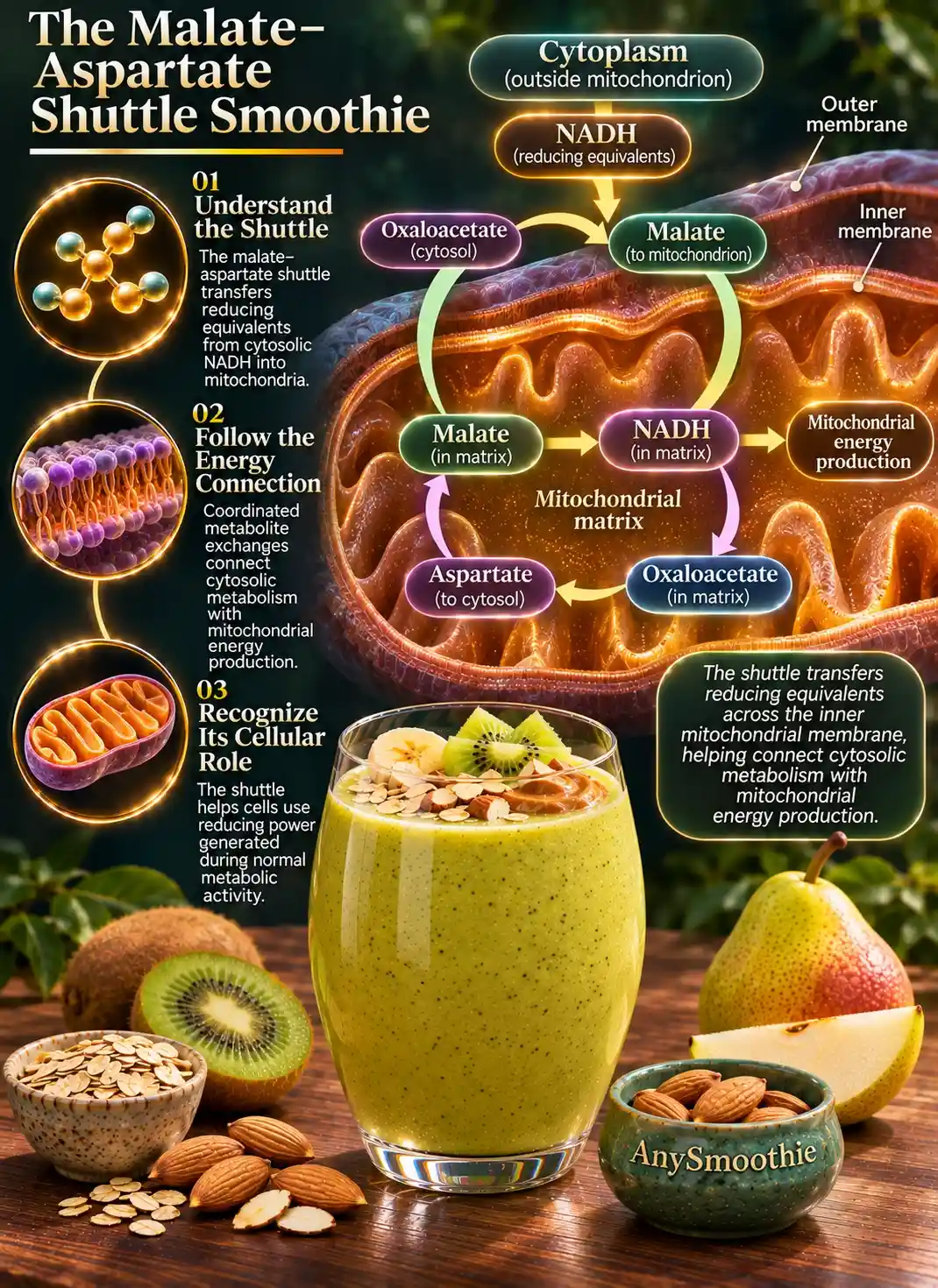
When cells break down glucose, they produce NADH, a molecule that carries electrons. Some NADH forms in the cytosol, the fluid outside mitochondria. However, NADH can’t pass directly through the inner mitochondrial membrane to deliver those electrons.
The malate-aspartate shuttle solves that transport problem indirectly. As described in biochemist Piet Borst’s review of the shuttle, linked chemical reactions transfer NADH’s reducing power across the membrane. “Reducing power” means the ability to donate electrons.
Outside mitochondria, a reaction uses NADH to convert oxaloacetate into malate. Malate crosses the membrane, then converts back to oxaloacetate while generating NADH inside. Additional reactions involving aspartate help complete the cycle. The amino-acid reactions associated with this part of metabolism also connect with PLP-dependent enzymes; see vitamin b6 smoothies for plp enzyme support. The transferred electrons can then enter processes that produce ATP, the cell’s usable energy currency.
A separate mitochondrial maintenance process is mitophagy; a related overview appears in urolithin a smoothies for mitophagy.
This is normal cellular metabolism. For a different cellular fatty-acid pathway that takes place in peroxisomes, see smoothies for peroxisomal alpha-oxidation. Eating foods containing particular nutrients doesn’t demonstrate that you’ve increased shuttle activity. A balanced diet supplies energy and nutrients for many body processes, but no specific smoothie has a proven, targeted effect on this pathway.
3 Smoothies for Malate-Aspartate shuttle support
Each recipe makes one serving and combines fruit with protein-containing foods. These are everyday food choices, not treatments or proven ways to change shuttle activity. Choose according to flavor preferences and dietary needs. The nutrition figures are approximate, so use them as general guides rather than exact measurements.
Blueberry, Spinach, and Oat Smoothie
Ingredients
- 3/4 cup plain nonfat Greek yogurt
- 1 cup blueberries
- 1 cup baby spinach
- 1/2 medium banana
- 1/4 cup rolled oats
- 1/2 cup water
Instructions
Blend all ingredients until smooth, adding more water for a thinner texture. Frozen blueberries make a colder, thicker drink, while fresh berries produce a softer texture. Keep blending until the spinach disappears into the mixture and the oats no longer feel gritty.
Estimated Nutrition (per serving)
- Calories: ~320 kcal
- Protein: ~22 g
- Carbohydrates: ~55 g
- Fat: ~4 g
- Fiber: ~8 g
- Sugars: ~25 g
Cherry, Cocoa, and Soy Smoothie
Ingredients
- 1 cup pitted sweet cherries
- 1/2 cup silken tofu
- 3/4 cup unsweetened soy milk
- 1/2 medium banana
- 1 tablespoon unsweetened cocoa powder
- 1 tablespoon chia seeds
Instructions
Blend until creamy, then let stand briefly so the chia seeds can thicken the drink. Scrape down the blender sides if cocoa clings above the mixture. For a smoother sip, blend again after the seeds have had a chance to hydrate.
Estimated Nutrition (per serving)
- Calories: ~315 kcal
- Protein: ~15 g
- Carbohydrates: ~45 g
- Fat: ~11 g
- Fiber: ~10 g
- Sugars: ~28 g
Citrus, Kiwi, and Kefir Smoothie
Ingredients
- 3/4 cup plain low-fat kefir
- 1 medium orange
- 1 kiwi
- 1/4 cup rolled oats
- 1 tablespoon pumpkin seeds
- 1/2 cup water
Instructions
Peel the fruit, blend with the remaining ingredients until smooth, and adjust the water to taste. Remove any orange seeds before blending. Because pumpkin seeds and oats can leave small flecks, give this smoothie extra blending time if you prefer a more uniform texture.
Estimated Nutrition (per serving)
- Calories: ~300 kcal
- Protein: ~14 g
- Carbohydrates: ~47 g
- Fat: ~8 g
- Fiber: ~7 g
- Sugars: ~28 g
Compare the three smoothies by taste, texture, and everyday fit
The blueberry option has the highest estimated protein content of these recipes. Its familiar berry flavor makes it a straightforward choice if you prefer a mild drink. Meanwhile, the cherry version offers a cocoa flavor and a fully plant-based option.
The citrus smoothie tastes tangier because of the fruit and fermented dairy. It suits people who prefer a brighter flavor over a dessert-like drink. However, both the citrus and blueberry recipes contain dairy, while the cherry recipe contains soy.
Your preferred texture matters, too. A thicker smoothie may suit a leisurely breakfast, while a lighter consistency may be easier to sip alongside another food. None of these differences establishes an advantage for the malate-aspartate shuttle.
Here’s how the three options compare.
| Smoothie | Nutritional profile | Texture | Flavor | Best fit |
|---|---|---|---|---|
| Blueberry, Spinach, and Oat | Higher protein; lower fat | Thick and creamy | Mild, sweet, berry-forward | A protein-focused breakfast |
| Cherry, Cocoa, and Soy | Plant-based protein; higher fiber | Creamy; thickens as it rests | Sweet cherry with cocoa bitterness | Dairy-free eating |
| Citrus, Kiwi, and Kefir | Moderate protein; fiber-containing | Lighter, with some flecks | Tangy and bright | A less dessert-like option |
Taste and dietary fit are more useful selection criteria than claims about targeting cellular energy pathways.
Nutrition estimates vary with brands, portion sizes, and the natural size of fruit.
Conclusion: Choose nourishment without promises about a pathway
These recipes offer practical ways to combine fruit, grains, and protein-containing foods. None is a proven way to directly alter the malate-aspartate shuttle.
Choose the flavors you enjoy and account for allergies or other dietary needs. If persistent fatigue or concerns about metabolism prompted your search, seek qualified medical advice rather than relying on a smoothie to address the cause.
🛡️ Safety Notes & Dietary Interactions
- Dairy and Soy: The blueberry and citrus smoothies contain Greek yogurt or kefir, while the cherry smoothie contains tofu and soy milk. Check labels and use suitable alternatives for milk or soy allergies.
- Fiber Adjustment: Oats, chia, spinach, kiwi, fruit, and pumpkin seeds contribute fiber. If your usual intake is low, increase gradually and adjust the liquid to maintain a comfortable texture and digestion.
- Seed and Soy Tolerance: Chia and pumpkin seeds add fiber and fat, while tofu and soy milk contribute plant protein. Check for allergies and introduce unfamiliar ingredients in amounts appropriate to your tolerance.
- Pathway Expectations: These smoothies provide ordinary nutrients but are not proven to increase malate-aspartate shuttle activity. Persistent fatigue or metabolic concerns should be evaluated professionally rather than attributed to dietary pathway support.
FAQs
Which smoothie provides the most protein?
The Blueberry, Spinach, and Oat Smoothie provides the highest estimated protein, at approximately 22 grams per serving. The Cherry, Cocoa, and Soy Smoothie provides about 15 grams, while the Citrus, Kiwi, and Kefir Smoothie provides approximately 14 grams.
Does eating these foods increase malate-aspartate shuttle activity?
Not predictably. The shuttle is a normal cellular mechanism that transfers reducing power associated with NADH across the mitochondrial membrane. Although these smoothies provide energy and nutrients used throughout metabolism, no recipe has been established as a targeted way to increase shuttle activity.
Which smoothie is the best dairy-free option?
The Cherry, Cocoa, and Soy Smoothie is the dairy-free choice among the three recipes. Silken tofu and unsweetened soy milk provide its protein base. However, it is not suitable for someone avoiding soy, so another dairy-free protein source would require a suitable substitution.
Which smoothie has the most fiber?
The Cherry, Cocoa, and Soy Smoothie provides the highest estimated fiber, at approximately 10 grams per serving. The Blueberry, Spinach, and Oat Smoothie provides about 8 grams, while the Citrus, Kiwi, and Kefir Smoothie provides approximately 7 grams.
Can I choose a smoothie based on exercise or fatigue?
You can choose according to appetite, activity, and nutritional needs, but the recipes are not treatments for fatigue. If persistent fatigue or concerns about metabolism prompted your search, the article recommends seeking qualified medical advice rather than relying on a smoothie.

Medical Disclaimer: AnySmoothie content is for educational purposes only and is not a substitute for professional medical advice. Consult a healthcare provider for personalized guidance. See our full Disclaimer & Terms of Use. AI Transparency: AnySmoothie may use AI to support content development. All content undergoes human editorial review for accuracy, clarity, and editorial quality. See our full AI Transparency.