
Smoothies can keep an IBS meal routine simple when your stomach wants less fuss. The key is choosing fiber with care, keeping portions moderate, and building a blend that fits your day instead of fighting it.
Fiber-rich smoothies for IBS meal routines work best when the fruit, liquid, and add-ins all move in the same direction. Some fibers soften the mix and support regularity. Others add too much rough bulk or too much sugar, which can stir up symptoms.
That balance matters because a smoothie can act like breakfast, a snack, or a light meal. Once the base ingredients are chosen well, it can become one of the easiest parts of the day.
How to build a smoothie that works with IBS, not against it
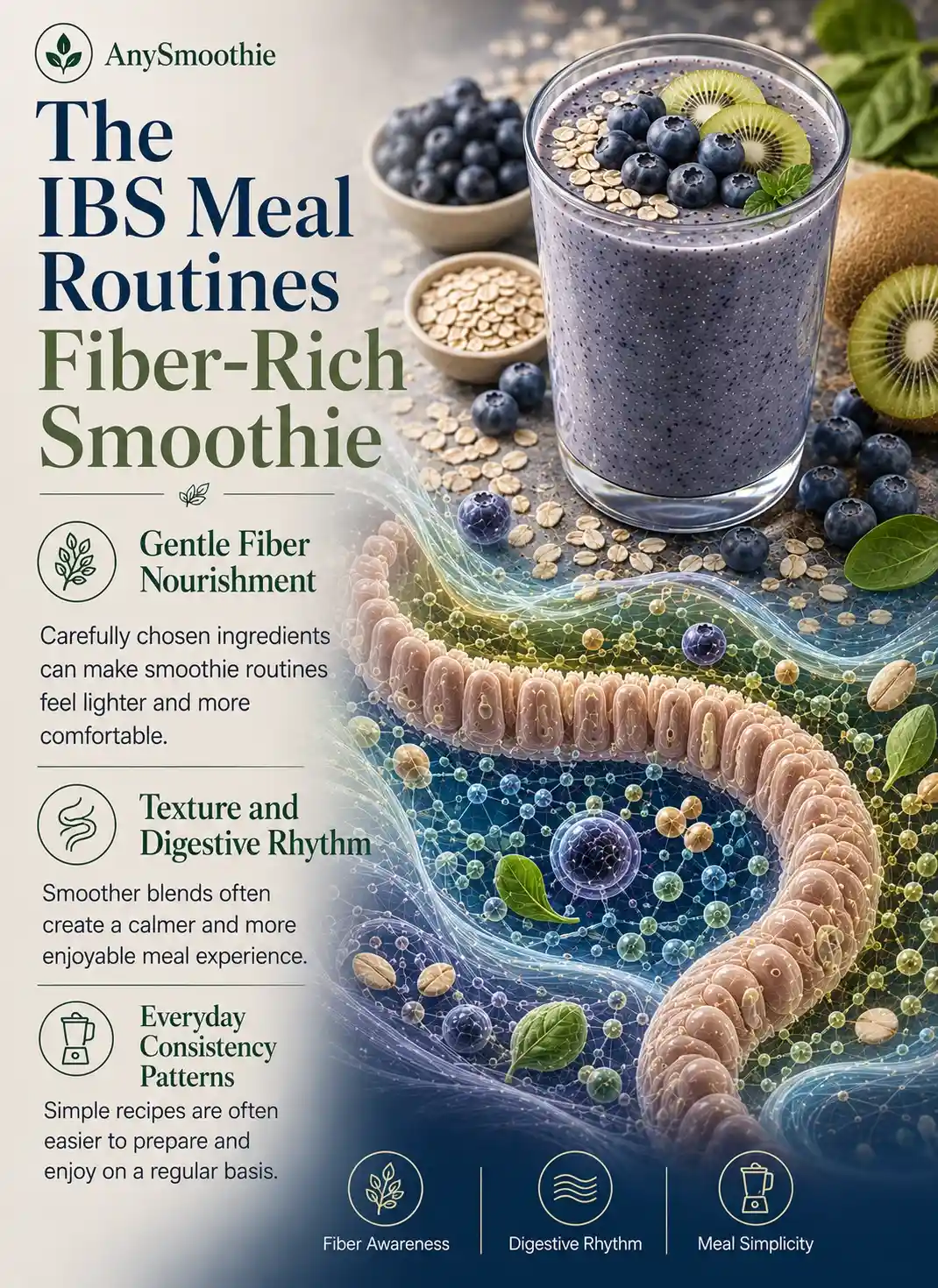
IBS-friendly smoothie building starts with fiber type. Soluble fiber absorbs water and forms a softer gel, so it often feels easier to handle. Oats, chia, flax, kiwi, and blueberries fit that pattern well. Insoluble fiber can be fine too, but large amounts may feel rough when symptoms are active.
Texture matters as well. A smoothie blends food into a finer mix, which may be gentler than chewing through a bowl of raw fruit or seeds. Still, some people react to cold drinks, large volume, or fast sipping. A smaller cup can work better than a big one, especially on sensitive days.
Choose fiber sources that are easier to digest
Oats, chia, ground flax, kiwi, blueberries, and a small piece of ripe banana are easy starting points. They add fiber without turning the smoothie into a brick. The best fiber is the one your body tolerates on a normal weekday, not only on a good day. If you want a solid overview of digestive health, the NIH has a helpful guide.
Keep the mix small at first, then build from there. If a smoothie feels too dense, thin it with more liquid before adding more fruit or seed.
Avoid common smoothie triggers that can stir up symptoms
Apple, pear, mango, honey, sugar alcohols, and some dairy products can be troublemakers. Frozen fruit is fine, but check the label if it comes in a sweetened mix. Protein powder deserves a close look too, because inulin, sugar alcohols, and large lactose loads can change how a smoothie feels.
Added sweeteners should stay modest. A smoothie does not need to taste like candy to feel complete.
How to time smoothies inside a steady IBS meal routine
A smoothie fits best when it has a place in the day. Some people use it for breakfast, others for a midmorning snack or a light lunch. The schedule matters because the gut responds better when meals arrive at a similar pace.
A steady eating window can make symptoms feel less random.
Spacing also helps. If a smoothie sits too close to another meal, the total load can stack up fast. The goal is a calm rhythm, not constant grazing.
Use the same meal window each day when possible
Try the same morning or afternoon window most days. On travel days or during flare-prone weeks, a familiar smoothie time can reduce guesswork. That predictability gives your digestion a cleaner pattern to work with.
Pair fiber with protein and fat for a more balanced smoothie
Fiber alone can leave a smoothie too thin. Lactose-free yogurt, kefir if you tolerate it, nut butter, hemp hearts, or a plain protein powder can round it out. The result is more balanced and usually more satisfying. For a general guide on balanced meals, see Healthy Eating Plate.
Start with a small serving and adjust from there
Begin with 8 to 12 ounces instead of a giant glass. Then wait and notice how you feel over the next few hours. Stress, sleep, and the rest of your meals can change tolerance from one day to the next.
3 Fiber-Rich smoothies for IBS meal routines
Here’s a quick side-by-side look at three easy blends.
| Recipe name | Main fiber source | Protein add-in | Best time to drink it | IBS-friendly note |
|---|---|---|---|---|
| Gentle berry oat smoothie | Blueberries, oats, chia | Lactose-free yogurt | Breakfast | Light, familiar, not too sweet |
| Creamy kiwi spinach smoothie | Kiwi, flax | Lactose-free yogurt | Lunch | Mild flavor, smooth texture |
| Banana peanut butter smoothie | Small banana, oats or flax | Peanut butter | Afternoon snack | Portion-controlled and filling |
These recipes keep the ingredient list short, so the routine stays easy to repeat.
Simple ways to keep your smoothie routine easy all week
Batch prep saves time and lowers guesswork. Freeze berries, kiwi, and banana in small portions, then keep oats, chia, flax, and protein powder in clear containers. A short ingredient list is easier to repeat, and repeatability is what makes the routine calm.
A note app or food journal helps too. Write down the time, the portion, and how your body felt later in the day. The pattern matters more than chasing the longest ingredient list.
Conclusion
Fiber-rich smoothies can fit into an IBS meal routine when the ingredients, portions, and timing are chosen with care. The right blend supports a steadier day because it stays simple enough for your gut to handle.
Start with one recipe, keep what feels good, and adjust one variable at a time. Small, steady changes usually work better than trying to perfect the whole routine at once.
🛡️ Safety Notes & Dietary Interactions
- Soluble Fiber Selection and Digestive Comfort Dynamics: Soluble fibers such as oats, chia, flax, kiwi, and blueberries absorb water and form softer gel-like structures during digestion. For many IBS meal routines, these ingredients tend to create a gentler texture profile than large amounts of rough, insoluble fiber, making them practical starting points when building a repeatable smoothie habit.
- Portion Control and Gastrointestinal Load Management: Even well-chosen ingredients can become difficult to tolerate when portions grow too large. The article emphasizes beginning with moderate serving sizes and paying attention to how the body responds over several hours. Smaller smoothies often fit more comfortably into IBS-friendly meal patterns than oversized blended drinks.
- Protein and Fat Pairing for Meal Stability: Fiber works best when paired with protein and moderate amounts of healthy fat. Lactose-free yogurt, tolerated kefir, nut butters, hemp hearts, and simple protein powders help create a more balanced smoothie that may support steadier satiety and reduce the rapid digestion often associated with fruit-only blends.
- Ingredient Awareness and Personal Trigger Identification: The article highlights that tolerance varies widely between individuals. Ingredients such as apple, pear, mango, honey, sugar alcohols, certain dairy products, or protein powders containing inulin may not work equally well for everyone. Tracking ingredients and symptoms can help identify personal patterns more effectively than constantly changing multiple variables at once.
FAQ
Why is soluble fiber emphasized so much in IBS-friendly smoothies?
Soluble fiber absorbs water and creates a softer texture both in the blender and during digestion. Ingredients like oats, chia, flax, kiwi, and blueberries provide this type of fiber while helping the smoothie feel more balanced and less abrasive. The article suggests that many people find these ingredients easier to tolerate than large amounts of rougher fiber sources during symptom-sensitive periods.
Why can timing matter just as much as ingredients in an IBS meal routine?
The article explains that digestive systems often respond well to predictable eating patterns. Having smoothies at roughly the same time each day may reduce guesswork and help create a steadier meal rhythm. Consistency in meal timing can sometimes feel more supportive than constantly changing recipes or chasing new ingredients.
What are some common smoothie ingredients that may trigger symptoms?
Apple, pear, mango, honey, sugar alcohols, some dairy products, and certain protein powders are mentioned as ingredients that deserve closer attention. The article does not suggest these foods are problematic for everyone, but it encourages people to monitor personal tolerance and avoid assuming every “healthy” ingredient automatically fits every IBS routine.
Why are protein and healthy fats important in fiber-rich smoothies?
Fiber alone can sometimes leave a smoothie feeling incomplete or unsatisfying. Adding lactose-free yogurt, tolerated kefir, nut butter, hemp hearts, or a simple protein source helps create a more balanced nutritional structure. This combination often improves fullness and helps the smoothie function more like a meal rather than a quick carbohydrate source.
How should someone start building an IBS-friendly smoothie routine?
The article recommends keeping things simple: choose a few well-tolerated ingredients, use moderate portions, and change only one variable at a time. Recording the smoothie ingredients, timing, portion size, and how you felt later can make it easier to identify useful patterns. Small, repeatable adjustments generally provide more insight than constantly redesigning the entire smoothie formula.

Medical Disclaimer: AnySmoothie content is for educational purposes only and is not a substitute for professional medical advice. Consult a healthcare provider for personalized guidance. See our full Disclaimer & Terms of Use. AI Transparency: AnySmoothie may use AI to support content development. All content undergoes human editorial review for accuracy, clarity, and editorial quality. See our full AI Transparency.