
A smoothie can contribute nutrients to your diet, but no recipe is proven to control your gut’s choline-to-TMA pathway. Its practical value is as part of your overall eating pattern, rather than a targeted treatment.
Below, you’ll find a simple explanation of the pathway and three one-serving recipes, without promises about TMA levels or related health outcomes. Start with how microbes process choline, then choose ingredients around your preferences.
How gut microbes turn choline into TMA
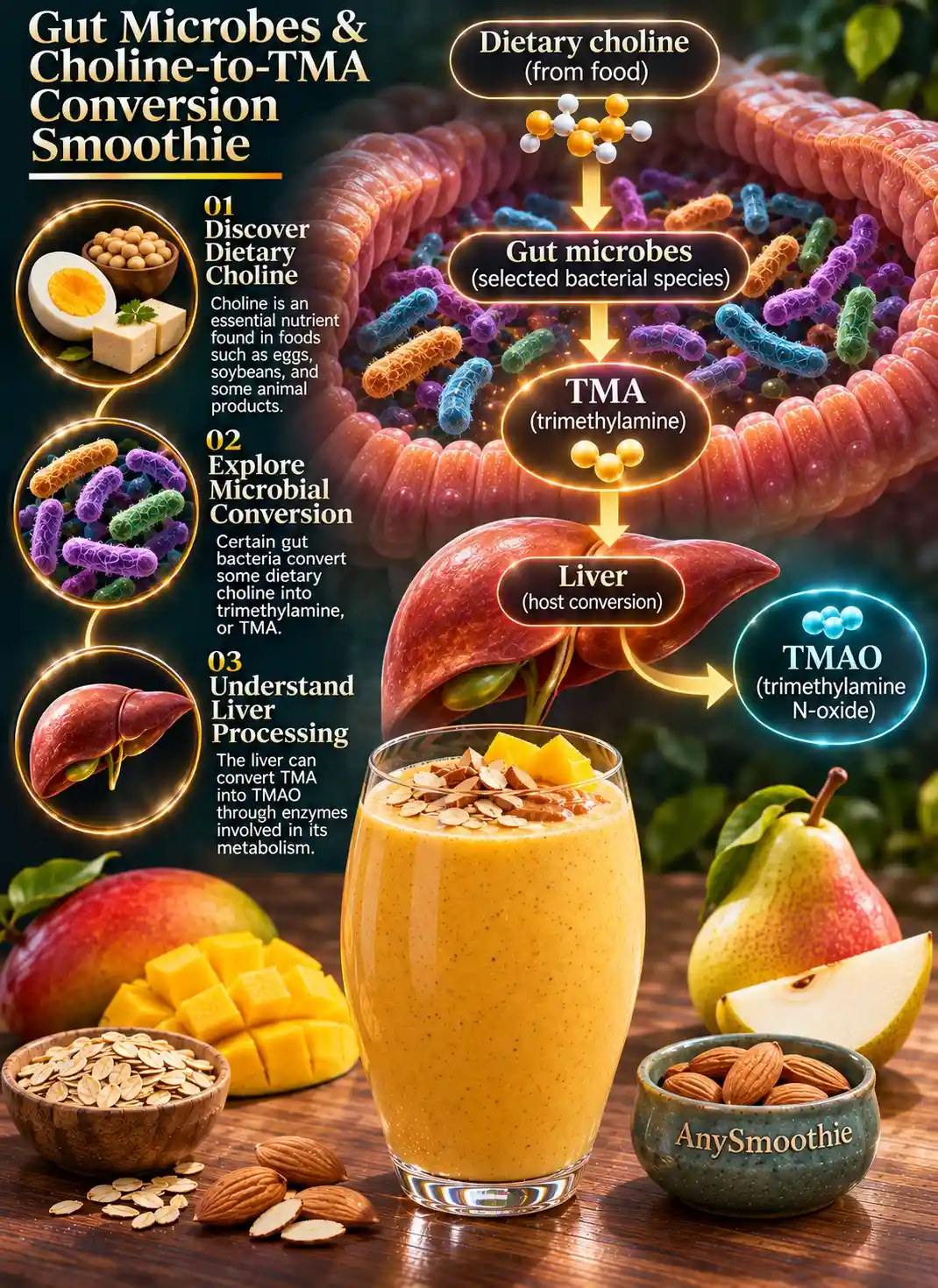
Some gut microbes use dietary choline to produce trimethylamine, or TMA. After absorption, the liver can convert TMA into trimethylamine N-oxide, or TMAO. Research on the microbial choline-to-TMAO pathway describes these connected steps. However, a smoothie cannot switch this process on or off.
For another example of how intestinal microbes process dietary compounds, see smoothies after food poisoning: 3 gentle recipes.
Where choline fits in a smoothie
Choline is an essential nutrient that supports cell membranes and other body functions. Smoothie ingredients, including milk, yogurt, soy milk, and oats, provide different amounts.
Meanwhile, fruits, vegetables, oats, and seeds contribute fiber and other nutrients. Including these foods doesn’t establish whether a particular smoothie will raise or lower your TMA production.
For a related discussion of how intestinal bacteria process another dietary substrate, see smoothies for lactase function and lactose digestion.
Why ingredients do not predict an individual response
People differ in which microbes they carry and how actively those microbes process choline. Diet and other individual factors also affect the pathway.
A recipe’s ingredient list therefore cannot tell you how much TMA you’ll produce. TMA production and a blood TMAO measurement aren’t interchangeable, either; kidney function also affects TMAO levels.
3 Smoothies for Microbial Choline-to-TMA Pathways
Each recipe makes one serving. The USDA FoodData Central database provides reference information for food nutrients, but actual products differ. The rounded nutrition estimates below describe food intake, not an expected effect on microbial activity. Use the specified ingredients for the closest match.
Berry, oat, and yogurt smoothie
Ingredients
- 3/4 cup frozen blueberries
- 3/4 cup plain nonfat Greek yogurt (170 g)
- 1/4 cup dry rolled oats (20 g)
- 1 teaspoon chia seeds
- 1/2 cup cold water
Instructions
Blend the water and yogurt first, then add the remaining ingredients. Blend until creamy, scraping down the sides if needed. Let it rest for two minutes so the oats soften, then blend briefly again.
Estimated Nutrition (per serving)
- Calories: ~260 kcal
- Protein: ~21 g
- Carbohydrates: ~38 g
- Fat: ~3 g
- Fiber: ~6 g
- Sugars: ~18 g
Green banana and soy smoothie
Ingredients
- 1 small ripe banana
- 1 cup unsweetened soy milk
- 1 cup loosely packed baby spinach
- 1 tablespoon smooth peanut butter
- 1 tablespoon ground flaxseed
- 1/4 cup cold water
Instructions
Blend the soy milk, water, and spinach until no large leaf pieces remain. Add the banana, peanut butter, and flaxseed, then blend until smooth. Serve immediately, because ground flaxseed gradually thickens the mixture.
Estimated Nutrition (per serving)
- Calories: ~310 kcal
- Protein: ~14 g
- Carbohydrates: ~34 g
- Fat: ~15 g
- Fiber: ~7 g
- Sugars: ~15 g
Cocoa, seed, and kefir smoothie
Ingredients
- 1 cup plain low-fat kefir
- 1/2 medium ripe banana
- 1 tablespoon unsweetened cocoa powder
- 1 tablespoon chia seeds
- 1 tablespoon unsweetened almond butter
- 1/4 cup cold water
Instructions
Blend the kefir, water, banana, cocoa, and almond butter until smooth. Add the chia seeds and blend briefly. Let the smoothie stand for five minutes, then stir before drinking; the seeds will create a lightly textured consistency.
Estimated Nutrition (per serving)
- Calories: ~330 kcal
- Protein: ~17 g
- Carbohydrates: ~37 g
- Fat: ~16 g
- Fiber: ~9 g
- Sugars: ~20 g
Use this comparison to choose by taste and texture.
| Smoothie | Overall nutrition profile | Texture | Flavor | Best fit |
|---|---|---|---|---|
| Berry, oat, and yogurt | Higher protein, lower fat | Thick and creamy | Berry-forward | Yogurt lovers |
| Green banana and soy | Plant protein, moderate fat | Smooth with light body | Mild and nutty | Dairy-free preferences |
| Cocoa, seed, and kefir | Fiber-rich, moderate protein | Thick and seed-textured | Cocoa with tang | Less-sweet preferences |
These differences describe the smoothies, not their effects on TMA.
How to use these recipes without overreading the science
Choose according to taste, dietary needs, and tolerance. These recipes are foods, not treatments or diagnostic tools. A 2022 microbial enzyme-inhibition study tested a targeted intervention in mice; its results don’t establish that smoothies control this pathway in people.
Adjust for allergies and food preferences
For dairy-free versions, replace yogurt or kefir with an unsweetened, fortified soy-based alternative if you tolerate soy. Protein and texture will change with the product.
Sunflower seed butter can replace peanut or almond butter for some dietary needs. However, check labels for allergens and cross-contact warnings. No substitution here has a proven effect on choline-to-TMA activity.
Keep the nutrition estimates in perspective
Brands, fruit sizes, and spoonfuls change the totals. In addition, sweetened milk alternatives or flavored kefir can add sugar beyond these estimates.
For a complementary discussion of food preparation, fermentation, and mineral availability, see smoothies for phytate and mineral bioavailability.
If you have kidney disease, a diagnosed metabolic condition, or a prescribed diet, ask a registered dietitian or clinician for individualized guidance.
Conclusion: Choose a smoothie you enjoy
Smoothies offer a convenient way to combine fruit, protein foods, and fiber-containing ingredients. However, no recipe here is proven to control the choline-to-TMA pathway or improve related health outcomes.
Choose a version you enjoy and tolerate, then treat it as one part of your overall eating pattern. That keeps a useful food choice separate from an unsupported medical promise.
🛡️ Safety Notes & Dietary Interactions
- Choline Pathway: These smoothies contain foods that may provide choline, but their ingredients cannot predict microbial TMA production or blood TMAO levels. Avoid using a recipe specifically to manipulate this pathway.
- Allergen Awareness: The recipes include dairy, soy, peanut, almond, chia, and flax. Check labels carefully and use appropriate alternatives for allergies, noting that substitutions change protein, fat, and texture.
- Fiber and Texture: Oats, chia, flax, and fruit contribute fiber and cause these smoothies to thicken as they stand. Increase fiber gradually and adjust water for comfortable digestion.
- Kidney and Dietary Conditions: The article specifically notes that kidney disease, diagnosed metabolic conditions, or prescribed diets may require individualized guidance. Review significant dietary changes with a clinician or registered dietitian.
FAQs
Does eating more choline increase TMA production?
Not predictably. Some gut microbes can convert dietary choline into TMA, but microbial communities and their activity differ between people. The amount of choline in a smoothie therefore cannot establish how much TMA an individual will produce.
Which smoothie provides the most protein?
The Berry, Oat, and Yogurt Smoothie provides the highest estimated protein, at approximately 21 grams per serving. The Cocoa, Seed, and Kefir Smoothie provides about 17 grams, while the Green Banana and Soy Smoothie provides approximately 14 grams.
Which smoothie has the most fiber?
The Cocoa, Seed, and Kefir Smoothie provides the highest estimated fiber, at approximately 9 grams per serving. The Green Banana and Soy Smoothie provides about 7 grams, while the Berry, Oat, and Yogurt Smoothie provides approximately 6 grams.
Can I make these smoothies dairy-free?
Yes. The yogurt or kefir can be replaced with an unsweetened, fortified plant-based alternative that suits your dietary needs. Soy-based options can provide protein, but the resulting nutrition and texture will differ. Check labels carefully if you also need to avoid soy or other allergens.
Should I use these smoothies to lower TMA or TMAO?
No. The recipes are presented as everyday foods rather than treatments or diagnostic tools. TMA production depends on microbial activity, while blood TMAO levels also involve other factors, including kidney function. These smoothies cannot reliably control either measurement.

Medical Disclaimer: AnySmoothie content is for educational purposes only and is not a substitute for professional medical advice. Consult a healthcare provider for personalized guidance. See our full Disclaimer & Terms of Use. AI Transparency: AnySmoothie may use AI to support content development. All content undergoes human editorial review for accuracy, clarity, and editorial quality. See our full AI Transparency.